
Why does London have more understanding for Albin Kurti's politics than the rest of the Quint?
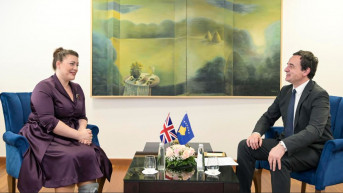
There is no shortage of examples that support the argument that officials in Great Britain have a special relationship with the Kosovo Government, different from that of other Quint countries. This has been openly discussed by Kosovo Prime Minister Albin Kurti and influential British MP Alicia Kearns during recent meetings in London and Pristina. Even interlocutors with Kosovo Online agree that British policy shows a significant understanding fo the actions of the current Kosovo Government, despite all the consequences and high tensions in Kosovo in the previous period.
Albin Kurti recently accused European mediator Miroslav Lajcak of supporting Serbia in the dialogue and sent letters to the official addresses of the Quint countries, complaining about his bias. What caught everyone's attention at that time is the fact that he skipped Great Britain. Some interpretations suggest that Kurti's failure to address London on this matter may indicate where the wind is blowing. This raises the question of the actual role of Great Britain in the Kosovo crisis.
Western countries have virtually isolated Kurti in recent months due to his refusal to ease tensions in the north. They have suspended bilateral visits, but the British authorities have not imposed the same restrictions. In June, the Kosovo Prime Minister was in London, where he met with UK Foreign Minister James Cleverly. He was recently in London, where he participated in a Labour Party conference and delivered a speech thanking for the support of Kosovo's independence.
Timothy Less, an associate of the Center for Geopolitics at the University of Cambridge, believes that the United Kingdom's policy towards Kosovo is in line with the positions of the United States and the European Union. However, he also acknowledges that there are certain differences, because, he points out “it's not a secret that official London seems to have more understanding for Pristina than some other Western actors“.
As examples of certain differences between Great Britain and other Quint countries concerning Kosovo, Less notes that official London "appears to support police actions in northern Kosovo and insists that the Community of Serb-majority Municipalities must be in line with the Kosovo Constitution and not become a new Republika Srpska".
"These minor differences in approach should not be exaggerated. The United Kingdom has a fundamentally similar interest to the United States and the EU when it comes to Kosovo, which is to prevent the return of instability that could destabilize both Bosnia and Herzegovina and the wider region," Less says to Kosovo Online.
He also notes that it is in the shared interest of the United Kingdom, the US, and the EU to prevent Russia from gaining greater influence.
"United Kingdom supports the efforts of the EU and the US to reach an agreement between Serbia and Kosovo before pursuing any alternative policy towards the two sides," Less believes.
Regarding the fact that during last week's visit of envoys from the EU, the US, France, Germany, and Italy to Belgrade and Pristina, Stuart Peach, the UK Government's Envoy for the region, was the only representative of the Quint that was not present. Instead, MP Alicia Kearns was in Pristina that day, who has repeatedly supported Kurti's Government and strongly criticized Belgrade, calling for sanctions against Serbia. Less believes that this move "does not convey any special message".
"Certainly, not that the debate over Kosovo's status should be resolved in favor of Kosovo and not through negotiations. I think two things here are indicative. First, after Brexit, the United Kingdom is not taking the lead in efforts to resolve the Kosovo dispute, which is formally in the hands of the EU and the US. The United Kingdom is now focused on ensuring security in Kosovo through NATO. Second, Alicia Kearns unilaterally decided to support Kosovo in its dispute with Serbia. This is what I can see from the reactions of the British Government to her statements, which sees Kearns more as a problem than as a part of any solution," Less says.
When asked about the claims that London was among the staunchest allies of Kosovo and Prime Minister Kurti himself, Less says:
"I think the idea that London is a strong ally of Kosovo only refers to its long-standing policy towards Kosovo. This means supporting Kosovo's independence and appreciating its loyalty and positions on issues such as Russia and Ukraine. When it comes to Albin Kurti, I've seen that Kosovo President Vjosa Osmani thanked Alicia Kearns for being a strong ally and for supporting the people of Kosovo, which is not surprising. I'm not aware of any government official explicitly supporting Kurti, and I don't expect that to happen as long as he continues to obstruct the dialogue".
An analyst from the Center for Social Stability, Srdjan Graovac, tells Kosovo Online that Great Britain leads in the stance of openly supporting Kosovo's Prime Minister Albin Kurti and the policy he pursues, while on the other hand, it should take a firm and sharp approach towards Belgrade.
Graovac, commenting on whether the fact that London's Envoy for the Western Balkans, Stuart Peach, was the only one of the Quint countries envoys who was not in Belgrade and Pristina last week is a sign that there are differences among these countries regarding the policy towards Kosovo and Prime Minister Albin Kurti, said that the major Western powers more or less had the same positions on this issue, but there was a noticeable difference in the style with which they approached it.
"There are no significant differences in the policies of Great Britain, Germany, France, and the United States regarding the issue of Kosovo and Metohija. For all of these countries, Kosovo is a done deal, an independent state, regardless of violations of international law. The only thing they think about is how to force Serbia to accept it as a kind of reality. British policy does not differ from the policy of the United States and anyone else among these Western countries. However, there are certain nuances among these countries, and we can see that. There are nuances among the Americans themselves when it comes to Kosovo, there are different currents, those who are clearly on Kurti's side, and hawks in the US establishment who support everything he does. On the other hand, there are those who are ready to criticize that, to point out the wrongness of the policy that the Kosovo Prime Minister is pursuing," Graovac points out.
He points out that the British are closer to the center of power in the US which provides strong support to Kurti.
"They are even ready to protect him, regardless of the incidents he causes and the fact that his behavior could be the cause of an escalation of conflict. The British advocate a firm and harsh policy towards Belgrade. Essentially, Kurti's policy suits them very much", our interlocutor states.
He emphasizes that Britain has another important task when we talk about Kosovo and the region, which is that after leaving the EU, they want to play a more significant role in international relations. He notes that while Britain was a member of the EU, it tried to pursue its interests in these areas through Brussels institutions, but that changed after leaving the Union, and they want to make a grand comeback to the Balkan region, which is why they have their Special Envoy.
"Britain's position is not insignificant, but it is far from being able to play a decisive independent role in this region. It is more of an exponent of the US policy and certain centers of power in Washington, as well as Germany. Essentially, the entire diplomatic activity led by the EU depends solely on the support of the United States. The EU has shown that it does not have the capacity to lead this negotiating process, that it does not have the power to force the Albanians to implement what they promised and what the EU guaranteed," Graovac says.
Regarding the fact that Stuart Peach was not present in Pristina on the day when the big five were there, but Alicia Kearns was in Kosovo, a British MP who uses every opportunity to support the Government of Kosovo, as well as Kurti personally, while on the other hand calling for sanctions against Serbia, Graovac says she is an open Albanian lobbyist.
"There is no doubt about that; she has clearly shown her full support for the Albanian side with her statements. Stuart Peach has also had moments that could be described as somewhat moderate, albeit compared to the behavior of Kearns and others who are extremist in their anti-Serbian views. Why he was not there and why Kearns was there is more in the realm of speculation," he says.



0 comments