
Will the Election results lead to changes at the top of Self-Determination? Who dares to challenge Kurti?
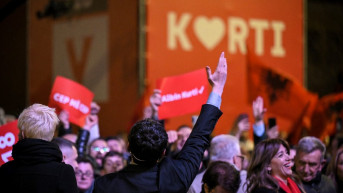
He promised half a million votes and an absolute majority in parliament, but now Albin Kurti faces a challenge in securing a new mandate and forming the "Kurti 3" government. Some analysts highlight the outgoing Speaker of Parliament, Glauk Konjufca, as the only realistic rival to Kurti in the event of post-election turbulence within the Self-Determination Movement. Disappointed electoral expectations could impact party members, but without clear "external support," the big question remains—who would dare to challenge Kurti at this moment, experts interviewed by Kosovo Online suggest.
Written by: Djordje Barovic
"Until a new government is elected in parliament, our government will continue to perform all executive responsibilities in accordance with the law. This places the government in a caretaker role, ensuring continuity, security, and the uninterrupted functioning of the state, in line with the Constitution and laws," Albin Kurti stated after the announcement of the final election results held on February 9.
However, post-election calculations clearly show that he will not be able to form the "Kurti 3" government on his own.
Winning 42.30% of the vote falls far short of his pre-election goal of repeating the 2021 success when his party secured over 50%.
This weaker result could trigger internal friction within the Self-Determination Movement. According to political analyst Dardan Sejdiu, only Glauk Konjufca "has enough leverage and credibility to avoid being labeled a traitor if he challenges party leader Albin Kurti."
"For a long time, Glauk Konjufca has been the number two figure in Self-Determination. If Kurti hadn’t changed the party’s statute—removing the rule that limited leadership to two terms—Konjufca would have been next in line," Sejdiu explained, outlining a possible leadership change scenario.
Ambitions and the 'Cult of Leadership'
However, Milos Pavkovic, a researcher at the Center for European Policy in Belgrade, doubts such an outcome.
He argues that, regardless of election results, there is no real "ambition" within Self-Determination to challenge Kurti’s leadership.
"I don’t expect a leadership change at this moment. Self-Determination is structured in such a way that loyalty to Kurti is unquestionable—there is a 'cult of leadership' around him, and no one within the party appears to challenge that. I don’t see any ambitions among members for change right now. If Kurti fails to form a government and someone else does, then his potential responsibility might be discussed within party structures. But as long as there is a chance for him to form the government, this will not be a topic of internal party discussions," Pavkovic told Kosovo Online.
He acknowledges that Konjufca is one of the most capable figures in the party but questions whether he would merely continue Kurti’s current policies.
"From 2005 until Self-Determination came to power, Kurti employed extremely radical tactics, attracting far-right members and voters to his movement. From destroying UNMIK and EU vehicles to causing unrest in the streets and throwing tear gas in parliament while in opposition—he led this form of unconventional political struggle, which secured his position as the undisputed leader of the party. And that remains unchallenged," Pavkovic explained.
He added that Kurti has not abandoned such tactics even after becoming prime minister.
"His leadership remains unquestionable because he institutionalized this strategy, particularly in relation to the Serbian community. He satisfies his extremist base by applying extreme measures through the legitimate monopoly on the use of force—via Kosovo’s police and security structures. This is how he channels the needs of his party members. That’s why his authority is undisputed within Self-Determination, at least until he officially loses power. If that happens, then his position as party leader could be questioned," Pavkovic noted.
The End of a Political Career?
Political analyst Artan Muhaxhiri from Pristina also dismisses the possibility of major changes within the Self-Determination Movement.
Speaking to Kosovo Online, he argued that opposing Kurti would mean the "end of one’s political career" within the party.
"Albin Kurti is the most powerful politician in Kosovo. He dominates the political scene and holds absolute power. Within Self-Determination, there is a 'cult of personality' centered around Kurti, and no one would dare to challenge or compete against him because that would mean the end of their political career within the movement," Muhaxhiri stated.
He explains that Kurti has created an "atmosphere of loyalty" within the party.
"Even if he loses the elections, even if he is not re-elected as prime minister, he will still have absolute dominance within Self-Determination. There is no room for differing opinions because there is no democracy in this party. Kurti decides everything," Muhaxhiri specifies.
He says that this level of loyalty goes so far that parliamentary deputies sometimes deliberately quote Kurti or create memes of his statements to demonstrate their devotion and admiration.
"When you start criticizing Prime Minister Kurti, the only option is to leave Self-Determination, which has already happened to several MPs. Haki Abazi was the most recent, but there’s also the Family Korenica List and others. As soon as you disagree with Kurti even slightly, it becomes very difficult to remain in the party because of the prevailing atmosphere," the analyst explains.
Commenting on speculation that Glauk Konjufca is the only real challenger to Kurti, Muhaxhiri says such a scenario would only be possible if Kurti himself orchestrated it.
"Konjufca has been with Self-Determination from the beginning. He has always been Kurti’s closest ally. He stood by Kurti even when there was a split with the Social Democrats and the group that later formed that party. He has shown loyalty and allegiance to Prime Minister Kurti, and I don’t believe he would ever attempt to take his place. That could only happen if it was arranged with Kurti. It will only happen if Kurti wants it to," Muhaxhiri is convinced.
Support from "Outside"
Marko Miskeljin, an associate at the Center for Social Stability, believes that changes could happen—but only with external support.
He primarily refers to the United States and its unfavorable stance toward the current prime minister and his intention to form a new government.
Otherwise, he stresses, Self-Determination leader Albin Kurti will "eliminate" any competition.
"He has undoubtedly demonstrated authoritarian tendencies in his actions. Such individuals first ‘purge’ any competition within their party, which I assume is happening now. That doesn’t mean there won’t be discordant voices or that someone won’t try to seize an opportunity—especially if, as expected, there are serious difficulties in forming the government and managing the decisions of Kosovo’s provisional institutions. This is particularly relevant in light of relations with the United States. That dynamic could be the path through which opposition to Kurti arises within the party," Miskeljin told Kosovo Online.
He explains that poor election results always lead to internal party analysis and personnel changes, in which current Speaker of Parliament Glauk Konjufca could come to the forefront.
"The anticipated and promised election result was not achieved. The logical next step would be to investigate why. The biggest influence on this outcome was certainly Kurti’s actions and the escalation he fueled throughout his second term. Someone like the Speaker of Parliament has significant public visibility, which is crucial in such moments of potential internal party upheaval," Miskeljin believes.
He also sees possible challengers to Kurti among some current ministers.
"If they dare, they could be the ones to at least challenge his authority and attempt to bring change within the movement. But given the resources and time Kurti has had to establish absolute control, it is unlikely that such an outcome will materialize," the analyst specifies.
He is also convinced that Kurti would not allow instability within the party.
"Depending on how government formation negotiations unfold and how relations with the U.S. administration develop, we shouldn’t be surprised if some internal turbulence arises. But at this moment, I would still give the biggest advantage to Kurti, considering he has maintained control over the party for a long time—even before he took office. This is something he has carefully prepared for, and it is likely something he will fight hardest to retain," Miskeljin emphasizes.


comments