
Will the election of Sekerinska give the Western Balkans 'its own person' in NATO?
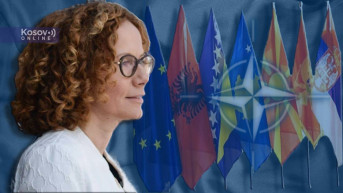
The new NATO Secretary-General, Mark Rutte, will assume office on October 1st. However, for the Western Balkans, the more important news will be who will take the position of his deputy, as the media are widely speculating that one of the most serious candidates is the former Minister of Defense of North Macedonia, Radmila Sekerinska. Could the region get "its own person" in the most powerful military alliance?
Written by: Arsenije Vuckovic
The current NATO Deputy Secretary-General, Mircea Geoană, has held the position since 2019, but he will step down to run in the presidential elections in Romania.
Citing a high-ranking NATO diplomat, Politico writes that there is a general consensus within the Alliance that his successor should come from Eastern Europe.
At the beginning of June, the Turkish portal Firtina Haber reported that nine NATO member states have nominated the former President of Montenegro, Milo Djukanovic, for the position.
"We had access to an informal draft being worked on by diplomats from nine NATO member states who intend to nominate Djukanovic for a high position in NATO, and the reasoning for his selection is quite detailed," writes Firtina Haber, as referenced by Podgorica media.
However, former NATO spokesperson Oana Lungescu claims that it will be a woman.
"The position could indeed go to a woman from Eastern Europe," said Lungescu.
Politico asserts that the most prominent candidates for this position are from Bulgaria and North Macedonia, with the advantage given to the Vice-President of the Party of European Socialists and former Minister of Defense of North Macedonia, Radmila Sekerinska.
"If elected, she would be the highest-ranking NATO official ever from the Western Balkans region outside the EU. The country joined NATO four years ago, and Sekerinska played a key role in its membership," writes Politico.
Scenarios and Controversies
The Executive Director of the Council for Strategic Policies, Nikola Lunic, in a conversation with Kosovo Online, stated that it would indeed be good for the Western Balkans to have the position of Deputy Secretary-General of NATO and that the region deserves it, but that such a scenario is not realistic, and that preference in the selection will likely go to one of the countries from the eastern wing of the Alliance, such as Poland.
"The Western Balkans region certainly deserves to have a Deputy Secretary-General of NATO. Many politicians are not only capable but also deserving of such a position, like Milo Djukanovic, who practically led Montenegro into NATO with his narrative. However, in the current geopolitical situation, I don't expect that to happen. I would expect the Deputy Secretary-General of NATO to be chosen from one of the countries on NATO's eastern flank. Let me remind you that a country like Poland is now allocating more than four percent of its gross national income to defense. All citizens know this, and formally or informally, they have earned such a position," Lunic believes.
He adds that the election of a figure from the Western Balkans to the position of Deputy Secretary-General of NATO would essentially be irrelevant for the region.
"For the security and stability of this part of the region, especially for Serbia and Kosovo, it is irrelevant. The Deputy Secretary-General of NATO, although having a functionally important role within NATO, is not formally a decision-maker. The decision-maker is the Secretary-General, who engages in discussions and negotiations with the sovereign authorities of NATO member states. Therefore, I think this will not have an impact on Serbia and Kosovo," says Lunic.
Even if Sekerinska were to be elected to that position, he emphasizes, it would only be significant for North Macedonia, and it would create a new controversy in the region.
"For Macedonia, it would certainly be significant. The capabilities of Macedonia, which have been neglected until now, would probably be enhanced. However, I am not sure that the entire region would welcome this positively. In the region, as you know, we have an unresolved history where the candidate's nationality is immediately perceived through the politics of a particular country. Therefore, whether it be a Croatian, Macedonian, or Montenegrin, certain countries will certainly have animosities toward such a choice," Lunic concludes.
Regardless of who is chosen, he continues, the Western Balkans remains of strategic importance to NATO.
"If you look at the final declarations of the last two NATO summits, you see that the Western Balkans region is of strategic importance to NATO. They emphasize this," Lunic points out.
To support this claim, he recalls that after the announcement by the President of Republika Srpska, Milorad Dodik, that Russia or China could veto the extension of the EUFOR mission in Bosnia and Herzegovina in the UN Security Council, plans were already in place for NATO to take over the EUFOR mission.
"And plans are already in place for NATO to take over the EUFOR mission. This would lead to the withdrawal of contingents from some countries, such as Switzerland and Austria, but would also be reinforced by NATO countries. So, NATO will not allow the escalation of any conflict in the Western Balkans," Lunic emphasizes.
The Balkans and Geopolitics
A PhD candidate in EU law and European integration from Skopje, Leposava Ognjanoska Stavrovska, stated for Kosovo Online that the election of Radmila Sekerinska as the new Deputy Secretary-General of NATO would have a positive impact on the security and stability of the entire region, especially in the process of integrating the Western Balkans into the European Union.
"I believe that the election of any candidate from this region—and of course, we would like that candidate to be from our country, North Macedonia—would have a positive impact. The security and stability of the region are one and the same; they imply the security and stability of every member country, and any attempt to destabilize any part of Europe or any part of the region would have implications for other countries. I would particularly emphasize here that certain decisions that are made and will be made in NATO, including decisions on future expansion or other modes of action, would have their reflection on the process of European integration, especially on certain developments within the European Union where the security dimension of expansion is increasingly emphasized. We know that this also involves making certain decisions that were previously unprecedented, driven by certain geopolitical circumstances," says Ognjanoska Stavrovska.
She emphasizes that this is of key interest, regardless of whether the Western Balkan countries have aspirations to join the Alliance.
"Regardless of whether all the countries in the region aspire to NATO membership or have not expressed such interest, they are still included in the process of European integration," she emphasizes.
The election of a candidate from North Macedonia, she asserts, is not only a clear signal that the Western Balkans is of strategic importance to NATO but also that the candidate understands the "role of certain global actors."
"This is a clear sign that this is a region of strategic importance for maintaining these organizations, which have traditionally been formed by Western European states. On the other hand, a person is needed who directly understands the role of certain global actors, such as Russia, and understands their methods of operation or the influence they exert in this part of Europe," Ognjanoska Stavrovska believes.
She points out that Radmila Sekerinska is well known not only to the Macedonian public but also to the world and enjoys a good reputation in transatlantic circles.
"This is certainly due to the fact that she has held high political positions in the country, and has been directly involved in and led certain processes related to our European integration. But on the other hand, I assume this is also the result of a certain personal stamp she has left within such processes, achieving certain results, especially during her tenure as Minister of Defense, when Macedonia became a NATO member," says Ognjanoska Stavrovska.
She is convinced that North Macedonia should support Sekerinska's election due to the country's strategic commitment and affirmation towards Euro-Atlantic integration.
"My opinion is that the state of Macedonia itself should support this choice, primarily through our diplomatic network, because Euro-Atlantic integration is our strategic commitment, from which, as we have seen, there has been no deviation even when the ruling parties have changed. This will, of course, greatly contribute to the affirmation of Macedonia as a NATO member country, not only as a consumer of security policies but also as their active contributor," Ognjanoska Stavrovska notes.
Recalling that the position of NATO Secretary-General is the highest civilian role in this military-political alliance, she emphasizes the importance of the Deputy Secretary-General's position.
"The role of NATO Secretary-General is actually the highest civilian position in NATO, that is, in the military-political alliance, which entails enormous responsibilities, competencies, and powers in the decision-making process, including chairing certain committees, as well as coordinating the entire process and implementing decisions. Therefore, it is implied that the position of Deputy Secretary-General is also very significant because it complements this highest civilian function, and on the other hand, sometimes it may involve performing certain entrusted tasks, especially in the case of the Secretary-General's incapacity or absence," she explains.
She also reminds us that the current NATO Deputy Secretary-General, Mircea Geoană, comes from Eastern Europe.
"The difference between the West and the East still dominates the military-political vocabulary. However, the need to once again search for a person from these areas reflects an awareness of the importance of understanding the region and the challenges it faces. Of course, this is also about the broader security situation, but I think it is becoming clear in these organizations, which are typically formed by Western European countries, that the survival of these transatlantic alliances and the maintenance of the values and interests that bind these member states would be impossible without the more active involvement or affirmation of Eastern European countries," concludes Ognjanoska Stavrovska.
Assessments and Messages
Historian Stefan Radojkovic told Kosovo Online that former North Macedonian Defense Minister Radmila Sekerinska is an ideal candidate for the new NATO Deputy Secretary-General. However, whether she will be chosen depends on the internal decisions of the Alliance leaders, primarily Washington, and their current assessment of the global situation. Her selection would also send a strong message to the Western Balkans that NATO seriously counts on the support of this part of Europe.
"If we look at her biography, we see that, like Mark Rutte, the new Secretary-General, she is actually an ideal candidate or one of the possible ideal candidates for that position. She is clearly pro-Western, pro-EU, and, more importantly, pro-U.S. oriented. She was in (Zoran) Zaev's government when the Prespa Agreement was signed under the U.S. umbrella. She has proven to be a very cooperative operative, ideologically and practically politically oriented towards the West, but primarily towards the U.S.," says Radojkovic.
Her election, he emphasizes, will largely depend on the geopolitical assessment of NATO leaders, but the Alliance also sends a message with her selection or non-selection.
"Whether she will be chosen actually depends on the internal decisions of NATO leadership, primarily Washington, and based on their current assessment of the global situation. Whether it is more suitable for them to choose someone from Poland, Romania, or Bulgaria, or to focus attention on the Western Balkans, which would again send a message to those regions that NATO seriously considers their role within the Alliance," Radojkovic explains.
He emphasizes that NATO would send a clear message by selecting her, indicating that it cares about its allies and developments in the Western Balkans.
"If the former Defense Minister from Macedonia is chosen, it will mean that NATO is seriously considering its allies and developments in the Western Balkans in line with current geopolitical circumstances," the analyst stresses.
He reminds us that since 2019, NATO has been trying to establish a new institutional practice in selecting the Alliance's leaders to demonstrate that both new and old member states are equally important.
"If the Secretary-General is chosen from Western European countries and from older members, then the Deputy Secretaries or Undersecretaries should be chosen from members who joined after the end of the Cold War, that is, the new NATO members. Thus, North Macedonia and Montenegro are also in the running," Radojkovic notes.
This new practice was established by choosing a representative from the "Eastern bloc" of NATO as the Deputy Secretary-General, specifically a candidate from Romania, Mircea Geoană.
"In this way, NATO, primarily led by the U.S., the key actor, tries to show that it cares about both new and old members of the Alliance, ensuring they have a certain share in the work and functioning of the Alliance," Radojkovic emphasizes.
He also explains that NATO's strategy is to promote politicians who are favorable to them, even if they are outside the main political currents in their home countries, as is the case with Radmila Sekerinska and the new Secretary-General, Mark Rutte.
"He lost, his party performed relatively poorly in the last elections in the Netherlands, his political career in his country is over, but that doesn't mean his political career is over at the international level. Just like with (Jens) Stoltenberg, who was the Prime Minister of Norway before becoming Secretary-General. So, they like to extend the political careers of those individuals who are favorable to them," Radojkovic believes.
When asked how the election of a candidate from the region would affect those Western Balkan countries that are not part of the Alliance, this expert says that nothing "spectacularly new" should be expected.
"It's actually a pretty one-way street. This won't mean anything spectacularly new for Belgrade or Sarajevo, but we should pay attention that if someone from North Macedonia is chosen, it will mean that NATO is dedicating increased attention to this region. That's the only thing we need to observe. If not, if it's someone from Poland, Slovakia, Hungary, or elsewhere, it means that the focus will actually be on Eastern Europe, that their gaze is directed primarily towards relations with Russia, where it then means that they consider this region relatively stable and peaceful, with no need for heightened activity," Radojkovic concludes.



0 comments