
Despite partial approval for Serbian goods, kilometer-long truck queues persist at Merdare
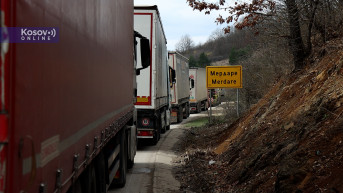
At the Merdare border crossing, kilometer-long queues of trucks have been forming for six months due to the detailed inspections that followed the Kosovo government's decision to partially allow Serbian goods. A Kosovo Online team spoke with truck drivers who have been waiting for days to enter Kosovo.
On October 7 last year, the Kosovo government decided to allow Serbian goods to enter after more than a year-long ban, but only through Merdare and under strict control, causing daily congestion at the terminal and further complicating imports.
This situation has significantly affected the volume of goods arriving from Serbia to Kosovo.
Miroslav Simic, who transports construction blocks from central Serbia, says that Pristina’s decision to allow imports only through Merdare—with inspections that sometimes last for days—has made his job much harder.
"We've been waiting for about 24 hours so far. It’s a huge obstacle; we can do much less work. We used to complete three trips per week, now just one, sometimes two, but it's tough," Simic said.
When asked whether he hopes that trade will be allowed at other crossings, Simic said that hope doesn’t help much, but it still exists.
"That's why we sit here, but nothing is changing," he added.
Ilmi Osmani blames the Kosovo government for the situation, accusing Prime Minister Albin Kurti of being an extremist.
"This is a problem created by the Kosovo government, no one else. It severely impacts business. We wait up to 24 hours, then we can't finish the paperwork at the terminal because it's the only one operating, and that's it," Osmani said.
He is not optimistic that other crossings will be opened for trade.
"We don't have hope. He (Albin Kurti) is an extremist, not the kind of leader a democracy needs," he added.
Slobodan Petrovic, another truck driver transporting construction blocks, said he is tired of the constant waiting and is considering changing jobs.
"It affects business a lot. We no longer have the strength to fight this. Soon, this will be over, and we'll quit and do something else. We wait at least 24 hours, sometimes longer, depending on the day. This happens twice a week, sometimes more, depending on the week," he said.
Skender Kelemendi, who transports Polimark products from Belgrade, admits that the situation has made work significantly harder and that things would be much easier if goods could enter through all crossings.
"That's how it used to be, and it was much easier. We could transport goods three times a week, now only once. We left on Sunday, and we might not even get in tonight—we wait two to three days at customs. It’s bad for business, but what can we do?" he said.
Another truck driver was also not optimistic about improvements.
"We hope, but I don’t think anything will change soon. It affects business a lot, really a lot," he noted.



0 comments