
Hofbauer: It’s not good when weak economies like Kosovo invest in armament instead of development
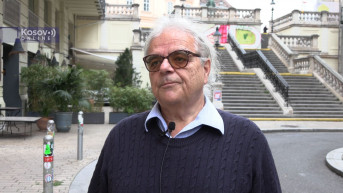
By deciding to invest money in armament rather than in infrastructure and social projects, the Kosovo government has given in to the pressure of countries that produce weapons, Austrian historian and economist Hannes Hofbauer told Kosovo Online. He noted that the EU, especially Germany, is allocating more and more funds to stimulate the military industry and purchase weapons.
Hofbauer, author of the book “In the Economic War,” which examines Western sanctions policy against Russia and its consequences, said that we are all witnessing a kind of “military Keynesianism.”
“The EU, Germany in particular, is spending large amounts of money to stimulate the military industry and arms purchases, thereby boosting the economy. This is what we call military Keynesianism. We saw a similar situation under Hitler, and later under Reagan, stimulating the economy through military demand. It may be good for current jobs, but for humanity and for peace, it’s a catastrophic development,” Hofbauer explained.
He added that since 2008, there has been a structural crisis in the use of capital, and many attempts have been made to solve that problem.
“During the COVID crisis, for example, the pharmaceutical industry was used to address it; now the focus has shifted to armament. Every dollar and every euro can only be spent once; you can choose whether to pump money into the military industry or into social services. In Germany, we see that infrastructure and social projects are being cut, while spending on weapons is increasing. This is certainly a major catastrophe we are witnessing,” Hofbauer emphasized.
Given that Kosovo is also purchasing increasing quantities of weapons, Hofbauer stressed that “it is not good when small countries like Kosovo spend money on buying arms instead of on infrastructure and social projects.”
“The pressure from those wanting to sell weapons is definitely to blame for that. Kosovo is a weak, small state, not even recognized by many EU members. They have succumbed to that pressure, and that’s a bad sign for the Kosovo government,” the Austrian expert said.
Regarding Kosovo’s announcement that it plans to launch its own defense industry, primarily an ammunition factory, Hofbauer noted that many countries in Eastern Europe, such as the Czech Republic, Slovakia, and Poland, are traditional arms producers, and a small country like Kosovo would hardly be competitive against them.
Speaking about the challenges Serbia is facing, particularly US sanctions on NIS and the EU’s decision to suspend gas transfers from Russia, Hofbauer said he had no doubt these were “mafia-style methods.”
“I already wrote in a commentary for the German press that what Trump and von der Leyen are doing to Belgrade amounts to mafia-style tactics. This is pressure initiated by the US, supported by the EU, and also by Croatia, which announced it would reduce oil deliveries to Serbia. I think these are mafia methods in dealing with a small country,” Hofbauer said.
He added that the reason behind all of this, which is also openly stated, is the fact that Serbia is the only country in Europe, apart from Belarus, that has not joined sanctions against Russia.
Sanctions against Russia are, in fact, the central theme of Hofbauer’s book “In the Economic War,” in which he exposes Western double standards. The book documents that the sanctions imposed by the US and subsequently by the EU over the war in Ukraine violate international law, since only the UN Security Council has the authority to impose sanctions.

0 comments