
Hofbauer: NATO aggression against the FRY destroyed the world order; Kosovo remains a frozen conflict
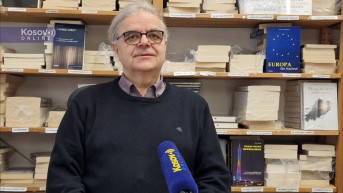
Austrian publicist Hannes Hofbauer believes that the NATO aggression against FR Yugoslavia and the unilateral declaration of Kosovo's independence caused great damage to international law and created a precedent that destroyed the post-war world order, while Kosovo remained a frozen conflict behind it all.
Hofbauer pointed out for Kosovo Online that with the aggression against the FRY, for the first time since 1945, the largest military alliance in the world had attacked a country.
Then, he recalls, an alliance of 19 members, including three - Hungary, Poland, and the Czech Republic - which had just joined, entered the war.
"That created a precedent. It created space for similar military operations, that is, aggressions. The US, above all, and other NATO members thereby returned the war to Europe," Hofbauer underlined.
Therefore, Hofbauer points out, the war was brought back to Europe by the aggression against the FRY in 1999, and not a year ago, as claimed, by Russia's attack on Ukraine.
A precedent was created in Kosovo
"Then we had a war which, as many say, is also the cause of the Ukrainian war. It created a precedent, which Russia now uses as an excuse. Of course, Russia's attack on Ukraine is a violation of international law. But that was preceded by eight years of civil war, which "began with the Ukrainian army's attacks on Sloviansk and Odesa. This, of course, does not justify Russia's aggression, but it does explain the long-simmering tensions," Hofbauer explains.
With the aggression against the FRY, he believes, "war thinking" in politics began, that is, the thinking that political interests can be imposed through war.
Regarding the secession of Kosovo, after the NATO war against the FRY, he says that it created a problem for international law.
"It was the first time, in post-war Europe, that a new state was created by war that is, based on military intervention" he notes.
He points out, however, that Kosovo cannot be considered an independent state, because it is a protectorate managed by the UN and the EU, and Kosovo's independence has not been recognized by all the countries of the world, for example, five members of the European Union.
Hofbauer underlines that Kosovo is a frozen conflict, in which the Serbian community and nationalist Albin Kurti are fighting for their interests, but also that it is not the only frozen conflict in Europe.
"There are other frozen conflicts such as South Ossetia, and Abkhazia, and the longest such conflict is in Cyprus, which has been frozen since 1974. Cyprus entered the EU as such, without resolving the territorial issue. This is a problem, because the whole of Cyprus is not under the control of the EU, but only Greek," Hofbauer emphasized.
That's why he believes that it could take a long time to resolve the Kosovo issue.
Kurti is an ultranationalist
When asked whether the international community was ready to make concessions in order to solve this issue the way it wanted, this year, he replied that he did not believe it was possible.
"The West sees the danger in creating some kind of structure like in Bosnia and Herzegovina - a state within a state. This also shows that Bosnian statehood is fragile, even though it has supposedly been resolved. But this is certainly not the case in the dialogue between Kosovo and Serbia. I think it will take a long time to find a final solution," Hofbauer emphasized.
Asked whether it could be expected that Albin Kurti would relent on the issue of the CSM, Hofbauer, illustrating his position, recalled a conversation he had had with the current Prime Minister of Kosovo.
"I remember a conversation with Kurti several years ago when he spoke about the issue of Kosovo's monasteries. He said that they should remain, but that they were not there for the Serbs, but that they were the cultural heritage of all people. He has an ultra-nationalist attitude, which is directed against the Serbian narrative and statehood in Kosovo. Based on that, I believe he is determined and will continue with his Albanian nationalist policy."
On the other hand, he says, it is known from other experiences that pressure can change the attitudes of leaders in small countries.
Serbia, he adds, has the advantage of being more resistant to pressure, with Russia on its side, and thanks to investments from China and the Arab world.
"That is why the EU exerts pressure, but it must act with caution and restraint," Hofbauer advises.
He also said that the international community should put pressure on both sides, although he was aware that it would not be easy to pressure Kurti.
"Ideologically, Kurti is close to Adem Demaci, an Albanian nationalist, who was not easy to convince to accept the so-called compromise in Rambouillet," Hofbauer points out.
When asked why the Western media were silent about the attacks and harassing the Serbs in Kosovo, he states that due to the war in Ukraine, the media space for conducting any kind of discussion has completely narrowed.
"Almost nothing can be seen anymore except what is the story of the West. But, there are still media in the digital space, and some printed ones like the 'Berliner Zeitung', where you can see information from a different angle. We saw that with the introduction of the embargo in the 1990s against Yugoslavia when the RTS program was taken off the air via Eutelsat. That was already more than silencing the event, and it reflects the situation of power," he stressed.
Sanctions against Russia's participation in the war
Regarding the pressure on Serbia to join the sanctions against Russia, Hofbauer hopes that Belgrade will be able to resist it.
"Personally, I hope that it will be able to resist that pressure because I consider sanctions an economic war. As a citizen of Austria, which should be a neutral country, I find it intolerable that Vienna supports sanctions. Of course, Russia's aggression should be condemned, and Ukraine should be given humanitarian aid, but not to lead an economic war with the aim, as they say in Germany, of the destruction of Russia, because that represents participation in the war," he underlined.
He expressed the hope that Serbia would not falter and that, with the support of sanctions, it would not participate in the war, although he states that the pressure is enormous, so much so that even Switzerland obeyed it.
When it comes to the request to speed up Ukraine's European path, which some European politicians are increasingly advocating, Hofbauer said that the admission of Ukraine would be a "disaster for the EU".
He reminds that already in 2009, through the Eastern Partnership and the conclusion of the Stabilization and Association Agreement with the former Soviet republics, it was evident that the EU was unable to implement the integration process on an equal level.
"It is a free trade agreement between a strong EU and weak economies, and it leads to the opening of the labor market in favor of the Union. If such a country were to be admitted to the EU, it would harm that country, but also the Union itself," Hofbauer is convinced.
0 comments