
Hoxha: "Some evidence" found in explosion investigation, special units near kindergartens and schools "accidentally strayed"
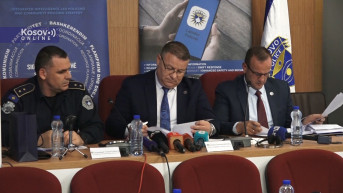
The Director of the Kosovo Police, Gazmend Hoxha, stated today that in the investigation of the explosion in the Ibar-Lepenac canal, "some evidence" was found and sent abroad for examination. He noted that the situation in northern Kosovo remains "unstable." Regarding nationalist symbols displayed by some Kosovo Police officers, Hoxha said they would be prosecuted.
"The investigation into the terrorist attack on the Ibar-Lepenac canal is ongoing. There have been several searches. Some evidence has been found—weapons, uniforms, explosives, and bombs. Other evidence has also been seized and is being examined in laboratories in Kosovo and abroad. We are working closely with EULEX and other international partners. We also have cooperation with KFOR on the ground. The priority is to solve this case and prevent similar incidents in this part of the country," Hoxha stated.
He said the situation in northern Kosovo remains unstable, but emphasized that the police are "doing the impossible" to ensure citizens' safety.
"The security situation is calm and stable, except in the north, due to grenade and explosive attacks on the police station and municipal building, as well as the terrorist attack on the Ibar-Lepenac canal. The police are doing the impossible, using all capacities, to guarantee citizens' safety, maintain order, peace, and the rule of law, as well as to enable institutions to continue functioning and ensure freedom of movement. There are challenges, of course, but we will succeed in restoring public order and peace in this part of Kosovo," said Hoxha.
Speaking about the presence of special units in the north, he reminded that there had been attacks on police officers, journalists, citizens, and members of KFOR and EULEX.
"During the barricades, citizens were kidnapped and taken to Serbia, vehicles and houses were burned, and members of the CEC (Central Election Commission) were attacked. You cannot deal with such situations with regular police officers. Trenches and barricades were set up to attack police officers, and explosives were found under trucks, the same type as used in Banjska and in many cases where we conducted searches," claimed Hoxha.
When asked whether it was necessary for special units to be near kindergartens and schools, Hoxha responded that they had "accidentally strayed" there.
The police presence, he said, has been increased due to a series of attacks in northern Kosovo.
"We must have more police officers in urban areas. The special units of the Kosovo Police are only stationed outside cities. All other units you see in the cities are from the Public Order and Rapid Reaction units. We are working to minimize the presence of these units, which could cause fear. We received a complaint when one of our units took the wrong turn and passed by a kindergarten, but our goal is not to intimidate anyone with armored vehicles. Most of us have been victims of violence and terror, and the last thing we want is to subject anyone to such pressure," said Hoxha.
When asked by Kosovo Online whether and what sanctions would be imposed on members of the Kosovo Police wearing badges or other insignia with nationalist connotations, which are not part of the police uniform, Gazmend Hoxha stated that those individuals would be prosecuted.
“This is a question we expected. We are aware and have received information regarding reports from non-governmental organizations in the north. We have taken this report seriously and established a task force within the police to address it. Anyone who has displayed symbols and insignia that are not police-related, violating principles and our procedures, will be prosecuted and subjected to internal control. Some of the images are very old, from several years ago, but in any case, some police officers have violated uniform procedures,” Hoxha said.
He added that everyone is living in a digital era, the age of social media, and it is not easy to control everything. Nevertheless, the police are working on drafting a regulation to govern the police's access to social media.
“To clarify what they are allowed and not allowed to post on social media,” Hoxha said during a press conference where the Kosovo Police’s annual work results for the northern region were presented. The conference was attended by Deputy Commander for the Northern Region Veton Elshani, police spokesperson Baki Kelani, and EULEX representatives.
The ethnic composition of the police in the north was also presented at the conference. Of the 339 members, more than half are Albanians, while there are 68 Serbs, 46 Bosniaks, 11 Turks, six Roma, seven Ashkali, 10 Egyptians, one Macedonian, and one Croat.
Residents of northern Kosovo most frequently reported domestic violence to the police this year.
0 comments