
Blakaj: No progress this year in identifying the missing; the issue has taken on a political character
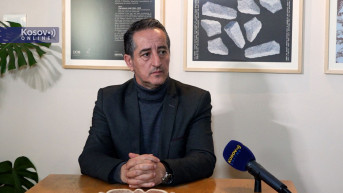
Bekim Blakaj, Director of the Humanitarian Law Fund in Pristina, said that there has been no progress this year in identifying missing persons and that the issue has shifted from a humanitarian to a political one. Speaking about the trial before the Kosovo Specialist Chambers in The Hague, Blakaj stressed that it is uncertain what the verdicts against former KLA leaders will be, as the public has not been acquainted with the prosecution’s evidence.
In an interview for Kosovo Online, Blakaj noted that protests against the Specialist Chambers—held across the region as well as in The Hague and Strasbourg—will not influence the court, but they do show that the accused enjoy strong support from a segment of Kosovo’s population.
He added that during the campaign every party seeks to present itself as having supported the KLA and as having members who are former KLA fighters, describing this approach as populist.
You recently said that the trials in The Hague are taking too long. Who finds it harder to wait—the defendants or those waiting for justice?
The main trial before the Kosovo Specialist Chambers is certainly taking a long time, but the interesting question is for whom it is taking longer. Naturally, at the Humanitarian Law Fund we are always concerned about the victims, who have already been waiting far too long for justice. We are now talking about 26 years after the end of the war in Kosovo, and it is crucial to see what the outcome of this trial will be and whether the victims will finally see justice. As I said, we at the Fund always stand with the victims and advocate the principle that they must receive justice.
The verdict is expected next year. Do you think it will close old wounds or open new ones? What has the process shown so far?
Unfortunately, most of the prosecution’s witnesses were protected—not only were their identities protected, but we also did not have the opportunity to hear their testimonies. It is completely uncertain what the verdict will be, because we do not know what the precise evidence of the prosecution was. I fear that, regardless of the outcome and the verdict, as has always been the case, these judgments will be viewed through a partisan lens. One side—depending on where the victims were—will have sought justice, while the other side will oppose the prosecution and the court. I am afraid this will happen again, and that one side will remain dissatisfied.
To answer your question directly, I do not believe the wounds will be healed. This will not resolve the conflicting views surrounding the trials. For that to happen, a much more serious process is needed—a societal process of confronting the past and recognizing the victims. Clearly condemning the perpetrators would be a good starting point for overcoming the past. This process does not take place only in courtrooms; it is a broader social process that must unfold over a longer period, so that the truth is accepted by all, narratives are not divided along ethnic lines, all victims are respected and recognized, and all perpetrators are condemned. That is the true process that could help our societies overcome the past and live in peace in the future.
When can a verdict be expected, given that the trial is set to conclude early next year?
Probably not early in the year. I believe it may extend until the middle of next year, because the case is demanding. There are still main hearings to be held; all parties will deliver their closing arguments, which will take time. Then the trial chamber will certainly take considerable time to draft the judgment and deliver it. After that, all parties will have the right to appeal, and until the decision becomes final, I believe it will require additional time.
In the meantime, protests against the court have been organized across the region, as well as in The Hague and Strasbourg, in support of KLA leaders. How do you view this?
We have witnessed such rallies in Pristina and Tirana, and last week there was one in Skopje, as well as abroad. Of course, the right to protest is guaranteed, but I do not believe any objective will be achieved. I am convinced that the trial chamber—and the Specialist Court as a whole—will not be influenced in any way by these protests. What they do show is that the defendants before this court continue to enjoy strong support from a segment of Kosovo’s population.
Kosovo’s caretaker Prime Minister Albin Kurti recently disclosed the contents of a letter he sent in 2022 to the President of the Specialist Court, Ekaterina Trendafilova, offering guarantees that KLA leaders could be placed under house arrest until the start of the trial. How do you view these requests and the fact that the letter’s contents were revealed only recently?
It is somewhat strange that the contents of the letter were not made public immediately after it was sent. I believe that at the time, the then prime minister was likely advised to act that way, but it is unclear why he waited for a moment that suited him to publish it. Generally, if there is no concern that defendants might evade justice or influence witnesses, they can be allowed to defend themselves at liberty—especially in cases where trials last too long. However, it was unlikely then, and remains unlikely now, that the defendants would be released before the end of the proceedings, particularly because the accused Hashim Thaçi faces a separate indictment for witness interference, that is, contempt of court. Precisely for that reason, it was expected that they would not be allowed to defend themselves at liberty.
The election campaign in Kosovo is underway, and former KLA leaders are often mentioned at rallies. Are KLA leaders a political asset in the campaign?
I think our society is still in that phase. This is largely populism. If we look at the campaign now, every political party is trying to prove that it supported the KLA and that its members are former KLA fighters. They clearly know they will gain support if they show that they back the KLA.
Although often cited as a priority, the issue of the missing seems to have been stagnant for a long time. How will we remember the year that is ending in this regard?
I believe that 2025 is a year in which there was no progress whatsoever in identifying missing persons. We were optimistic after the Ohrid agreement and the joint statement by Serbian President Aleksandar Vucic and Kosovo Prime Minister Albin Kurti that the process of locating the bodies of missing persons would finally be set in motion. But we were soon disappointed once again, because that agreement was not implemented—not a single word of it. As a result, there were no positive developments in identifying the missing.
That agreement explicitly stated that both sides would treat the issue of missing persons as a humanitarian matter, not a political one. In practice, however, the opposite proved true. Political maneuvering became an obstacle to cooperation. Joint meetings were not held; one side refused to meet with the other side’s representative and demanded his replacement; the other side refused to attend a meeting scheduled in Vienna because of something that happened in Kosovo. This clearly shows that the process was treated as a political issue rather than a humanitarian one. Unfortunately, the greatest pain is borne by the families of the missing, whose wounds are reopened as if it were the very day their loved ones disappeared.
How many people are still missing, and what needs to be done by both sides to move the process forward?
Around 1,600 people are still listed as missing. I should note that at the Institute of Forensic Medicine morgue in Pristina there are the remains of around 250 unidentified individuals, which means the number of missing is effectively lower by that amount. In any case, the parties have a moral obligation to share all information that could help locate mass or individual graves and enable the recovery of remains. If, in some cases, the bodies were destroyed in any way, at the very least that information should be provided to the families of the missing. They have the right to know the truth about the fate of their loved ones.
This cannot be done without close cooperation between the two commissions. They do meet from time to time, but it is evident that there is a lack of will to search for such information. In the absence of that will, the fate of the missing remains unresolved for all of us—especially for the families of the missing.
0 comments