
Djuric: Only a serious reaction from the international community can thwart Kurti's malicious agenda
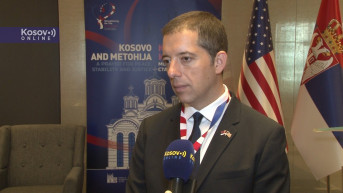
Serbian Ambassador to the United States, Marko Djuric, expressed concern that unilateral moves by Kosovo Prime Minister Albin Kurti towards the Serbs in Kosovo will continue in the future unless there is a united and serious reaction from the international community.
In an interview with Politika, Djuric emphasized that Serbia and the United States had different views on Kosovo but that significant progress had been made over the past ten years.
"It is of paramount importance for the survival of our people in Kosovo and Metohija that pressure on the extremist regime in Pristina to stop endangering the Serbs and finally begin to respect and implement the agreements reached so far continues and intensifies from both the US and European centers of power", Djuric stated.
How would you summarize the official Washington's reaction to the outcome of the parliamentary elections in Serbia held on the 17th of this month?
The official US administration sent a clear message that it looks forward to cooperating with the future Government of Serbia and continuing to work together to improve bilateral areas of interest, strengthen the rule of law, and preserve regional peace and stability. Ambassador Christopher Hill's statement, calling for the stabilization of the current situation and emphasizing the importance of respecting the will of the citizens freely expressed in the elections, as a reflection of the legitimacy of democratic processes and the readiness of all political actors in our country to peacefully and responsibly accept the election outcome, whether favorable to them or not, is very significant. Our people have once again decided to entrust the Serbian Progressive Party and the leader of the "Serbia Must Not Stop" list, President Aleksandar Vucic, symbolically reaffirming the support strongly expressed in last year's presidential elections, for which, we recall, not even a second round was needed, as was often the case in the past with candidates. It is sad that representatives of certain political currents do not want to accept the decision of the majority of the Serbs but seek to seize power on the streets through violence, pressure on the public, and trivial attempts to mask their political failure. Not only do they fail to respect their own citizens, devalue their choices, and denigrate the dignity of Serbian institutions, but they also seriously undermine Serbia's international reputation.
What do the results of these elections mean for the future relations between the US and Serbia?
The election results have shown the determination of our people to continue on the path we have been confidently walking for more than a decade in the next, for us, very important four years on the international stage. The people have chosen a stable, serious, responsible, and proven successful political option that will follow continuity in strengthening and advancing Serbia in every possible aspect, both domestically and internationally. Cooperation with the US, the largest power in the Western world, is an integral part of Serbia's foreign policy mosaic, and the general will expressed in the most democratic and well-organized parliamentary elections since the introduction of the multiparty system in Serbia sends us two key messages. The first is, undoubtedly, the enormous trust of the people in the future of Serbia led by President Vucic and the largest political party in our country, and the second is the enormous responsibility of the Serbian Progressive Party as the elected political option to justify that trust in the next four-year governance of the state. Maintaining good relations with the US and their further improvement are top priorities in Serbia's diplomacy, and I see only their further growth and development for the benefit of the citizens of our country in the future – from ever stronger and more diverse cooperation in the fields of economy, investments, ICT sector, energy, defense, education, science, to initiating strategic dialogue as mutual confirmation of the high level of mutual relations. Certainly, there is always room for expanding cooperation, but much has also been achieved, not only in the last three years but generally in the past decade, during which the profile of our cooperation with the US has been completely transformed, currently being the first export market for the Serbian IT industry and the fourth trading partner of Serbia in the world with a record $1.2 billion in annual trade turnover. I am excited about the new four years of a policy that has brought us such achievements and eagerly await new successes for our country.
Kosovo is one of the key challenges for Serbia. Do you see a more flexible approach from Washington on this issue in the future?
Serbia and the US are linked by numerous views and common interests in various spheres of activity, but the issue of the status of Kosovo and Metohija is where our two countries do not see eye to eye. A significant shift, unlike the once explicit, rigid, and almost exclusive American perspective, has been noticed in the last decade – a shift that I have personally witnessed in the past three years of my service – through openness and readiness to listen and understand our positions. Evidence that this is indeed the case is the continuous appeals from high American officials directed at Pristina, insisting on the full implementation of the Brussels Agreement, especially on the final establishment of the Community of Serb-majority Municipalities.
One of the clearest and most positive signals from the American side came just a few days ago when Congresswoman Claudia Tenney, co-chair of the Serbian Caucus in the US House of Representatives as a part of the Friends of Serbia group in Congress, submitted a Bill to this body in support of the Brussels Agreement. This significant document not only recognizes the repression, terror, and violence that have been blatantly carried out against the Serbs in Kosovo and Metohija for months but also denies any aid from the US Government to Kurti's institutions until such actions are terminated. Additionally, American support for the authorities in Pristina is directly conditioned by the formation of the Community of Serb-majority Municipalities and the cessation of the campaign of pressure and violations of human rights against the Serbs in our southern province. Another strong political message conveyed explicitly by Claudia Tenney's proposal is the demand to withdraw all so-called special forces from northern Kosovo or end their illegal presence, which could be considered a novelty in the American approach to the Albanian side. I expect that the power of these stated facts will soon encourage an increasing number of both democratic and republican congressmen to politically support this document and thus express their support. Undoubtedly, by taking this step, Congresswoman Tenney has shown America and the world that she is a true friend of Serbia and the Serbs, courageously raising her voice in the highest legislative body of the US to defend the rights of the Serbs in Kosovo and Metohija, driven by nothing but fairness, a sincere desire to help, and the conviction of doing the right thing.
The Serbs in Kosovo are subjected to various pressures and harassment, and now Pristina is announcing the introduction of mandatory military service. Isn't this a further escalation of tensions, instead of calming the situation?
Year after year, and now particularly concerning, month after month, and week after week, Kurti is implementing a targeted campaign of ethnic cleansing of the Serbs from the territory of Kosovo and Metohija, widespread repression, violence, intimidation, and the elimination of the Serbian factor from political life in Kosovo. I fear that his unilateral moves, provocations, and deprivation of basic human rights from the Serbs just because they are Serbs will continue in the period ahead unless there is a united and serious reaction from the international community that would finally thwart his sinister agenda. It is crucial for the survival of our people in Kosovo and Metohija that pressure on the extremist regime in Pristina to stop endangering Serbian lives continues and intensifies from both the US and European centers of power. This regime must finally start respecting and implementing the agreements reached so far.
How would you characterize the current relations between Belgrade and Washington - where are they strongest, and where could they be improved?
I am proud to serve as a diplomatic representative of Serbia in Washington at a historic moment when relations between Serbia and the US are steadily and securely progressing. The fact is that we are working to expand cooperation on every possible front, and this will remain our goal in the future, especially when we start collaborating more intensively within the planned strategic dialogue. If I had to highlight a few areas from all the results so far, whose further improvement I personally witnessed, first and foremost would undoubtedly be the economy and military cooperation. The collaboration between our armed forces and cooperation in the defense industry have been pillars of overall cooperation for over a decade, and an important part of those relations is the State Partnership Program between the Serbian Armed Forces and the Ohio National Guard. We have expanded this excellent military cooperation to the civilian sector in recent years, where, in just two years, we managed to conclude two memoranda of cooperation with the US side – in the field of education and economic development. Six months ago, we established the US-Serbia Business Council in Washington as an important platform where we work together with our friends from the US Central and Eastern European Business Association, of which we have also become a member, to attract American investments to Serbia and connect American and Serbian companies. We have organized several business roundtables where dozens of American companies had the opportunity to get acquainted with the business conditions in Serbia and investment opportunities. In the past few months, I visited several US states – from California and Nevada to Florida – where we are exploring additional possibilities for economic and business cooperation, laying the foundations for new economic arrangements with the US.
In addition to the above, Serbian-American political relations are maintained through regular meetings at high and the highest levels, both in the country and abroad. Considering that the last American President to visit our country was Jimmy Carter, we remain hopeful that in the coming period, after more than four decades, we will manage to organize a visit by the US President to Serbia, definitively affirming not only the partnership between Serbia and the US but also a shared interest in stability and cooperation in our region.


0 comments