
Doyle: Witnesses play the key role; the accused in detention while there is a risk of obstructing justice
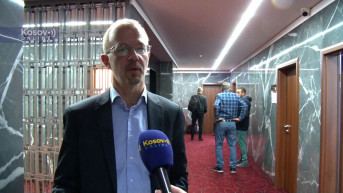
Michael Doyle, Spokesperson for the Kosovo Specialist Chambers in The Hague, says in an interview with Kosovo Online that recent changes to Kadri Veseli's legal team have not affected the pace of the trial. He emphasizes that it is uncertain whether Thaci and others will remain in detention until the end of the trial, as every two months, a review is conducted to determine if the conditions justifying their detention still exist.
Doyle reminds that in the case of Thaçi and Veseli, a two-month review was recently conducted, and the judges decided that there was still a risk of obstructing justice.
A few months ago, you mentioned efforts to speed up the proceedings in the case against Thaci and others. How far has that gone?
From the beginning, the trial panel has adopted procedures, held conferences with the parties, and issued necessary orders to ensure the trial is not only fair but also as swift and efficient as possible.
These measures have included asking the prosecution to further streamline the case, including reducing the number of witnesses. In May, the prosecution announced the reduction of certain witnesses from its list and expressed its intention to submit written statements from several others. The prosecution announced yesterday the reduction of 11 witnesses from the list and the fact that seven more witnesses will submit written statements. So far, 85 witnesses have testified in court, and 69 have submitted written statements.
Could the change of lead attorneys for Thaci and Veseli affect the trial speed in such cases, and are such changes common?
It is not uncommon for defendants to wish to change their legal representatives during a trial. One of the rights of the accused is to be represented by a lawyer of their choice. However, when such a change occurs during the trial, as was the case recently with Mr. Veseli, the trial panel must approve the request and assess whether the change or the interruption of representation would negatively affect the rights of the accused or cause significant delays in the proceedings.
In the recent case, Mr. Veseli requested to terminate Ben Emmerson’s mandate as his lawyer. The trial panel assessed that since Veseli's team consists of 11 members, including two who have been working on the case for some time, there was no risk of disrupting the continuity of his representation or violating his rights. Based on this, the trial panel decided to terminate Ben Emmerson’s mandate as Veseli's representative.
Will the accused in the Thaci and others case remain in detention until the end of the trial, or is it possible they could be released to defend themselves while at liberty at this stage of the trial?
This is really a matter for the judges. The law requires that every two months, the judges assess whether the conditions justifying the defendant's detention still exist. This includes whether there is a risk of the accused fleeing, obstructing the process, or committing new crimes. In the case of Thaci and Veseli, they recently had such a two-month review, and the judges determined that there is still a risk of obstructing justice, considering potential witnesses and the risk of new crimes. However, this question must be reassessed every two months by the judges. So if circumstances change, the accused will not remain in detention.
It has been emphasized many times that witness protection is a priority for the Court. Are you satisfied with this matter, and has there been any compromise to the safety of witnesses so far?
So far, 150 witnesses have safely testified in four different trials before the Specialist Chambers, and the Chambers has a dedicated unit for witness protection and support, including providing protection before, during, and after testimony when necessary. It is incredibly important to understand the key role that witnesses play in delivering justice. Often, it takes a great deal of courage for someone to come forward and tell their story.
Therefore, the Specialist Chambers and judges are very focused on ensuring that any witness at risk is protected. We have seen this in numerous closed hearings where testimonies were not made public if there was a risk of revealing the witness's identity, and names were redacted from the court records.
Do you think the attitude within Kosovo society toward the Specialist Chambers has changed, as there has generally been a negative view so far?
I think there is a wide range of opinions that can be seen in the media or at events when we travel across Kosovo to different communities and answer people’s questions about what is happening in The Hague. People are entitled to their opinions, whether positive or negative.
What I think the public should understand is that the Kosovo Specialist Chambers is a court of law with legal jurisdiction and operates within the framework of laws enacted by the authorities. The Specialist Chambers ensures fair, impartial, and independent trials, and that is the rule of law of which the Specialized Chambers are a part, a system of accountability that includes all courts.


0 comments