
Elizabeth Allen: We won't tell Serbia how to conduct its foreign policy; our partnership with the US is more important
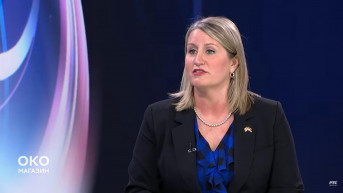
The American Deputy Secretary of State, in an interview for RTS, spoke about why Serbia is an important political and economic partner to the United States, how American support for the resolution on Srebrenica influences this, their perspective on Serbia's relations with China, and the dialogue between Belgrade and Pristina.
Elizabeth Allen entered the White House during the Obama-Biden administration and worked as the Deputy Director of Communications for the President of the United States. In the Biden administration, she obtained significant positions in the State Department under Secretary Antony Blinken. Initially, she served as an assistant for global affairs, then became the Under Secretary for Public Diplomacy and Public Affairs.
This week, she is visiting the region, which includes Sarajevo, Belgrade, Pristina, and Skopje. She spent the most time in Belgrade, where she met with the President and the Speaker of the Assembly, held discussions with representatives from the NGO sector and media, and will also be a guest at the Balkan Youth Summit BOLD held in Sjenica.
In her interview for RTS, she spoke about the excellent political and economic relations between the U.S. and Serbia, emphasizing that the U.S. is Serbia's top trading partner in services, particularly in the IT sector. She addressed American support for the Srebrenica resolution at the UN, clarifying that it is not directed against Serbia or the Serbs but aims to preserve the memory of the victims. She praised Serbia's international engagement, especially in current crises in Ukraine and Israel. Regarding Serbia's relations with China, she stated that the U.S. would not dictate Serbia's foreign policy.
Are you satisfied with the current relations with Serbia, and how can you illustrate this?
Allow me to say first that it's a pleasure to be here. It's my first time in Serbia, and I thoroughly enjoy the visit. My visit signifies the partnership between the United States and Serbia, a partnership that spans 140 years and has a solid foundation. We have many areas of cooperation. Together, we work on regional integration. We have deepening economic ties that are only getting stronger. The United States is Serbia's top trading partner in services, especially in IT and energy, where there is still much more we can do together. We work together to assist Ukraine. We collaborate to deepen our defense cooperation, including the partnership between the Ohio National Guard and Serbian forces. And, of course, in connecting our people. There's much work to be done here. There's a shared culture, history, and affinity between the people of the United States and Serbia. Where we can build relationships between the Serbian and American people, we want to do even more.
But how does the United States' decision to sponsor the Resolution on Srebrenica in the United Nations improve U.S.-Serbia relations?
Well, in any partnership, there will be areas where we want to think together and where we may have disagreements, and that's okay. That's something we can talk about. The United States is one of several co-sponsors of this United Nations resolution, and I think it's important to say that this UN resolution on Srebrenica is actually about commemorating the victims, marking the crimes, about the real memory of the victims of that moment. It's not about Serbia or the Serbian people or assigning any collective guilt to anyone.
But do you understand that this is an important issue for people in Serbia?
Yes, and I've heard that here. I've heard people with different views on it over the past few days here in Belgrade. I'm traveling across the region. Serbia is the second of four countries I'm visiting in the region. And one thing I can tell you, coming from people of different perspectives, is that we need to think about how to reconcile with the past to build the future. So, those kinds of discussions and facing some truths and hard truths are sometimes a way to really move forward.
Do you have any suggestions on how Serbia and the U.S. can improve relations? Are there criticisms on your side?
There are certainly areas we have, where we need to work on in terms of disagreements or different points of view, indeed, but that exists in every partnership. So, you know, whether it's about different geopolitical events, disinformation, and media freedom - these are all topics I've come to discuss. We think there's more we can do. These ongoing dialogues will certainly be part of every conversation between partners.
You've been to Sarajevo and Srebrenica, three days ago. Now you're in Belgrade. You're continuing to Sjenica, then to Pristina and finally to Skopje. All by car. In the nineties, this journey would have been life-threatening. So, how does the stability of the region look to you through the car window?
Great question. And it's truly a pleasure and a unique experience when you can drive through the region. Honestly, you see much more than when you come by plane. Stability in the region is something we've been working on with our partners for a long time, and we continue to work on it. We have both commitment and great hope for continued regional integration. This is, of course, a moment of difficulty, and we recognize that. We're concerned about inflammatory rhetoric and the growing ethnonationalism, of course. But that's something we're working on with our partners in Serbia, with all four countries I'm visiting, and we'll continue those conversations.
But what would you say about the stability in the region? Do you think it's good, bad, mediocre?
You see, I think every time in history, there are different circumstances, right? And so, this moment is not the nineties for various reasons. And it's important to say that the world around us is changing, not just things in the region. There are different incentive structures. There are different ways of communicating with people. And that's why I'm focused on our commitment to deepening that regional integration and have hope for the commitment to the future.
What is your stance on the dialogue between Belgrade and Pristina, and what message do you plan to convey to local political leaders?
Yes, you see, we absolutely support the ongoing dialogue facilitated by the EU. It's a way to make progress on issues between Belgrade and Pristina. We're really pleased to see the progress, particularly made by Serbia. We welcome the reforms and progress achieved within that dialogue. And we also need to see more progress. And that includes Kosovo. Yes, but all of you basically expect that you might push Pristina a bit further. I will clearly articulate our expectations from Kosovo. And as I said, we expect them to progress through that dialogue.
How would you like Serbia to position itself in the current geopolitical situation, especially regarding the crisis in Ukraine and Gaza?
That's interesting. That's something I discussed with President Vucic yesterday. Partnership, like between the U.S. and Serbia, means that we comment, coordinate, work on global geopolitical events together. So, regarding your question, we discussed the crisis in Ukraine. We talked about the crisis in the Middle East. We think about what's happening around the world. And Serbia has been a very good partner in providing humanitarian aid to the people of Gaza, as well as continuous support to Israel. Serbia has been a very good partner in the past in preserving peace and resolving conflicts. In Sinai, for example, where you played an important role. You have an important role in assisting Ukraine, including political support in international institutions and humanitarian and technical support to Ukrainians. And of course, we greatly appreciate Serbia's partnership with NATO, which we hope to continue to deepen, especially in terms of joint military exercises. We all can do better if we train together more.
As for Serbia's relationship with China, I believe that's of great interest to the United States?
Absolutely. And, you know, there were a number of high-level visitors here in Belgrade last week. I'm very glad to be among them. You see, I'm not here to tell Serbia how to conduct its own foreign policy, and we certainly don't expect Serbia to choose different relationships with various world powers. So, I won't characterize Serbia's relationship with the PRC. What I can characterize is what comes out of the partnership between the U.S. and Serbia, and that's a partnership for mutual benefit. So, for example, when the United States invests here in Serbia and companies come here to Serbia, very often it's Serbians who lead American companies here in Serbia. We're creating jobs at the local level for people to support their families, to find economic futures through that American investment. American companies are looking for ways to find sustainable supply chains and economic incentives that will last longer in Serbia than just this moment. I think that's a really important point. So, we're developing our relationship with Serbia for mutual benefit.
And yesterday you checked... well, you didn't open but you checked on the progress of building the American Resource Center in Serbia. What is that center supposed to do?
Part of my responsibility, part of my portfolio, is finding ways for, as I mentioned earlier, the U.S. and Serbian people to get to know each other better. And I deeply believe that we should invest in platforms and places for gathering, learning, training, and thinking. So, I'd say a couple of things. One of the things that the United States and Serbia share is a legacy and culture of innovation. So, whether it was the days of Nikola Tesla or something else, that's something that's in the spirit of the American and Serbian people to really drive innovation, entrepreneurship, creativity. And the place we visited yesterday, walked through the construction site, will ultimately be a center for joint innovation and the ability for people to come together and drive change, a creative economy, and propel us forward when we think about science, research, and creative arts as means to create a shared future.
The other thing I would say, and we discussed it here today, is that there's a wide range of issues that the United States and Serbia are working on together. Somewhere we have more disagreements, somewhere less. Somewhere we have more cooperative aspects, but we won't be able to continue working together if we don't understand each other. And so, I'm very focused on creating opportunities for mutual understanding between our peoples, and creating centers like the American Resource Center is one way to do that.
You're here in Serbia for the first time. You'll spend almost four days here, which is quite a lot for this trip. So, have you learned anything about the Serbian people that you didn't know before? And did anything surprise you?
The weather has been lovely, well, that's not about the people, but thank you for welcoming me with nice weather. And I had the opportunity to take a stroll, visit Kalemegdan, have some šljivovica last night. But you see, what I found in the Serbian people, especially among the young people in Serbia, is that they are really committed to a future where they find freedom and rootedness in the Euro-Atlantic community. I've heard that from several of them. And of course, people have different viewpoints, but I've really heard from many that they want to move forward from the past, even if it means facing some difficult things, and truly build a future where people have prosperity, economic opportunities, a chance for their families. And they can do that in a society with more freedom and more truth.


0 comments