
Djuric: Pristina becoming increasingly isolated in the international community due to unilateral actions
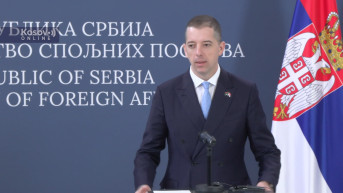
Serbian Foreign Minister Marko Djuric stated that, through intensive diplomatic efforts, Serbia has succeeded in securing the support of key European partners on the issue of Kosovo. He stressed that the unilateral actions and violence of Albin Kurti's administration have drawn condemnation from the international community and contributed to its growing isolation, RTV reported.
Djuric said that, despite the fact that some European international organizations have an unfavorable majority when it comes to Kosovo's status, Serbian diplomacy has succeeded in preventing Pristina from joining the Council of Europe.
"On the European continent, Serbia faces the least favorable situation in terms of the number of countries recognizing the independence of Kosovo and Metohija. Fortunately, some of the major European countries have conditioned Pristina's progress on the establishment of the Association of Serb-majority Municipalities, the implementation of certain standards regarding the protection of the rights of the Serbian people in Kosovo and Metohija, and this is, among other things, the result of the efforts of our diplomacy," Djuric said during an appearance on Radio Belgrade 1.
Speaking about the Council of Europe Committee of Ministers meeting held in Moldova in mid-May, the Serbian foreign minister said that Pristina had once again failed to achieve its objective.
"One piece of very important news for us from that meeting is that Pristina once again failed this year, at the regular session of the Committee of Ministers, to achieve its ambition of joining this important international organization, even though more than two-thirds of its member states recognize the unilaterally declared independence of Kosovo," Djuric said, as quoted by Tanjug.
He added that this was the result of years of work at all levels, including discussions held by Serbian President Aleksandar Vucic with key European and global leaders, such as French President Emmanuel Macron and German Chancellor Friedrich Merz, during which Serbia consistently emphasized that the protection of Serbian rights and interests must precede any further advancement of Pristina's position.
Commenting on the unilateral actions and pressure faced by the Serbian population in Kosovo, Djuric pointed to what he described as the counterproductive international effect of such actions for the authorities in Pristina.
"On the one hand, over the past three and a half years, Pristina has inflicted enormous damage on our people on the ground. It has caused great harm and, if you will, inflicted considerable suffering on the interests of ordinary people. Some of our institutions were forcibly shut down and pushed out of the territory. However, Belgrade's investments have not stopped; on the contrary, they have increased. The efforts of the Office for Kosovo and Metohija and other state institutions have continued, and that is important," Djuric said, according to RTV.
At the same time, he expressed satisfaction that Pristina's conduct had nevertheless drawn a certain degree of criticism within the international community.
In his view, the approach adopted by the authorities in Pristina ultimately strengthens Belgrade's arguments.
"The more violent Kurti's administration becomes on the ground, not only toward Serbs but also toward anyone who thinks differently, the more isolated it becomes within the international community. It is an irrational approach to engaging with the international community, and it absolutely works in our favor. The more irrational, radical, and unwilling they are to engage in dialogue, negotiations, and cooperation, the stronger our arguments become that we are dealing with a truly chauvinistic administration that will stop at nothing to achieve its goal of completely driving our people out of the area," Djuric emphasized.
The Serbian foreign minister stressed that diplomatic successes must ultimately translate into tangible benefits for the people living in Kosovo.
"What we must ensure is that our successes are not Pyrrhic victories. That is why it is very important that, in recent years, both the President and the Government have further increased financial support for our people in Kosovo and Metohija and for our Church, and above all that the Serbs themselves remain determined to stay and endure," the minister said.
Serbia and Albania reach preliminary agreement on opening consulates in Shkoder and Bujanovac
Djuric also announced that Serbia and Albania had reached a preliminary agreement to open consulates in Shkoder and Bujanovac.
"I am pleased that I had productive discussions with Albania's new Foreign Minister, Ferit Hoxha, during which we reached a preliminary agreement to open consulates of our two countries in Shkoder and Bujanovac," Djuric said, as reported by Nova.
Speaking about the European Union, Djuric said that Serbia had accelerated the implementation of reforms under the EU agenda and reiterated that EU membership remains Serbia's national interest.
"I believe it is both responsible and important that Serbia has accelerated the implementation of reforms that are part of the European agenda. I consider it to be in our national interest to have a seat at that table because, one way or another, not only is 62 percent of our trade with EU countries, but 78 percent is with the EU and the wider region combined. If you look at it from every perspective, our security and the way we live are tied to this continent. Decisions will be made there either with us or without us, and it is better to be an active participant in the decision-making process than merely an object of those decisions," the minister said.
Djuric also spoke about Serbia's relations with the Czech Republic, stating that "Serbia has another strong pillar of support in Central Europe."
"We had excellent talks in the Czech Republic, where we met with the new Foreign Minister, Petr Macenka, who stated during my visit that the decision by previous Czech governments to recognize Kosovo and Metohija had been made under pressure. He also said that the issue of Kosovo and Metohija is a Serbian issue," Djuric said.

0 comments