
Escobar: I don't see bias in Lajcak
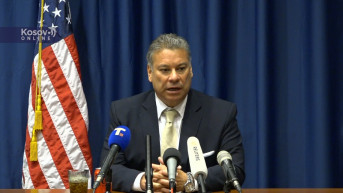
The United States Special Envoy for the Western Balkans, Gabriel Escobar, stated that he found no evidence of bias in the work of Miroslav Lajcak, the EU Special Representative for the Serbia-Kosovo Dialogue, as reported by Radio Free Europe.
"I don't find any evidence of collusion in working to advance Serbia's interests in this," Escobar said.
He expressed concern about messages from Pristina criticizing Lajcak.
Escobar emphasized that the United States expected both sides to intensify their commitment and for Kosovo to demonstrate more pragmatism and realism in its approach to the EU.
What do you see as a way out of the current deadlock in the Serbia-Kosovo dialogue?
Currently, there is no alternative to the dialogue. So, the important thing for both parties is to continue with the dialogue. I am sure you have seen Borrell's statement. We are calling on the Kosovo side to be more constructive. And I must say that I am somewhat disturbed by the messages coming from Pristina. I have been working with EU Special Representative Miroslav Lajcak. I don't find any evidence of bias. I don't find any evidence of collusion in working to advance Serbia's interests in this. What we are trying to do, and what the EU is trying to do, is create conditions for normalization and harmonization for integration into the EU at the same time. So, I think the answer is for both sides to intensify their commitment and for Kosovo to show more pragmatism and realism in its approach to the EU.
The European Union has stated that it will consider additional measures against both sides if they do not move forward with the implementation of the Ohrid Agreement and its annex. Is the United States considering potential measures toward both sides in that case?
I wouldn't say measures; I would say consequences. And I will tell you that the consequences that Kosovo is facing are that if they refuse to cooperate with the EU, the EU is not going to engage in additional assistance and additional integration measures. I think those measures affect Kosovo and the Kosovo economy. I hope that, at least bilaterally, the United States will be able to work with Kosovo to find a way to remove those measures by 2024. So, we will continue to work with Kosovo to bring them closer to the European Union. But we would like to see political will and movement in that direction.
Is there a deadline for this?
No, and that's an unfortunate circumstance. So, these measures are indefinite until there is a movement toward progress in the implementation of the Ohrid Agreement and the de-escalation plan.
Are the US and the EU on the same page when it comes to the Community of Serb-majority Municipalities having to comply with the decision of the Constitutional Court of Kosovo? I ask you this because EU spokesperson Peter Stano today (September 21) did not want to explicitly acknowledge that the EU's position is that the Constitutional Court decision should be taken into account when establishing the Community.
We have said repeatedly that the Community of Serb-majority Municipalities should not create problems within Kosovo in its functioning. It should be in compliance with their legal legislation; it should be in compliance with the Constitution. So, within that framework, I still think there is an enormous capacity to allow Serbs to manage their own municipal services in a way that best suits their citizens, without becoming the Republika Srpska. We have addressed that repeatedly. I am disappointed that this question continues to be raised – that it would be Republika Srpska. It will not be. It's really about municipal authorities doing what municipalities already do, in Serbian language.
The Parliament of the Republika Srpska, an entity of Bosnia and Herzegovina, has taken a step further toward adopting a "foreign agents law" similar to the one already in place in Russia. How do you comment on this?
First of all, I wouldn't say it's similar to the one in Russia; it's identical to the one in Russia. So, for us, it's an undemocratic act, a dangerous act. We see it as a desperate move by authorities trying to silence independent journalists from pointing out all the deficiencies. So, by telling journalists they cannot publish the truth, they cannot hide the truth. I think this law cannot in any way help Bosnia and Herzegovina, especially Republika Srpska, move closer to Europe. But I think that's the plan. I don't think Republika Srpska President Milorad Dodik actually intends to help bring Republika Srpska closer to Europe.
Does the High Representative in Bosnia and Herzegovina, Christian Schmidt, enjoy sufficient support, given recent events and statements by Republika Srpska President Milorad Dodik that Mr. Schmidt will be deported if he tries to enter Republika Srpska?
First of all, he (Dodik) doesn't have that authority. Let me say that the role of the High Representative in Bosnia and Herzegovina is laid out in the Dayton Peace Agreement. So, he is an important part of Dayton. His legitimacy draws from Dayton. And he has our full support, as well as the full support of the European Union. And not only that, he has the full support of the Peace Implementation Council (PIC).

0 comments