
Hovenier: Kosovo’s reputation in Washington has suffered a serious blow over the past 16 months
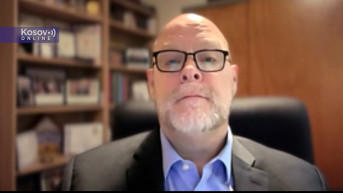
Former United States Ambassador to Kosovo Jeffrey Hovenier assessed in an interview with Kosovo Online that Kosovo’s reputation in Washington has been seriously damaged over the past 16 months due to political instability, repeated elections, and institutional deadlock. He stressed that the United States expects the new government, among other things, to take on a role in reducing tensions, both within Kosovo and across the region.
What does the United States expect from Kosovo’s next government after the June 7 elections, particularly regarding political stability, governance, and dialogue with Serbia?
My impression is that the United States has been consistent and clear on this issue.
They want a government in Pristina that will be a reliable partner, a government that will address priority issues such as strengthening democratic institutions, combating corruption, implementing governance reforms that have been delayed for too long, and taking on a role in reducing tensions both within Kosovo and throughout the region.
I think Washington will watch very closely to see whether the new government succeeds in electing a president, forming a stable coalition, and carrying out the basic functions of government, challenges Kosovo has faced through multiple election cycles over the past 16 months.
Were there any messages during the campaign from the State Department or other US officials that could be interpreted as support for a particular political option, or is Washington seeking to remain strictly neutral?
Again, I must emphasize that since I am no longer part of the US administration, I can only speak about what I see from the outside, not about its internal deliberations.
Still, my assessment and impression are that the United States has maintained a position of electoral neutrality.
Washington does not support political parties or candidates in Kosovo’s internal elections.
What the United States has done is send very clear political signals about what it expects from any future government.
Those expectations relate to effective governance, reducing tensions within Kosovo, particularly in the north, and at the regional level.
I believe every Kosovo politician should be able to read those signals.
The suspension of the Strategic Dialogue between the United States and Kosovo last autumn, under Albin Kurti’s caretaker government, was, in my view, a significant message.
It was not support for any opposition party, but rather a clear message that the existing situation was unacceptable to Washington, and I think that is an important factor ahead of these elections.
Kosovo is heading into yet another election after months of institutional deadlock. How has this crisis affected Kosovo’s standing in Washington, and what steps would the next government need to take to restore US confidence?
I believe Kosovo’s reputation in Washington has suffered a serious blow over the past 16 months.
I say that as someone who has invested years in US-Kosovo relations and for whom that relationship is very important.
However, repeated elections, the failure to elect a president, and reliance on caretaker governments have undermined confidence in Pristina’s ability to fulfill some of its obligations.
Washington works best with partners who are predictable and capable of delivering on what they promise.
There is also a financial cost.
Kosovo risks losing millions of dollars or euros from the European Union’s Growth Plan, as well as from other funding sources, if key reforms are not adopted, and this legislative paralysis is a direct consequence of the institutional deadlock.
That is why restoring confidence will require much more than words.
The new government will have to demonstrate that it is serious.
It will have to show that it can elect a president and form a stable and predictable coalition, adopt a budget, and take early and visible steps toward reducing tensions, both within Kosovo and across the region, as well as implement certain rule-of-law reforms.
Still, I think there is good news as well, namely that Washington appears genuinely willing to re-engage.
US officials have publicly stated that they hope to renew engagement after these elections and expect a different and more positive relationship.
That is something we should all welcome.
However, I would caution that this opportunity will not remain open indefinitely.
The new government will need to act quickly and decisively to consolidate its capacities and begin rebuilding trust between Kosovo and its partners, including the United States.
I would also note that everything I have said about relations with the United States appears to apply to the European Union as well.
In that case too, the new government will have to take steps to restore confidence.
So I believe there is a real risk, and my hope, as I have said, is that Kosovo will succeed in forming a stable coalition.
That also includes electing a president who will be a non-partisan figure capable of representing the interests of the state rather than those of any political party.
If it succeeds in doing so, Kosovo will have an opportunity to play the role we want it to play: to be a source of stability, a source of predictability, and a partner to the United States and the European Union, as it has been in the past, in advancing the region’s security and prosperity.
At a time of growing regional and global security challenges, how important is it for Kosovo to quickly form stable institutions after the elections, and what risks could prolonged political uncertainty pose for the wider Western Balkans region?
What happens in Kosovo does not stay in Kosovo.
The issue of Kosovo’s relations with its neighbors, and particularly with Serbia, has a major impact on the overall stability and security of the region.
That is why the United States expects Kosovo to play a constructive role and contribute to reducing tensions.
We recognize and respect Kosovo’s sovereignty.
We reject any claim that Kosovo is anything other than what it is: a sovereign, independent, and multiethnic state.
But Kosovo can continue to achieve its strategic goals through partnership with the United States and the European Union, and that will bring stability, or greater stability, to the region.


0 comments