
Petritsch: Banjska is an important warning; Nagorno-Karabakh scenario should be prevented in the Western Balkans
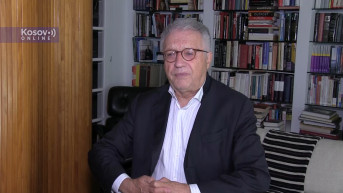
Former European Union Special Representative for Kosovo, Wolfgang Petritsch, says in an interview with Kosovo Online that Banjska should serve as an important warning to everyone because any conflict involving casualties worsens the situation. Therefore, he emphasizes that the security situation must be a top priority, and KFOR must be strengthened.
Petritsch also warns that what happened in Nagorno-Karabakh, which was undoubtedly ethnic cleansing, must be prevented at all costs in the Western Balkans.
How do you assess the current situation in Kosovo following the events in Banjska?
The current situation, following the events in Banjska, is the most dramatic since 2004 or 2008 when Kosovo unilaterally declared independence. The cause is that the dialogue, mediated by the EU, has stalled, and it has been stalled for quite some time now. It's important to consider that the dialogue process has been ongoing for 10 years. There was progress initially, which contributed to improving the lives of people in northern Kosovo and other areas where Serbs live. The security situation improved during that time. There was hope that the dialogue would lead to the normalization of relations, but that hasn't happened. Therefore, we must now try to analyze the causes and take swift action. That's what's essential now, what matters the most.
Do you think the accusations against Belgrade coming from Kosovo authorities, as well as from some regional and Western circles these days, are justified?
I don't put much stock in assigning blame. I think we have a situation that is so intertwined that it is often difficult to determine who started something because the conflict has been going on for too long, and one provocation follows another. In politics, there seems to be no willingness to meet each other halfway. During the Rambouillet negotiations, Russian negotiator Boris Mayorski said, "It takes two to tango". It's the same in negotiations. You need to talk, but I fear that in the coming months, there won't be ideal conditions, mainly because there will be elections soon, in December in Serbia, next year in Kosovo, as well as in the EU and the US. In my experience, this means that all substantive discussions, including progress, are put on hold during election campaigns. After the elections, the EU will need to approach things differently. Perhaps this is a time for both sides to reflect on the need to show more flexibility, especially regarding the lives of people on the ground.
After the Serbs left the police and administration in Kosovo, we have a space without the rule of law. Also, the election of mayors was not a democratic signal. Something needs to be done about that, and with the EU's mediation, it should be resolved in the coming weeks and months. This would contribute to increasing trust or rebuilding trust in the dialogue. But it can only be a temporary solution. Essentially, now we need to consider how serious the situation on the ground is. There has been an increase in emigration because the young Serbs do not want to live in a situation where they do not see a future for themselves. The economic situation in the labor market is not such that it can offer a good life. And establishing a good life is, in fact, normalization. Normal people want to lead a normal life, a life in security.
Since we cannot count on greater progress in negotiations toward normalization, I believe that the security situation must now be a priority. We need to try to strengthen KFOR. At the same time, it is necessary to strengthen the security situation in Bosnia and Herzegovina. EUFOR has already done that and doubled its troops. From an external perspective, it is important to see that problems and solutions lie within the triangle of Belgrade-Pristina-Sarajevo. Belgrade, as the largest state in the region, has the most important task in this regard and, therefore, it must act with great responsibility. That's what is expected. In recent months, there has been an understanding of Serbian positions, primarily in the United States, more than was the case before. A constructive approach will achieve something. The longer the stalemate lasts, the more it becomes not just a stalemate but a space without the rule of law where criminal elements strengthen, making life even more difficult for citizens.
Does dialogue still make sense, considering that you recently stated that when mediation lasted for a long time, it lost its meaning? How should the EU proceed now, and does it have the capacity to bring solutions?
The current negotiating team, Miroslav Lajcak and Josep Borrell, will presumably be replaced after the EU elections. After the elections, there will be a new distribution of power and a new composition of the European Commission. I assume there will be a new team for the dialogue. Dialogue is important, but the way it has been conducted in the last two years shows that it is not working. Now we need to think about how to make progress, what has succeeded, where mistakes were made, and where we need to move forward. We need to reduce emotions, eliminate threats, and say - we want to find a solution for the people. It is always forgotten that, although it concerns the collective security of states, the ethnic aspect is not unimportant, but what is more important is to contribute to a normalized situation where people can have a better life economically, socially, and educationally.
What effect can threats of sanctions against Serbia have, which will be discussed at EU meetings? Do you think that a policy of conditioning and pressure can lead in a positive direction?
It's always difficult because in situations like this when nothing is progressing at the negotiating table, diplomacy thinks about what else can be done. Sanctions are always one option. But we can see from history, and now in the case of Russia, that sanctions have long-term effects and also prevent dialogue. Thank God, there is no war in Kosovo as in Ukraine, but at the same time, for that reason, diplomacy should be given a chance, to consider what has been done well and what hasn't. The responsibility of political elites in Belgrade and Pristina is enormous. The dramatic situation we have witnessed now does not bode well for the future of the region.
In the end, it also concerns Serbia's approach to the European Union. I believe that Serbia, as President Vucic constantly emphasizes, sees its future in the EU. However, to enable that future, it is necessary to solve the problems. Belgrade plays a crucial role in this. If that role is played constructively and positively, Serbia will have a positive future in the EU because Brussels would always prefer certain regions to solve their problems independently rather than through the EU, as is the case with dialogue now.
How much have EU and US representatives contributed to the current situation in northern Kosovo, given that for months they have been unable to convince the Government in Pristina to de-escalate tensions?
We are dealing with strong personalities. Vucic and Kurti are strong political figures. The chemistry between Vucic and Thaci was better than with Kurti. As professional politicians, they must take into account that they must engage in dialogue with those who are elected. This is especially true for Kurti, as it can be observed that, despite his principled stance, the situation in the dialogue has not improved. That needs to change.
What, in your opinion, is the way out of the current crisis in Belgrade-Pristina relations, which reached its peak after the tragic events in Banjska?
Banjska should be an important warning. Every conflict with casualties worsens the situation and acquires a new negative dimension. This must be taken into account. The killing of a police officer and three Serbs, evidently killed by the Kosovo Police, must be acknowledged as a situation that has worsened emotionally. Politically, it is very difficult to resolve. Emotions need to be set aside. An investigation must be carried out. It's good that Belgrade insists on the need to ensure legal security and leaves it to the judiciary to determine the causes and arrest those involved. I think this investigation is very important for re-establishing a minimum level of trust.
This is a prerequisite for successful negotiations in general. Trust has never been at a high level. The minimum trust must be re-established, and a return to the negotiating table is needed. Both sides must understand that this is an EU matter; it's a European issue. In the war between Russia and Ukraine, we cannot say, "It's a small region, nothing is happening". But the Western Balkans must quickly approach the EU. Ukraine and Moldova cannot be the first in line. However, negotiations have been going on for too long, and progress is needed.
At the same time, Belgrade, Sarajevo, and Pristina must contribute. Progress cannot continue through the militarization of the conflict. That's why I consider it very important that the security situation is strengthened now, and this will be the case for the next year and a half. European and US military forces are necessary to ensure that. Both sides must accept this.
Can the Nagorno-Karabakh case, in which the international community did not react much, have a negative impact on Kosovo?
The tragedy of Nagorno-Karabakh shows the direction in which the situation can go if the problem remains unresolved for too long. Azerbaijan has obviously taken advantage of the situation and decided to resolve the issue. Ethnic cleansing has been carried out - 100,000 people have fled. This reminds me of the tragic fate of the Serbs in Croatia, and I believe that the repetition of what happened in Nagorno-Karabakh must be prevented at all costs in the Western Balkans. We must leave the 1990s behind and look to treat each other peacefully.
I understand that these are big words, maybe even naive in the current situation, but security must be established, KFOR must be strengthened, and efforts should be made for EUFOR to be proactive in Bosnia and Herzegovina. This is necessary to create conditions for moving towards the normalization of relations. We should never lose sight of the fact that the EU's vision includes the inclusion of all Western Balkan countries.

comments