
Rafuna: Political Deadlock Sends a Bad Message to Foreign Investors, We Must Accelerate Reforms
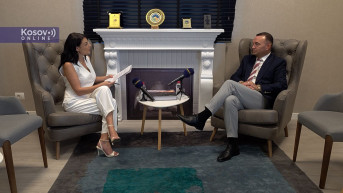
Political deadlock and the failure of institutions to function are slowing economic reforms and undermining efforts to attract new investment, according to Lulzim Rafuna, President of the Kosovo Chamber of Commerce, who warns that the institutional crisis is also causing Kosovo to fall behind in accessing funds under the European Union’s Growth Plan.
Written by: Milena Maksimović
In an interview with Kosovo Online, Rafuna says that Kosovo must establish fully functioning institutions as soon as possible and accelerate reforms in order to make up lost ground compared with other countries in the region and remain competitive in attracting foreign investors.
Rafuna discusses the impact of the political deadlock on the economy, the expectations of the business community, foreign investment, Kosovo’s connection to the regional gas network, and labour productivity.
A group of Kosovo intellectuals, academics, experts and artists sent an open letter expressing concern over the institutional crisis and appealing for institutions to be formed and the constitutional order protected. You are one of the signatories. Do you expect politicians in Kosovo to heed the appeal?
We do, and that is precisely why we signed it. I have repeatedly called, including through your media outlet, on all political parties represented in the Kosovo Assembly to reach an agreement as soon as possible so that we can have fully functioning institutions. We need this in order to implement economic reforms and make Kosovo more attractive to foreign investors.
How does the failure to form institutions affect Kosovo’s economy and society as a whole?
Every foreign investor, as well as domestic businesses planning to expand their operations, looks first and foremost at legal and political certainty. They need to know what kind of government there will be, what its programme will be, what vision and fiscal policy it will pursue, and what reforms will be implemented in healthcare, the judiciary and other areas. That is why it is extremely important to have functioning institutions and to begin implementing reforms immediately so that we can become more attractive to both domestic and foreign investors.
How is the current political deadlock affecting Kosovo’s international standing and funding under the European Union’s Growth Plan?
When it comes to the Growth Plan, only Bosnia and Herzegovina is in a worse position than Kosovo. The reforms that were envisaged and agreed in Brussels, and which we proposed under the Growth Plan, cannot currently be implemented because certain laws need to be adopted. Since we do not have a functioning Assembly, those laws cannot be passed. As a result, we are already behind schedule and will continue to face delays in accessing funds under the Growth Plan. That money is intended for capital investment and has a direct impact on both our economic and social development.
What are the economic consequences of the political deadlock?
We are falling behind with reforms because of the political deadlock and the absence of functioning institutions. The countries around us are progressing faster precisely because they have functioning institutions. However, it is not too late. If we establish functioning institutions and begin working immediately, we can make up some of the lost time. The Kosovo Chamber of Commerce stands ready to assist all institutions in accelerating reforms in education, the judiciary, healthcare and fiscal policy, as well as in implementing strategic investments.
Is this situation affecting the arrival of foreign investors?
To some extent, yes. Having also served as President of the Western Balkans 6 Chamber Investment Forum (WB6 CIF), I can say that major businesses looking to invest view this region as a single market. It is therefore extremely important for all Western Balkan countries to advance reforms simultaneously. That will make us considerably more attractive to foreign investors. Naturally, having our institutions in a state of deadlock for two years does not send a good message to foreign investors. We need to accelerate these processes, which is why we have called, and continue to call, for functioning institutions to be established in Kosovo as soon as possible.
The United States has called on Kosovo to join its gas network, but this has not happened so far. What does Kosovo stand to lose by not joining the network?
I believe the time will come when Kosovo accepts this. At present, assessments are being made as to which solution would be best and how much it would cost. We have an option involving Albania, via Vlora, while another possibility is for the gas supply to come through Greece and North Macedonia. We have asked the Kosovo Government to accelerate the process and tell us which solution would be preferable – via Vlora or Skopje. If Kosovo does not become part of this system, it will lose out, because billions in investment are at stake and will be channelled into the infrastructure that needs to be built. That is why I believe the Kosovo Government will accept it, and we are urging it to do so because this is a strategic issue. Kosovo should be part of this gas system. The entire Balkans is becoming interconnected – Croatia is part of the system, Serbia has now joined, North Macedonia has been part of it for a long time, Albania has signed an agreement with Greece, while Bosnia and Herzegovina has an agreement with Croatia via Krk. Kosovo should also be part of that system.
There has recently been considerable criticism of KEK’s agreement with North Macedonia. What is your view of it?
I do not yet have a detailed analysis of the agreement. It is an agreement between KEK and a corporation from North Macedonia. Such cooperation existed previously as well, so this represents a continuation of that cooperation. At this point, we do not see any particular problem.
According to data from the International Labour Organization, Albania ranks last in terms of labour productivity. What is the situation in Kosovo?
If we look at the Balkans as a whole, there are certain differences. Montenegro ranks first in the region, partly because it is more heavily focused on tourism, a sector that is extremely important to its economy. Serbia and Bosnia and Herzegovina are somewhere in the middle, while North Macedonia has fallen due to the situation it is facing. Kosovo, I believe, is gradually making progress, although we need to look at the latest data. We have now increased the minimum wage, and there is therefore a significant gap between the public and private sectors. Kosovo is still not at the level we would like it to be, but we are gradually making progress.
What are the consequences for the economy and gross domestic product if productivity is low?
Naturally, the consequences are not positive. That is why the state needs to focus on sectors in which it can become more competitive and use them to increase productivity. This is one of the key prerequisites for economic growth.

0 comments