
Weber: We won't see the implementation of agreements or the CSM this year; the West should establish a stable status quo
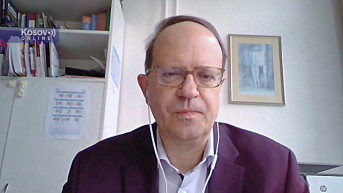
Bodo Weber, a Balkan expert and senior associate at the Council for Democratization Policy in Berlin, says for Kosovo Online that this year we won't witness the establishment of the Community of Serb Municipalities or the implementation of agreements from Ohrid and Brussels, and he suggests that the West should strive to establish a stable status quo.
Weber criticized Lajcak's statement that the CSM was an internal matter for Kosovo, and said that it was not in Kurti's and Self-Determination's interest to hold general elections.
Is this the year when we can expect the establishment of the CSM? Do you remember those seven points that Kosovo Prime Minister Kurti announced on social media at the end of 2023, after the energy agreement? Is it up to Pristina to show goodwill and form the Community of Serb Municipalities?
I'm not sure if the energy agreement is a concession from Belgrade, as it was agreed upon a long time ago. Regarding the Community, these seven points by Albin Kurti are part of this constant bickering, and I don't understand Lajcak's recent statement that the Community is an internal matter for Kosovo, just a few months after the EU and the US came up with a ready-made draft of the Statute. I don't believe that statement will contribute to the implementation of the agreements, the Basic, and the Ohrid. I was among those who immediately said after Borel and Lajcak's statements that an agreement had been reached, the Basic Agreement in Brussels and the Ohrid Agreement, that this approach is wrong and does not lead to goals and progress. Last fall, I said that this initiative had failed, and recent statements only confirm that. I'm afraid that with the upcoming EP elections and the end of the mandate of this European Commission, this initiative will not succeed, including the key element of establishing the Community, around which a dispute has been ongoing for a decade. I don't believe the initiative will pass because President Vucic insisted that Belgrade does not recognize what was agreed upon in Brussels and Ohrid, which is the de facto recognition of Kosovo as an independent state.
If there is no CSM and no implementation of the agreements, can we expect new incidents in 2024, and considering the EP elections, will there be elections in the US as well?
That part exists too. President Vucic will delay the implementation from his side, hoping for Trump's success in the US elections. I expect both sides to play for time until the summer break, and we won't see much progress. The formation of the new Serbian government is also in progress, and we all know that President Vucic can delay quite a bit from that perspective. Not only won't we see a status quo, but we have seen a deterioration of the situation, with Serbs leaving institutions, armed conflicts in Banjska, and events in Zvecan in the summer before that, so the West should strive to establish a stable status quo by strengthening KFOR. The only thing we might see is new elections in the north, at least for three out of four mayors, and the return of the Serb List to power. This wouldn't solve the problems of Kosovo Serbs, but it would lead to stabilization. Even if that happens, we wouldn't see new elections for municipal assemblies.
How do you comment on the fact that the Kosovo Government continues to insist on banning Serbian goods, as well as the series of actions by the Kosovo Police, which, in December, raided stores searching for such products?
Kurti's government lost patience with the West, which is somewhat understandable. They want to round off the issue of independence and integration in the north, and that move is understandable, but on the other hand, it doesn't lead to the goal but to a dispute and alienation of Serbian citizens, especially in the north. The blockade of Serbian products is part of that process, as is the conflict with Serbia, and these actions mentioned inflict economic damage on the economy in the north, as well as all of Kosovo.
The EU has warned several times about land expropriation?
That is part of the political approach I mentioned. It can be understood why Pristina is doing this, but I don't see how it will lead to the goal. There are inconsistencies with the government insisting on the rule of law, and then they make decisions on expropriation, which the West warned is not in line with the law. The whole process we see in the north, from Serbs leaving institutions, especially the police, to the filling of that vacuum by Pristina with its police forces and part of the special police, especially after Banjska. Citizens in the north are now free from the pressure of criminals close to the authorities in Serbia, but on the other hand, they are afraid of facing the special police every day.
Will there be general elections in Kosovo in 2024?
That is hard to estimate, but as far as I remember, it has been talked about all of last year. So I'm not sure if it would pay off for Kurti's government to go to elections now or what the motivation would be. According to the latest public opinion polls, Self-Determination has not lost its dominant position, and the opposition is not consistent. It secretly agrees with this discomfort with the Franco-German initiative but has tried to use the dispute that arose between Pristina and Western capitals on the domestic political scene. Unlike Serbia, where President Vucic's well-established tradition is always to go to early elections to avoid a crisis and strengthen his position – I don't know if such a move would pay off for Prime Minister Kurti and Self-Determination.



0 comments