
Andric's unwritten character
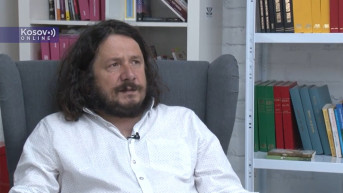
Writing for Kosovo Online: Muharem Bazdulj
At the beginning of the last decade of the twentieth century, British historian Noel Malcolm published "Bosnia: A Short History", although he hadn't previously focused much on Bosnian historical themes. Towards the end of the same decade, the same historian published "Kosovo: A Short History", even though the historical theme of Kosovo wasn't particularly close to him before. Someone witty once made a clever variation of the humorous curse "May your house appear on CNN", formulating it like this: "May Noel Malcolm write a short history for you".
At a time when the vast majority of people in the Anglo-Saxon West were actually hearing about Bosnia and Kosovo for the first time, these books enjoyed significant success with a broader audience. The scholarly reception, especially in our regions, was more skeptical. A certain political layer in these publications, especially in Serbia, was notably observed. In Sarajevo, "Bosnia: A Short History" was given an almost canonical status, overlooking details that otherwise provoke genuine hysteria in the local public. For example, when writing about World War II, Malcolm speaks with great respect and reverence about Draza Mihailovic as the leader of the Chetnik guerrilla fighting against the Nazis. Malcolm's vision of Mihailovic would not be criticized even by Rados Bajic, but, as they say, what is allowed for Noel is not allowed for Rados.
I remembered Malcolm when I found a reference to his book on Kosovo in a publication by an Italian historian who deals with a miraculously historical figure that seems more literary than historical, a figure as if descended from the pages of an unwritten Andric's book. I'm referring to a man who proclaimed himself Sultan Yahya (1585 - 1648).
In a fictionalized account of his life, it is summarized roughly as follows:
Yahya is the Muslim version of the name Jovan, and in the Qur'an, Yahya is the equivalent of John the Baptist in the Gospels. Yahya was the child of a Byzantine princess from the Komnenos dynasty and the son of Murad III. When his mother feared that her son would lose his life in court intrigues, she sent him to Greece, to a monastery in Bulgaria. Accompanying the boy was one of her faithful eunuchs. The boy was baptized into the Orthodox faith in the monastery, and when he grew up in about ten years, he would leave the monastery with the same eunuch. They traveled the Balkans disguised as dervishes, and Yahya had an obsession with becoming the ruler of the entire empire, which is why they called him Sultan. In the following years, he would roam Europe, from Prague to Florence, from Venice to Paris, from Heidelberg to Antwerp, all the while seeking the assistance of European crowned heads. The Medicis, Savoys, Nevers, Waldensians, popes, and emperors all received him. He waged war with the Florentines in Syria and Kosovo, attacked Bar and Shkodra with the Austrians, and with Polish mercenaries, Ukrainian and Russian Cossacks, he even attacked Constantinople. He had a hundred and thirty ships, and he was just about to realize his mad ambition.
As exciting as Sultan Yahya is as a character, the context in which his biography is inscribed in history is just as intriguing. Perhaps the best scholarly work on him was written by the Croatian historian Stjepan Antoljak. Antoljak primarily relied on Vatican sources, particularly on Yahya's biography written in the 17th century by the Croatian Catholic priest Fra Rafael Levakovic.
Levakovic is now remembered as an "active Catholic missionary among the Orthodox, laying the foundations of the Slavic Catholic liturgy in Latin, as well as Catholic propaganda in Serbian lands". He was a prominent supporter of the Union of Brest and the replacement of Cyrillic with Latin.
Just as the Catholic Church and its orders had an agenda with Jem Sultan from "The Damned Yard", it is evident that they also had some plans with the self-proclaimed Sultan Yahya. In his adventures, he often emphasized his alleged military successes in Kosovo, such as the detail from 1617 when, according to his own testimony, with a very small number of his soldiers, he broke into Kosovo and managed to steal 60,000 head of cattle.
Yahya's biographer Levakovic held church positions from Smederevo through Sofia to Ohrid, circling, therefore, around Kosovo, traversing the area that has remained at the center of interest for great powers, both from the East and the West, to this day.
Yahya died in Kotor in 1648, and Levakovic in Zadar in 1649. Between three and a half and four centuries have passed since then, and from a cultural and geopolitical perspective, their life stories are more than relevant. They exist not only as footnotes in popular historical overviews but also as figures that, from a deeper literary sense, still embody vibrant cultural-political concepts.

0 comments