
FEUILLETON Americans, Serbs, and Albanians in the Balkan Wars and World War I (4)
Writing for Kosovo Online: Dragan Bisenic, a journalist
"Edith Durham - From Pro-Serbian to Anti-Serbian Books"
The US billionaire Charles Crane described that few travelers who embarked on a journey through Albania on foot or horseback would fall in love with this country and its people.
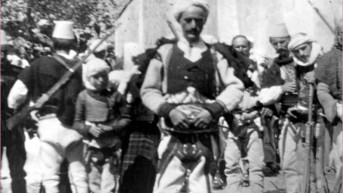
Byron often depicted Albanian traditional attire in his verses; perhaps it was inevitable, given that he had an Albanian mistress.
At the end of the 19th century, journalist Edith Durham learned the Serbian language and wrote the book "Through the Lands of the Serb" in 1904.
After being an ardent admirer of the Serbs during the anti-Austrian and pro-Yugoslav phase, Durham closely identified with the Albanian cause and advocated for the unity and independence of the Albanians. She then extended her stay to Albania, about which she wrote a book in 1908, and remained there for the next 20 years. Initially, she worked for the British Foreign Office as a part of British policy in the Middle East. Later, she claimed to have come to Albania on the advice of a doctor who said that the trip would be good for her nerves, but Albania wasn't what she had in mind. She explored the country from one end to the other in the period just before the war, traveling alone or with a single servant. The Albanians didn't know how to handle this unusual, stocky woman; eventually, they decided to treat her as an honorary citizen. When British soldiers passed through the eastern part of Albania during the war, they discovered that when the Albanians said: "tur-ham", they meant "passport" ("durr-ham"). Durham made some obscure claims about Albanian origins. In her book "High Albania" (London: Edward Arnold, 1909), she argued that certain highland tribes had come from Bosnia during the Slavic migrations and sought refuge among Illyrian tribes. Durham was vehemently against the inclusion of Kosovo and Metohija in Yugoslavia.
"She was sharply criticized by supporters of the Yugoslav state, who supported the inclusion of Kosovo, inhabited by the Albanians, in Yugoslavia. According to the US scholars Thomas Kashman and Stjepan Mestrovic, her eccentric personality and constant lobbying activities made her disdained by the British Foreign Office. Becoming increasingly anti-Serbian after World War I, she condemned the "Serb rabble" because they "did not create Yugoslavia but achieved their original goal of creating Greater Serbia... where the majority of people live under much stricter rule than before".
Great Powers' fear of Serbia and Greece taking the spoils
When Edith Durham first encountered Albania, national feelings in this country were just awakening. Austrian Professor of Jewish origin, Norbert Jokl, had collected Albanian words in a dictionary at that time and compiled a grammar; this convinced literate Albanians that they could indeed be a nation. After much debate, the Latin alphabet was chosen and given preference over Greek or Arabic script. Albanian books were first printed; folk stories, heroic folk songs, historical legends, and poetry were recorded. Albanian schools were opened, often hidden in remote areas. Although Turkish rule was relatively easy, many Albanians were content to work for the Ottoman Turks, either as soldiers or administrators. When the Young Turks attempted to revive the Ottoman Empire just before the outbreak of World War I, their harsh repressions had the opposite effect: it led to national awakening, rebellions, and uprisings aimed at liberating the country from Ottoman rule. The large Albanian diaspora enthusiastically supported the rebels.
The British desired Albanian independence and created it in 1912, claiming that it was a matter of "national survival" when it seemed that Albania's neighbors - Greece and Serbia - might use their victories and the expulsion of the Ottoman Turks from Europe to divide the spoils. Of course, this did not suit the great powers who feared a new Balkan war that would jeopardize their interests in Turkey; thus, they created Albania as a separate state in 1913.
Its borders were drawn by an international commission whose work was accompanied by the objections of Serbs and Greeks.
In November 1912, after the outbreak of the First Balkan War, "The New York Times" turned to Crane for his opinion on the situation in the Balkans as the "greatest US authority on that part of the world" and regarding independence for Macedonia and Albania. Crane spoke about Bulgaria, Serbia, and Albania.
Crane took a pro-Bulgarian stance in this matter but also supported Serbian interests. He first recalled the time of the Treaty of San Stefano when two US anthropologists were sent to Bulgaria to prepare the determination of the borders of "Greater Bulgaria" "on an ethnological, not geographical basis". This included "the greater part of Macedonia".
This proposal went to the Congress of Berlin, but due to the "desire of the so-called Great Powers, only the northern part, one-third, gained freedom, while the rest, Eastern Rumelia and Macedonia, were returned to Turkey". Crane emphasized that if the "proposal for an enlarged Bulgaria had been accepted, all massacres in the previous 34 years would have been avoided, and lasting peace would have reigned in the Balkans".
After the uprising in Eastern Rumelia and its accession to Bulgaria, which doubled the country's territory, only Macedonia remained in Turkey, "where perhaps the purest Bulgarians live". Crane noted that "Macedonian Bulgarians" had always played a "significant role in the Bulgarian Government".
Crane stressed that the "Young Turks" in Macedonia were worse in every respect than the "old Turks", spreading violence and terror throughout the country.
Crane compared Bulgaria's rise to Japan
Bulgaria's ascent since 1878 was as magnificent as Japan's. Breaking free from 500 years of rule under one of the greatest tyrannies in the world, Bulgaria became a first-class young republic, surrounded by powerful neighbors who did not want its success and obstructed it at every turn. However, Bulgarians fully justified their experiment in independence. They are excellent traders, among the best in the business, good soldiers, diplomats, and administrators. They have universal education, and their views are entirely American", Crane concluded.
He supported this by stating that "practically all the men who lead Bulgaria come from Roberts College", and their wives "always graduate from the American College for Girls in Constantinople". All of them speak English with an American accent. Their houses, their clothing, and their libraries are American. They can directly integrate into American society, and no one would suspect they are not Americans. There is nowhere a more distinguished people", Crane concluded.
Regarding Serbia, Crane considered Austria's attitude towards it.
"Serbia is right in the center of the Balkans, cut off from the Adriatic and from Austria, and economically dependent on Austria. Austria keeps Serbia in absolute submission, and when it wants to show any pressure, it boycotts Serbian products. This is, of course, an unsustainable position. Therefore, for Serbia, it is a matter of life and death to gain a port so that its territory can access the Mediterranean for the export of its meat products. It is unconvincing that the major European powers can enter a great war to help Austria prevent Serbia from gaining economic independence", Crane said.
As for Albania, he said that it was a "strong nation" determined to gain independence. He noticed that they were nationally homogeneous, regardless of whether they were Muslims, Orthodox, or Catholics. He estimated that if Albanians secured their freedom, they would progress as rapidly as the Bulgarians. He concluded that it was "impressive how these young states quickly moved away from Turkish rule".
An event like the rapprochement between Serbia and Bulgaria in the turbulent period that was the early 20th century could not pass without the involvement or at least the influence of world powers. Russia and France looked favorably on this alliance, while Great Britain and the Central Powers, Austria-Hungary and Germany, viewed these events differently.
Bulgarians seek Macedonia
"The negotiations between Serbia and Bulgaria were difficult. Bulgarians sought Macedonia, but Serbia did not agree to it, and the negotiations even came to a halt. Nevertheless, Milovanovic and Geshov reached an agreement, and they had to hold the meeting in a railway carriage between Belgrade and Lapovo in utmost secrecy so that Austria-Hungary would not sabotage the agreement.
The agreement was signed on March 13, 1912, and consisted of two parts, a general and a secret annex. The general part was of a declarative nature but had significant political weight. In this part, the states guaranteed each other's independence and territorial integrity, as well as assistance in case of conflict with a third party. However, the secret annex, which contained provisions on the offensive action against the Ottoman Empire, was much more important. It also resolved the division of spheres of interest in Macedonia. Serbia received an undisputed part to the north and west of the Sharr Mountains, and Bulgaria received a part to the east and south of the Struma River. The area in between was to be either divided or granted autonomy and in case they could not reach a final decision, the judgment was to be made by the Russian Tsar", historian Dr. Miroslav Svircevic revealed historical details of this agreement.
Already in May, during a military convention, open discussions about the war began, and other Balkan countries became increasingly interested in the Balkan League. Greece was especially eager to join the alliance with other Balkan countries against Turkey due to Italy's attack on North Africa and the conquest of Rhodes and the Dodecanese, with Greek Prime Minister Venizelos being a strong supporter of the Balkan Agreement. Thus, the agreement between Serbia and Greece was signed on May 29, 1912, and it was very brief, with the issue of Macedonia not even being considered. The Balkan allies were deeply divided in their approach to Macedonia. Serbia and Greece were against Macedonian autonomy, while Bulgaria supported it, hoping to gradually annex it as it had done with Eastern Rumelia. The final agreement was signed by Serbia and Montenegro.
"Negotiations between Serbia and Montenegro were interrupted, but with the mediation of Bulgaria, they resumed, and the agreement was signed in Lucerne in September. Some would say it was done in a Serbian manner", Svircevic says.
Montenegro did not have any separate treaties, but there was an agreement with Serbia. Trotsky referred to Macedonia as the "Balkan Poland" which had its first division, and probably further divisions would follow.

0 comments