
FEUILLETON Americans, Serbs, and Albanians in the Balkan Wars and World War I (5)
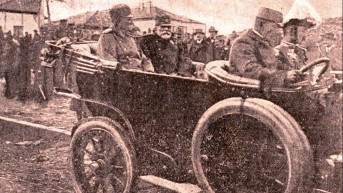
Writing for Kosovo Online: Dragan Bisenic, a journalist
"The Role of the US President Taft in the Balkan League"
While in Serbia, Trotsky, despite the prominent pro-Russian enthusiasm of the leading politicians and the masses, found only a few people who spoke Russian. Or as he wrote, "The number of the Serbs who spoke Russian could be counted on the fingers of one hand".
He noted the existence of various progressive factions, one of which, led by Zivojin Peric, wanted Austria to "absorb Serbia". Newspapers called "Mali Zurnal" did not hesitate to engage in scandals, fabrications, and slander, alongside the dissemination of pornography to influence public opinion. However, they only sold 10,000 copies. On the other hand, Vladan Djordjević and his newspaper "Stampa" represented the "Obrenovic line".
In May 1912, the Albanian "Hamidiye" rebellion, aimed at restoring Sultan Abdul Hamid to the throne, expelled the "Young Turks" from Skopje and pushed them toward Bitola, forcing the "Young Turks" to grant significant autonomy to this region in June 1912. Serbia, which helped arm Albanian Catholic and "Hamidiye" insurgents, sent its secret agents to prominent Albanian leaders because Serbia, along with other Balkan states, was already in discussions about an alliance to drive Turkey out of the Balkans. The formal agreement between Serbia and Montenegro was signed on March 7, 1912.
Bourchier did the job
Bourchier traveled to England in July 1912. When the Balkan League was practically already formed, even though the details of the military agreement were specified somewhat later. However, he had already completed his intermediary mission, so there wasn't much more to be done.
In early autumn, things worsened between Turkey and Bulgaria, as well as Turkey, Serbia, and Montenegro on the other side. There was a dispute over borders that resulted in a series of massacres, which did not improve the situation at all.
But nothing happened until the end of September when large Turkish forces, assembled near Adrianople, raising fears of an invasion of Bulgaria. In the end, the four states mobilized one after the other on September 30, 1912.
On the same day, George Moses resigned and returned to the US. His mission was complete.
For Mabel Grujic, it was clear: "The connection between the Balkan countries was undoubtedly the result of their belief that Ambassador Moses acted in accordance with the instructions of his government because, at that time, no diplomat would take such an initiative in such significant European difficulties without instructions from his superiors. In this case, it was President Taft", she stated in a letter dated November 17, 1950. She added that when she had pointed out this fact to President Taft during their meeting at Yale in October 1912, he had just smiled.
Bourchier went to Sinaia, hoping to achieve an agreement between Romania and Bulgaria to secure Romanian "friendly neutrality" during the upcoming war. He received approval from the Romanian Government.
One contributing factor to the Balkan War was the war between Turkey and Italy. Peace was reached when it became clear that the Balkan War was imminent. However, if the peace had lasted, Italy would inevitably have sided with the Balkan states and might have become involved in a war with Austria. Naturally, making peace was a significant blow to the Balkan League, especially due to the operation of the Italian fleet. However, the entire task of the blockade now fell to the Greek fleet, whose effectiveness was unproven.
The allies kindly asked Turkey for reforms in Macedonia and guarantees for their implementation. Turkey did not respond. War followed immediately, and King Nikola led the way.
He did so at his own discretion, and Athens and Sofia followed.
Nikola was determined to go to war. When the great powers intervened, he thought that an agreement could be reached through negotiations, which was the last thing he wanted. He exchanged messages with Venizelos and Bourchier, unequivocally confirming that he was going to war to free the Balkan Christians from Turkish slavery.
Proclamation of King Peter I
King of Serbia, Peter I, issued a proclamation to the Serbs on October 18, in which he expressed support for both Albanians and Serbs:
"The Turkish Government has shown no interest in fulfilling its obligations toward its citizens and has been deaf to all proposals and complaints. Matters have gone so far that no one was satisfied with Turkey in Europe. This has become unbearable for the Serbs, and Greeks, but also for Albanians. With God's blessing, I have ordered my heroic army to begin a holy war so that we may breathe freely and work for a better future. In Old Serbia, my army will meet not only with Christian Serbs but also with Muslim Serbs who are equally dear to us, and furthermore, with Christian and Muslim Albanians with whom our people have shared joys and sorrows for 13 centuries up to now. To all of them, we bring freedom, brotherhood, and equality".
The Serbian Army was the first to enter Ottoman territory inhabited by Albanians in October 1912, as a part of the military campaign during the First Balkan War. The Kingdom of Serbia occupied a large part of the land inhabited by Albanians, including the Albanian Adriatic coast. Serbian General Bozidar Jankovic commanded the Serbian Third Army during the military campaign in Albania. The Serbian Army faced strong guerrilla resistance led by leaders such as Isa Boletini, Azem Galica, and others. During the course of the war, Serbian forces persuaded prominent figures and tribal leaders to sign a declaration of gratitude to King Peter I Karadjordjevic for the "liberation by the Serbian Army".
Continuation of the series: "Americans, Serbs, and Albanians in the Balkans and World War I" coming tomorrow.
Tomorrow, the continuation of the feuilleton "Americans, Serbs, and Albanians in the Balkans and World War I"

0 comments