
FEUILLETON: Dissolution of Yugoslavia, NATO aggression, and the seizure of Kosovo (5): Interregnum as an excuse
Writing for Kosovo Online: Miroslav Stojanovic
Ludger Vollmer, State Secretary in the Ministry of Foreign Affairs, writes in an article titled "Easter when bombs were falling," how the German delegation, led by Schroder and Fischer (he was also a part of the delegation) on the plane, on their way to Washington, considered avoiding commitment to entering the "Kosovo war" during talks with Bill Clinton. And as an explanation (excuse), they could use the political intermezzo: they did win the elections, but at that moment (October 8, 1998), they had not taken power yet...
It was as if the "interregnum" offered a way out - the old outgoing government, the new one not in power yet, who can make political decisions at all? And can the outgoing government bind the new government when it comes to such an important issue? Formally yes, but politically?
Because of the "unclear situation at home," it was necessary, therefore, to ask the Americans (Clinton) for "understanding" for Germany to "stay out of the conflict." The command to activate air strikes "if the expulsion of Kosovo Albanians is not stopped" (ACTOD) is valid "but we Germans stay out of it." The US Ambassador to Germany John Kornblum was also consulted, who was also on the plane. The Ambassador considered such an option "thinkable."
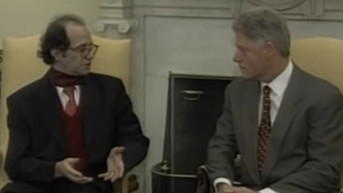
After lunch at the White House, a longer conversation followed, "in private" between Clinton and Schroder. Although he did not inform the members of the delegation about the details and content of the conversation, the chancellor left the impression that the US President "understands German indecision."
Referring to the interregnum was a trick, admits Vollmer. Politically decisive for the survival of the new (ruling) coalition, which the "Kosovo case" put, from the very start, before great challenges, threatening to collapse before it practically "took off."
As soon as they returned to Germany, shock followed: Americans demanded a clear decision. Immediately. With the explanation: NATO without Germans won't work. The Red-Green coalition cannot get away with it so easily...
Although he participated in the negotiations on behalf of the Greens, precisely in that part of the agreement concerning foreign policy, Fischer's "right-hand man," State Secretary Vollmer, claims (in 2012) in the mentioned text that he really did not know that Schroder had committed, first to Kohl (immediately after the elections) and then to Clinton (during that meeting in the White House) that Germany would (unconditionally) "participate in a possible military intervention." NATO's aggression. For him, and for most others who were involved in creating the coalition, "it was a complete revelation."
Regarding this matter, Vollmer notes: "For the objective state of affairs, this circumstance is very significant. But not for the question of who politically exploited whom. Nor where the truth lies in the feverish search for the right policy towards Kosovo."
In the decisive debate in the Bundestag on October 19, 1998, Fischer explicitly declared his support for a NATO operation. State Secretary (also from the Green Party) Vollmer, he says, warned that German participation in it would be, without a "clear conclusion of the Security Council, contrary to international law."
The pacifist wing (still) of the Greens received the news of the Milosevic-Holbrooke agreement with relief, whose implementation was supposed to be accompanied and monitored by the Organization for Security and Co-operation in Europe, OSCE.
The Greens had been advocating since the end of the Cold War for the OSCE to take on, instead of the Western military alliance, a "central security role." However, NATO strategists deliberately undermined the work of the OSCE, notes Vollmer, "to prove that NATO alone is capable of 'heavy lifting'."
Only the moment for NATO to really start its "heavy lifting" was awaited. And - the infamous Racak incident occured!
The news that the Serbs, in an even more infamous interpretation by the US general (with a problematic biography) Walker, apparently deliberately brought to the head of the (civilian) Verification Mission, "committed a massacre against the Albanians," arrived at the moment when the new German Foreign Minister Fischer was consulting with the top officials of the ministry about the principles of the "new (post-Kinkel) foreign policy". And - the alarming news changed the topic.
Vollmer claims that he immediately launched an initiative for a "comprehensive conference on the Balkans" to "prevent war". His boss, Fischer, promptly got to work.
On the second day of the conference, he returned "exhausted and satisfied". The holding of the conference was agreed upon, and the Americans supported it.
However, for their consent, the Americans demanded a "high price" - if the conference failed (and they would, as it turned out, do everything to make sure it did), the Germans must inevitably participate in a military operation...
In order for the planned conference to be "treated favorably", Bonn entrusted the organization of the conference (formally and officially convened by the Contact Group) to Paris. The new government, namely, was convinced that Germany would not be a "suitable" and acceptable host because of "what Kohl and Genscher did", namely the recognition of Slovenia and Croatia.
Thus, "Rambouillet" was "born", a sinister symbol for us, as has been extensively written about, at this place, in recent days. Rambouillet, whose end and demise were a prelude to the NATO aggression. With German participation in it.
In Bonn, they firmly believed, like the experienced diplomat Wolfgang Ischinger (the initiator, incidentally, of the idea to solve the insoluble "Kosovo problem" according to the formula of the 1972 agreement between the two Germanys), that "it would all last only a few days". It turned out that NATO strategists, says Vollmer, "naively and wrongly assessed Milosevic".
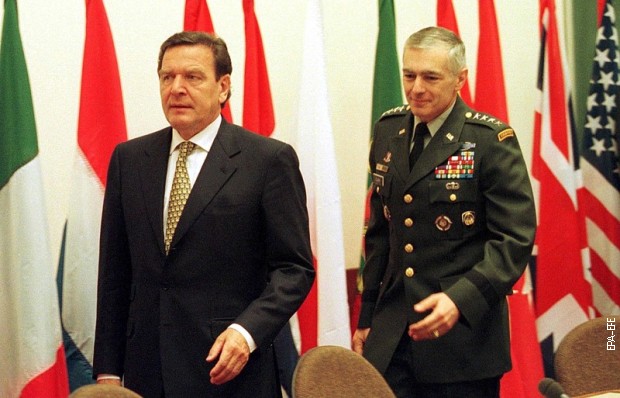
The Germans jumped into the war lion's den without "ever knowing the plans and objectives of the airstrikes". The Americans did not allow, notes Vollmer, "them to see the cards". Once again, says Vollmer, the "German security dilemma" came into play: "We depend on transatlantic partners, and we have no influence on making strategic decisions."
To be continued tomorrow: Pacifists as warmongers
0 comments