
FEUILLETON: Dissolution of Yugoslavia, NATO aggression, and the seizure of Kosovo (4): The seizure of the Serbian province
Writing for Kosovo Online: Miroslav Stojanovic
How did Germany, by participating in the NATO aggression (1999), embark on a war against Serbia and the Serbs (alone) for the third time in the (Twentieth) century?
That's how it started. The government of conservatives and liberals, with Chancellor Helmut Kohl and Foreign Minister Hans-Dietrich Genscher, began in 1991, albeit with some hesitation, to dismantle Yugoslavia, recognizing the secessionist republics of Slovenia and Croatia, decisively and with destructive energy.
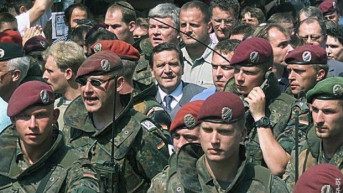
Kohl's and Genscher's successors, Social Democrat Gerhard Schroder (Chancellor) and (Green) Joschka Fischer (Vice Chancellor and Foreign Minister), in 1999, without hesitation, rallied under the war banner of US President Bill Clinton, in an even more destructive undertaking: seizing the province of Kosovo and Metohija from the (home country) Republic of Serbia.
What really happened (and was concealed) before the bombers of the Western military alliance embarked on their three-month destructive campaign against the Federal Republic of Yugoslavia, practically against the Serbs and Serbia?
In this case, as with the fatal Rambouillet, the pieces fit together like in Rashomon, often very contradictory. Even according to the German sources. And with one fact: Srebrenica was, in everything, used and most abused...
The unveiling of a truer picture and more reliable facts about what happened behind the scenes, and why, is a task for future researchers. When secret documents from various archives are finally disclosed. Like those recently launched into the media and political orbit by the Wilson Center in Washington about the German role (and guilt) in the breakup of Yugoslavia.
Then it will be more reliably determined whether Kohl's successor on the chancellor's throne, Schroder, as he claims, trying to justify his decision to lead the country into war, making a radical turn and departure from electoral and programmatic promises, entered into an already given obligation. And that he had no other choice. Without great drama and political upheavals with the (too)powerful ally across the Atlantic.
It sounds truly paradoxical that this was done by (until then) sworn pacifists, social democrats, and ecologists: they, as the opposition, fiercely criticized the (visible) militarization of the foreign policy of the previous government.
In memoirs published in 2006, Gerhard Schroder mentions a meeting he had with his predecessor, the "eternal chancellor" (who ruled for a full sixteen years, one day longer than also "long-lived" Angela Merkel) Helmut Kohl, after winning the parliamentary elections at the end of 1998, but before his official (chancellor) inauguration.
At that meeting in Kohl's office, Oskar Lafontaine, at that time the president of the Social Democratic Party (SPD) and future finance minister, as well as the coalition partner, leader of the Green Party, Joschka Fischer, were present. The new chancellor (Schroder) told the outgoing one that he would respect what (supposedly) Kohl had committed to - that Germany, if and when necessary, would actively participate in the "Kosovo War." A term that German politicians, and the West as a whole, would use interchangeably for the NATO aggression.
Whether Schroder's explicit statement about assuming the obligation to enter a potential war was indeed unquestionable is brought into question as a dubious alibi by the fact that the man who relinquished the chancellor's throne (an unusual practice in political terms) to another (in this case, Schroder, although he had the right of precedence as the party leader), Oskar Lafontaine.
Lafontaine, in fact, was a fierce critic of the chancellor's war policy. And because of that (among other reasons), twelve days before the start of the NATO aggression, he demonstratively resigned from all positions. Both the party leadership and ministerial positions.
In the book by the most famous of Brandt's "political grandchildren," "The Heart Beats on the Left," Lafontaine angrily remarked: I could not believe that it would be precisely the government of sworn pacifists (social democrats and greens) that would involve Germany in a war for the first time in half a century!
To be continued tomorrow: Interregnum as an excuse
0 comments