
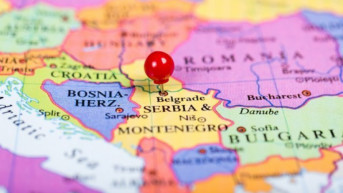
FEUILLETON The foreign factor and the construction of the Albanian nation (13): Borders of Albania
Writing for Kosovo Online: Dragan Bisenic
The culmination of all the efforts that Austria-Hungary, through its "scholars" and true experts, undertook regarding the Albanian issue was the demarcation of territories, i.e., borders. In this endeavor, the Monarchy was not the only one, nor was it isolated. Serbian state leaders of that time believed that the Austro-Hungarian and Bulgarian axis had been formed earlier, despite Bulgaria's participation on the side of the Balkan nations in the First Balkan War.
The Austro-Hungarian and Bulgarian representation of the Serbian population on ethnographic maps used for informing "Europe" acknowledged that Serbs were in the majority only in the northern part of Sandzak, in the minority mixed with Albanians in the southern part of Sandzak, in Metohija and Kosovo, and nowhere else. This was stated by historian and former director of the National Library of Serbia, Jovan N. Tomic, in his book "Austro-Bulgaria and the Albanian Question," published at Gaetz Kohn bookstore in 1913 (page 53).
After he established that the interests of Bulgaria and Austria towards Serbia coincided in many points, Tomic renamed Austria-Hungary to fit this new "coalition" which he called "Austro-Bulgaria".
The interests of both countries sought a smaller and weaker Serbia. Such a Serbia should not hinder Austria in its advance to the south and the conquest of the western regions of the Ottoman Empire, nor should it obstruct Bulgaria from occupying its eastern part. By working against Serbia, Austria worked in favor of Bulgaria, and vice versa.
Austria's desire was expressed in the words of Eugene of Savoy: "If Serbia cannot be Austrian, then it better be Turkish," and was reiterated by Prince Metternich. However, when Serbia was created, no matter how small it was at the time, it forced Austria to change the direction of its policy and face much greater difficulties in its advance than it had anticipated.
Like all young states, Serbia was full of vitality, surrounded by unfreed compatriots or "brethren", as it considered other Slavic nations. Even in the toughest times, Serbia never ceased to be an attractive point for other Serbs. However, in the first phase before the Berlin Congress and the establishment of independent Serbia, Benjamin Kallay, whose mother was from a Serbian but Hungarian Blaskovic family, was on the Serbian side. At the Berlin Congress, Austria had plans in which Serbia would be one of the provinces of Austria-Hungary.
Kallay's initial pro-Serbian ideas aligned with the confederation concepts of small Danubian, Balkan, and Southeast European countries, with the most prominent Hungarian advocate being Lajos Kossuth. When Milivoje Blaznavac entrusted Kallay before the election for the governor with occasionally indulging in similar ideas, believing that one day "Southern Slavs, Hungarians, Greeks, and Vlachs" would create an allied state within some kind of confederation that would "make them, individually and all together, great", Kallay enthusiastically noted in his diary that these were his (Kallay's) "favorite old ideas!" He had once "enthusiastically dreamed about them in his lonely little room" as a young man. Therefore, spontaneously recording his identical thoughts and Blaznavac's, he adds a comment that actually explains the controversial essence of this kind of identity. Blaznavac, namely, shrewdly observes Kallay: "He just overlooks that in this vision of the future, he assigned the main role to Serbia, just as I do not speak about the fact that I assign it to Hungary again". At that point, he sought to prevent Serbia from becoming the center of future unification and the Serbian state "Piedmont". Eleven years after the Berlin Congress, Serbia sought to emancipate itself from Austria.
Tomic stated that on those maps, east of Gnjilane and south of Kacanik, it was presented that the Slavs, somewhat mixed with Albanians, were actually Bulgarians. However, east of Kumanovo and south of Skopje, "all are Bulgarians". These were maps of the future "Greater Albania" and the future "Greater Bulgaria" facing each other on the border of the Kingdom of Serbia, so that the northern border extended far to the east, and as it descended to the south, it increasingly yielded to Bulgaria, encompassing purely Greek regions and approaching the Adriatic Sea.
In December 1912, a book titled "With Victorious Bulgarians" was prepared and printed in London in January 1913 by Austrian officer Hermenegild Wagner, a correspondent for the "Reichspost" newspaper known for his anti-Serbian articles. The elegant and refined English edition was financed by the Bulgarian Government. It appeared in London just when the ambassadorial conference was discussing the borders of Northern Albania, and its preface was personally written by the Bulgarian Prime Minister, Ivan Geshov.
Geshov stated how he had been sentenced to death by the Porte.
"After many futile attempts to reach an agreement with the Ottoman Porte, until the entire Bulgaria was convinced that any agreement with the Turks was impossible, the condemned captive of 1877 took a step that the entire Bulgarian nation greeted with enthusiasm. He declared war for a great cause - to rescue millions of poor people from destruction and to expand the borders of freedom and civilization," the Bulgarian Prime Minister wrote. The book included a map of the Vardar battlefield. On that map, which was attached to pages 94 and 95 and had no connection to the book's topic, the ethnic composition of the Serbian, Bulgarian, and Albanian populations was presented, as desired by Austria for the creation of Greater Albania and Bulgaria's desire for the creation of Greater Bulgaria," Tomic stated.
They would border Serbia, extending south, south of the Sar Mountain, and up to Skopje; Bulgaria's borders would go towards Kicevo and Ohrid, descending to Kostur. With this map, Bulgaria, which refused to officially sign the Memorandum of the other allies on the borders of Northern Albania, unofficially, in a disloyal manner, sought to aid its older ally within the Balkan League.
It aimed to support the proposal for the borders of Northern Albania submitted by the delegates of the temporary Albanian Government, sent to London at the expense of Austria. The first delegate of the Bulgarian Government, Danev, wished to realize his plans and create Greater Albania. The stay of the Albanian delegation in London was financed by the Austro-Hungarian Ambassador in London, Count Mensdorff, with £150 for each delegation member. (H. Löhr, Die Gründung Albanien: Wilhelm zu Wid und die Balkan-Diplomatie der Großmächte, 1912-1914, Frankfurt am Main – Vienna 2010, 56-57.)
This map was made only for the English edition and for the London Conference, as it is not present in the French and German editions that appeared after the conference decided on the northern and eastern borders of Albania. Representatives of the six great powers decided on the new borders and the balance of power in the Balkans from mid-December 1912 to August 11, 1913. The conference itself was exceptionally informal, thanks to the fact that the representatives of Austria-Hungary, Russia, and Germany, Counts Albert von Mensdorff and Alexander Konstantin Benckendorff respectively, or Prince Karl Max Lichnowsky, were relatives, and the advisor to the Austrian-Hungarian delegation was the frequently mentioned Austrian consul in Shkodra, Theodor Ippen.
The end of the feuilleton
0 comments