
FEUILLETON The foreign factor and the construction of the Albanian nation (3): Pashko Vasa and the emergence of 'Albanianism'
Writing for Kosovo Online: Dragan Bisenic
Pashko Vasa and Semseddin Sami Fraseri played an exceptional role in the creation of the Albanian nation. Vasa addressed this issue in his book in the French language titled "The Truth about Albania and the Albanians: A Critical Historical Study". He tried to make it clear to his compatriots that religion does not define nationality and called for all areas inhabited by the Albanians to unite into one vilayet, advocating for Albanian participation in self-administration within the Ottoman Empire.
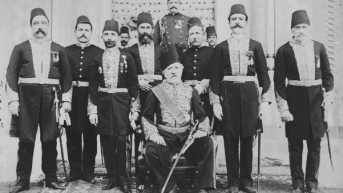
Turkish scholar Ugur Bahadir Baryaktar disputed many of Pashko Vasa's findings (pictured sitting in front of his supporters), particularly his connection of the Albanians with the Pelagian-Illyrian theory, in which Vasa was a prominent figure in the Albanian national movement. Baryaktar states that Vasa was a "political archaeologist" during a time when archaeology was scarce.
As a descendant of the Mirdita tribe in Albania and a loyal bureaucrat in the Ottoman administration, Vasa was born in 1824 in Shkodra, northern Albania. Being a Roman Catholic, he had a deep interest in studying language and literature.
"Mythological" people
His stay in Rome was abruptly cut short due to the revolutionary wave in Italy, and eventually, Vasa was expelled to Istanbul. Equipped with republican and anticlerical views, though impoverished, Vasa eventually gained a position in the Ottoman bureaucracy. He also contributed to the creation of the alphabet for the Albanian language by publishing the brochure "L’alphabet latin appliqué à la langue albanaise" (The Latin Alphabet Applied to the Albanian Language).
This volume was indeed one of the first publications undertaken by the Society for the Publication of the Albanian Script, whose distribution was also encouraged by the Ottoman authorities. After its republication in French in Paris, the pamphlet was also published in English in London and German in Berlin, thanks to the Ottoman consul in Paris. The tome was later translated into Albanian, Ottoman Turkish, and Greek and finally into Arabic (1884) and Italian (1916).
On the other hand, the political reaction of the Albanians, in line with the activities of the Albanian League, adopted two memoranda against the division of Albania, which were sent to the great powers and in whose creation Vasa was involved. The memorandum on Albanian autonomy, submitted to the British consulate in Istanbul in March 1878, was probably written by Vasa personally; in the same spirit, another memorandum was written by prominent Albanians in
Istanbul and sent to Bismarck and Count Gyula Andrassy, the head of the Habsburg delegation, in June 1878, and Vasa was among the signatories.
As Albania was barely known in European circles, Vasa published "The Truth about Albania and the Albanians" in 1879. Territorial claims by neighboring states, especially Greece, were ongoing, necessitating the legitimate existence of Albanians.
Classifying three types of nations in history, Vasa characterized the third as nations whose origins date back to "mythological times". By including Albanians in this category, he explicitly stated that they consider themselves a nation. Therefore, Vasa established the existence of his compatriots and promoted their differentiation from the Greeks. The impact of the crisis on Vasa was enormous, given that in the memorandum submitted to the British consulate, he supported the possibility of an "alliance with Greece against the Slavic threat".
Rapid changes in the development of Balkan politics forced Vasa to produce variable treatises burdened with political goals. Greek irredentism posed an immediate threat in 1879 as the Conference did not make a final decision on Greek claims to southern Albania. The commission led by General Suchos and Ahmed Muhtar Pasha initiated discussions in February 1879. Albanian alliance activities were intense and operated by submitting petitions to the Great Powers, while Vasa, on his part, evidently served the Albanian cause by writing his pamphlets.
"The Truth about Albania and the Albanians" can now be summarized in a few words: Albanians differed from Greeks. Considering the date of publication in such a context, it is understandable that Vasa barely mentioned anything related to the Slavs. After the political upheavals of the Albanian opposition, in which Vasa was deeply involved, he was appointed as the governor-general of the Lebanese Sanjak in January 1883. It was a mysterious exile: while Vasa was banished to a distant place, the palace promoted him and granted him the title of Pasha. Life in exile was not easy for Vasa, as he lost his second wife, Katerina Bonati, in 1884 and his surviving daughter in 1887.
Unpleasant events did not prevent Vasa from producing Albanian-oriented philological and literary works. Reflecting once again on literary works, he published in 1887 "Grammaire albanaise à l’usage de ceux qui désirent apprendre cette langue sans l’aide d’un maître" in London. Three years later, Vasa, under the pseudonym Albanus Albano, published the novel in French "Bardha de Témal, scènes de la vie albanaise" in Paris. When he died in Lebanon in 1892, where he continued to serve as the governor of the province, the Albanian national struggle entered a relatively peaceful period.
To present his views on the Albanians, Vasa divided his book into three chapters consisting of a total of fifteen sections— the origin of the Albanians, what they became, and how they live.
"Older" than Ancient Greeks
Accordingly, the first chapter addressed the ethnogenesis of the Albanians: Pelasgians, ancestors of the Albanians according to Vasa, differed from the Greeks and preceded them upon arriving in Greece. The second, building on the first in a historical context sheds light on prominent figures of Albanian origin in the quest for the Golden Age. Finally, the third, consisting of five parts, dealt with how the Albanians lived at that time.
Highlighting the "presumed" characteristics of the Albanian personality as well as social life, Vasa also criticized the contemporary policy of the Ottoman administration. As the following sections advance the discourse that Vasa meticulously constructed, it was a certain agenda for him to abound in alleged evidence in terms of recognizing the Albanians among European and Ottoman readers. He presented the Albanians as one people, united by language, history, and customs, thereby downplaying the significance of aspects that set Albanians apart, namely geography and religion. Resorting to Albanianism, to deal with religious differences, was aptly demonstrated, paving the way for the recognition of Albanian rights. While Vasa attempted to contextualize the underdevelopment of the Albanians, he blamed the Ottoman Empire, largely because the officials sent by the central administration did not know Albanian customs, language, and practice, for the Tanzimat reforms that were incompatible with Albanian lands. Therefore, in line with the politicization of Albanianism at the time, Vasa demanded the formation of a unified Albanian administrative unit (composed of the provinces of Shkodra, Ioannina, and Kosovo), explaining that "the division of Albania into three vilayets was already sufficient to completely destroy the beneficial action of administrative unity without worsening the heterogeneous mixture".
Baryaktar assesses that in his "quest for the Golden Age", which Anthony Smith considers functional for the appropriation of antiquity, Vasa wanted to act as a "political archaeologist", so he "excavated" finds of an identity to which he felt he belonged and ultimately brought a "mythical-historical discourse in line with his nationalist ethos".
Defining myth, however, is no easier than defining a "nation", but one must be cautioned about the risk of "mythification of myth". As the boundary between historical universality and myths becomes blurred, the search for truth can turn into deciphering myths. As the well-known quoted phrase, "the truth of one historian becomes the myth of another", reveals; myths are, in this sense, shared truths necessary for the preservation of the group. In other words, ... a myth is a special set of ideas with moral content that the community tells about itself as a narrative. In this sense, a myth can, but does not have to be connected to historical truth, although those who rely on the narrative generally believe that it is. At best, a myth is a way of organizing history so that it makes sense for that specific community.
Continuation tomorrow: Kallay's mission to transfer the "spirit of the West" to the Balkans

comments