
FEUILLETON The foreign factor and the construction of the Albanian nation (7): The creation of the Myth of Skanderbeg
Writing for Kosovo Online: Dragan Bisenic
Thalloczy presented his manuscript in German in the autumn of 1898. After a few months, it was published in Albanian in 600 copies. The author was not explicitly named; it was only stated that the author belonged to the Gheg tribe. The place of publication was listed as "Alexandria", and the publisher was "Skenderija". The information in the current publication mentions Vienna and Adolf Holzhausen. The Vienna National Library identifies the author as Lajos von Thalloczy.
For Krisztian Csaplar Degovics, this is an important, conscious, but anonymous contribution to the national construction of the Albanians and the scientific foundation of Albanian historical consciousness by a scholar who had nothing in common with the Albanians, neither linguistically nor in terms of origin, and who did not want to belong to them. The book, often based on the literary works of "national revivalists", especially Pashko Vasa and Naim Frasheri, and written in an easily readable style, became popular among followers of the emerging national movement, although the exact impact on individual representatives is not yet known.
Although there is no evidence, there is a great chance that the main content elements of the book were used in the aforementioned programmatic text by Shamsuddin Sami Frasheri from 1899. In any case, this is a source of the most important historical myths of the Albanians, such as Illyrian origin, the cult of Skanderbeg, and the empire of Ali Pasha of Tepelena as a state. The lack of an independent state tradition with the lives of noble families or individual prominent figures was replaced, in accordance with Thalloczy's view of Hungarian history that he adopted, by the idea that the continuity of statehood is primarily the result of the stability of Hungarian noble families and the tradition they supported.
The work covered the history of the Albanians in 4 chapters: 1) the Illyrian period (167 BCE), 2) the Roman period (167 BCE – 626 CE), 3) the Middle Ages (626 – 1479), and 4) Ottoman period (1479 – end of the 18th century). The discovery of the third edition increased knowledge about this work. It was published by the Franciscan publishing house in Shkodra in 1939, and the book was signed by Zef Zurani, a merchant and banker from Shkodra. Zurani, in fact, had very close relations with Ippen and Thalloczy. Ippen suggested him to be the translator of the book into Albanian. Stefan Zurani (or Zeff Curani in Albanian), born in Albania, was an official of the Osterreichischer Lloyd shipping company living in Trieste. Zurani played an important role in the Austro-Hungarian plans in Albania.
He headed the Organizational Committee of the Albanian Congress in Trieste. The Trieste Albanian Congress (albán kongresi alshkiptar e Triestes) was a meeting of representatives of Albanian emigrants held in 1913 between March 1 and 4, with the financial and moral support of the Austro-Hungarian Monarchy, in Trieste. The assembly was convened to promote international recognition of Albania, which declared independence at the session of the National Assembly in Vlore on November 28, 1912. The organizing committee included Hil Mosi, Hamdi Ohri, Mazhar Toptani, Stefan Ashiku, Filip Kraja, and Armunka Epaminonda Balamači. In February 1913, Zurani informed his Viennese patrons that by March 1, an all-Albanian congress would be organized in the city on the Adriatic coast, and invitations had already been sent to their compatriots and emigrants. The plan received the interest and approval of the Austrian Ministry of Foreign Affairs, and the Monarchy even took on the financial burden of the Congress.
The year of the first publication of the book (1898) holds symbolic importance. In 1896, the monarchy initiated the first major campaign towards the Albanians, aimed at seriously awakening and strengthening Albanian national sentiment, even among Muslim Albanians. The costs of the first edition were covered by the joint Ministry of Finance of Benjamin Kallay, and the invoices were issued in the name of Lajos Thalloczy.
The aim of this book was to familiarize Albanians with their history in a popular manner and to support the beginning of their nationality. The style was uniform to be accepted by all Albanians, regardless of their religion, both in form and content. Christian-Muslim contacts and relations between Tosks and Ghegs were to be clarified, creating the content of shared knowledge. In retrospect, many similarities can be found between Thalloczy's history book and the views on the history of Aleks Buda, the main representative of communist Albanian historiography. The choice of words and style was based on epic poems, which replaced the lack of writing. The work was written in the first person plural ("our ancestors", "our country", etc.) and brought together the "stories" of Christians and Muslims. Unity was created by uniting Albanian values - origin and descent (Albanian blood), native language, Albanian virtues (heroism, patriotism, Albanian heart), and thousands of years of shared history. Albanian history was periodized for the first time, mentioning points of connection between Albanian and Hungarian history (the presence of Illyrians in the Carpathian Basin, Louis I’s campaign to Naples, battles of John Hunyadi and Matthias Corvinus against the Ottomans).
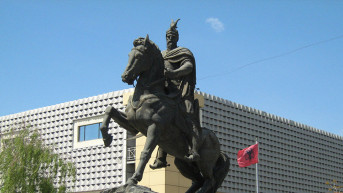
Regarding the Roman period, it emphasized that Illyria provided the best troops and legions in the empire, and talented generals from this province and soldiers were crucial guarantees for the existence of Rome. Unlike the trend in Balkan historiography, there was no backward projection of current ethnic conflicts for several centuries. The myth of Skanderbeg played a central role as the goal was to create an exemplary national hero. Although he was a popular literary figure among Italo-Albanians, mainstream Albanian culture had almost completely forgotten him.
Representatives of the Rilindja, such as Frasheri and Fan Noli, revived him for the Albanian national issue because he was a well-known historical figure in Europe. In Thalloczy's book, the most important elements of his cult were written: Skanderbeg as the creator of medieval, independent Albania, as the builder of a "modern" state, as a representative of European culture, as the last bastion of Europe's defense against the Ottomans. What was crucial was the Catholicization of the aging Skanderbeg, aiming to identify all four religious confessions (Sunnis, Bektashis, Orthodox, and Catholics) with him.
During the Ottoman period, it was emphasized that the local tradition of freedom movements, especially among the Catholic mountain tribes, had survived. Albanians provided the military elite, while Ottoman pashas transferred to Albania from foreign countries and oppressed the Albanian population.
Bushati and Ali Pasha Tepelena were Muslims but not Ottomans. The Gheg family of Bushati united the Albanian regions in the north, and the Toskan Ali Pasha united those in the south. The Albanian issue became an essential part of international diplomatic negotiations in the early 19th century. The Tanzimat era was colored dark: hostile, cruel, and bad Ottoman officials were responsible for increased taxes and the lack of schools and magazines in the Albanian language. The Prizren League, organized by Christians and Muslims, was suppressed by the Porte. However, the history of this league was not described, probably because the book could not be directed against the Ottoman Empire.
It is interesting that Albanian readers were addressed as "dear brothers" who were not familiar with their history and were not aware of their power. They were reminded that they had always lived in independent administrative units within major empires and provided local resistance. The concept of freedom always played a central role for them. The indigenous inhabitants of their territories, alongside the Greeks, the oldest Balkan nation, who raised their children to honor and heroism, were always ready to make the greatest sacrifices for the freedom of their individuality, family/nation, and country. Hence, the awe-inspiring glory of the Albanians in wars. The difference between Ghegs and Tosks is a result of numerous unsuccessful uprisings that forced a part of the people to migrate from their homeland. The ability to unite, regardless of dialects and religions, was demonstrated by historical examples such as the efforts of Ali Pasha Tepelena and Bushati. Despite the change in names, there has been no change in the ethnic character of an area. The change in the overall name of areas inhabited by the Albanians occurred almost unnoticed: Illyrian provinces were called "Arbanas/Arbëria/Arbni" from the 11th to the 14th century, and in the Ottoman period, they were marked as "Shqypni".
"Tosks" was introduced as an independent term in the 14th century, and "Ghegs" in the 18th century. Ethnic self-determination was adapted to the names of countries that changed from era to era: the ancient Illyrians became medieval "arbni/arbri," Ottoman Arnauts, and "shqypetar" in the early modern period. The people's names changed but always meant "we", "Albanians". Regarding the concept of "nation", it was said that the Illyrians were a tribal group, "fs", "vllazni" in terms of people, and in the early modern period and in the sense of a nation. The Albanian term "komb", in Gheg meaning "bundle, tie, knot", became the exclusive term for the nation due to the influence of Sami Frasheri. The labels "Tosks" (first during the Slavic conquest) and "Ghegs" (only from the early modern period) were rarely used in the book. As for Albanian historiography, there are still Muslim-Christian differences in opinions and divergent regional traditions (Albania, Kosovo, Macedonia). The average Albanian citizen has an intensified and irrational emotional relationship with their national history, so criticism of it is automatically perceived as a personal attack. Thalloczy's historical concept has elements that can offer solutions to the paradox of Albanian history and form the basis for reformulating the historical self-portrait of the Albanians.
Continuation tomorrow: Lajos Thalloczy and the construction of the Albanian nation


comments