
Is this the Franco-German plan?
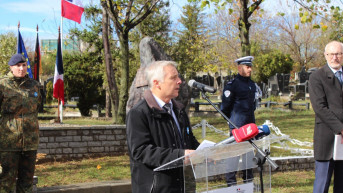
There is something deeply tragic in what the French Ambassador in Pristina did when ordering the relocation of the gravestone dedicated to the fallen Serbian soldiers in the Balkan Wars and World War I at the Dragodan cemetery. This is not only an offense to the Serbian friends and allies of France but more so a renunciation of their own culture and the European civilizational model.
Written by: Milos Garic
These days, many rightfully ask how such a (un)considered move could happen. When you look at the whole thing in retrospect after everything that has been said in the meantime, one of the main conclusions is that this self-inflicted harm by the French is a reflection of a much more serious state, a spiritual and moral defeat into which Europe has sunk in recent decades, and one that cannot be fixed by all those corporate billions earned on stock exchanges worldwide.
Whether by rummaging through other people's cemeteries in the Balkans, Europe is trying to find its long-lost identity, or it is just a habit of the Europe that, in search of the "Holy Grail", destroys and plunders.
I prefer to believe in the Europe of Shakespeare, Leonardo, Newton, Mozart, Kant, Camus, and Sartre, in that old Europe that was the unrivaled guide to the whole world for the past five centuries. Why is it not so today? What are the causes of the European decline?
Until a few days ago, it was indecent even to think about a situation where a foreign ambassador in any city would ask for the relocation of tombstones that have been there for decades because they are bothering him for photography. And then, last week, during the commemoration of the end of World War I, the official representatives of France and Germany in Pristina decided to show the opposite. And we saw, it is possible.
The joint French-German ceremony commemorating Armistice Day, held a few days ago in front of the graves of buried Serbian soldiers in Pristina, who died in that bloody conflict on the side of the victorious powers, among whom were the ancestors of Ambassador Olivier Guerot, showed how shameful running away from the truth can be, and how much danger is brought by rewriting and falsifying history.
Some questions have opened up that speak volumes about the very poor state of today's world, where the concepts of good and evil have been completely mixed up. Freedom, courage, sacrifice, dignity, defense of the homeland, justice. Victory in the struggle for these values. Is it possible that this is no longer important to anyone? What has happened in the meantime? Today, after more than 100 years and all the horrors that have happened in the meantime, this fragile truce in Europe is the most important achievement, but why is the French Ambassador participating in the humiliation of his own nation?
Insisting that, in the name of new, "high" goals, victim and executioner, occupier and defender, winner and loser, are thrown into the same "basket", and thus undeniable historical facts are annulled, has led to the fact that the West no longer has clear coordinates in which it moves, least of all moral ones.
The hard-won freedom of Europe today increasingly resembles a colorful "ice cream advertisement", roles are divided, and everyone plays their own, so the main actors - the French and the Germans - do not want to allow one tombstone to be an obstacle to the whole story. And since the monument is Serbian, it’s even worse for it.
Here you come to a logical dilemma. Why did they have to mark the date that means nothing to the Albanians in Kosovo anyway, and it doesn't mean anything to the Germans because they would prefer to erase it from the planet's collective memory, precisely in that place, at the Serbian cemetery? It could have been organized at the French Embassy or at the monument to William Walker if there were no better options.
The honor guard of Kosovo Albanians from the KSF last year, in the same place and on the same occasion, held a ceremonial guard for Serbian and French fighters, and there was a great commotion in Pristina media afterward. This November 11, the ambassadors found a Solomon solution to satisfy those who do not like historical facts. The showdown with Serbian graves, which has so far been a feature of anonymous extremists throughout Kosovo, has now become the official policy of the authorities in Pristina, which, to make matters worse, has support from the ambassadors of key European countries.
Did Ambassador Guerot explain that the Serbs in Kosovo could not even own their graves? Is this the Franco-German plan?
Are the Serbs guilty because there are no marks of Albanian participation in the Great War throughout Kosovo, and because there are no worthy civilization traces left from Albanian history there? What are the Albanian equivalents of Cer, Kolubara, Corfu, Vido, and Thessaloniki Front?
These are difficult and uncomfortable questions that Mr. Guerot and Mr. Rohde want to answer by changing the perception of reality.
And so, on this occasion, it is necessary to remind that the Serbs, defending themselves in the Great War, with the heaviest price in human lives, won over those who wanted to conquer and dismember them, and there was no truce with the Austrians, Germans, or Bulgarians. It was a heroic victory.
Brainwashing, however, has been going on for a long time, and complete confusion is persistently created in various ways, creating the possibility of imposing new "values" and new "truths". However, the Serbs do not allow imposed demoralization, which hits the center of balance of a people, and through the loss of fighting spirit and energy threatens to lead to destabilization and nullification of man, society, and state.
How many times, in the last twenty years, from various addresses, foreign and domestic, has the sentence been uttered that the Serbs should accept the "reality" and that Kosovo is "lost"? According to some plans, this should have been a done deal long ago. However, the Serbian reality is made of sturdier material.
Therefore, it is important that the gravestone of the fallen Serbian heroes from the First World War, buried in Pristina, remains where it has been all these previous years. To preserve the memory and illuminate the way forward. As the poet said, "Flowers will bloom in the cemetery for some distant generation“.

0 comments