
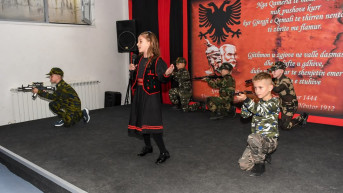
Greater Albanian aspirations intensify: Political messages delivered through elementary school students in Tetovo
Written for Kosovo Online by: Zeljko Sajn
We are witnessing a world increasingly fearful of nuclear weapon use, especially after the latest provocation of Russia by the USA. The Biden administration seems unable to reconcile with Trump’s legacy, while Zelensky, backed by the West, takes military actions that risk plunging the planet into apocalypse. Putin appears prepared for anything, primarily to establish peace—a notion evidently unwelcome to the current Anglo-Saxon leadership structure. Today, we face the most overt nuclear crisis since the Cuban Missile Crisis of the 1960s and the Middle Eastern tensions of the 1990s.
After the Cuban Missile Crisis was resolved between Kennedy and Khrushchev, the American side deemed it a stepping stone toward Kennedy's second presidential term and dominance in the Middle East and Global South, particularly in Indochina, where the U.S. was deeply embroiled in the Vietnam conflict. However, on the night the Cuban Crisis officially ended, Kennedy exhibited no euphoria, almost as if he foresaw trouble on the domestic front. Two years later, in 1963, President John F. Kennedy was assassinated.
Decades after the Cuban Crisis, fear of nuclear weapon use was rekindled by the West and the U.S., obsessed with the "Iranian threat." This was a few years before NATO bombed the Federal Republic of Yugoslavia. Noam Chomsky, a prominent critic of major powers, recorded this period, noting that while Arab citizens disliked Iran, they perceived a greater threat from the U.S. and Israel. Chomsky supported this view with statements from U.S. General Lee Butler, former commander of the U.S. Strategic Command, who said in 1998: "It is extremely dangerous for a tinderbox like the Middle East to have one state [Israel] possessing a powerful nuclear arsenal, as it then encourages others to follow suit."
Thus, after the Cuban Crisis and before the Ukrainian crisis, the most severe threat to global peace occurred in the Middle East, a point highlighted by Butler. However, the Arab League and members of the Non-Aligned Movement reached a consensus to continue advocating for the Middle East to be declared a zone free of nuclear and all weapons of mass destruction. On December 4, 2012, the UN General Assembly voted 174-6 in favor of a resolution urging Israel to join the Treaty on the Non-Proliferation of Nuclear Weapons. Predictably, opponents included Israel, the U.S., Canada, the Marshall Islands, Micronesia, and Palau.
Under the guise of democracy, hypocritical policies thrived, and Western ideology, protected by NATO, grew stronger, aiming to establish a new hegemonic world order outside the framework of the UN, disregarding international law on territorial integrity and sovereignty. Wars ravaged nations with communist ideologies, including the Socialist Federal Republic of Yugoslavia, with the ultimate goal being the dismantling of the USSR and later its successor, Russia, while seizing natural resources to achieve global dominance. Today, we witness conflicts in the Middle East and Ukraine, with Cold War actors now openly engaged in indirect conflict, using Ukraine as a battleground.
Thirty-five years after the fall of the Berlin Wall, Russia is regaining its footing—militarily, economically, and politically—but the formation of a new order based on balance between the Anglo-Saxon bloc and representatives of the East and Global South is still awaited.
At the 16th BRICS summit in Kazan, Putin reiterated his willingness to sign a peace agreement, emphasizing that "no one must threaten Russia." He also expressed a preference for pushing the button to send gas to Europe rather than a different button. Considering that Putin has been offering peace in writing since 2022, while the Anglo-Saxons push Zelensky to reject it—such as Johnson forbidding the signing of an Istanbul peace agreement—it is logical to question what the West, under Biden's leadership, truly wants. Figures like former U.S. Secretary of State Madeleine Albright have revealed ambitions to exploit Russia’s natural resources and redraw borders, such as Serbia’s—excluding Kosovo and Metohija.
Against this backdrop, what is the message conveyed through the students of Tetovo’s "March 7th" Elementary School? It signals that changes are coming, awaiting the moment to reactivate the forces of the Kosovo Liberation Army (KLA/UÇK), which historically operated in unison across former Yugoslavia, Serbia, and Macedonia. The push for a "Greater Albania" grows stronger, using any means to convey its message. The celebration of Albanian Flag Day was leveraged to send political messages through children in educational institutions, followed by acts of vandalism—burning national flags and using firearms.
Similar events occurred in Kosovo and Metohija during the 1980s and 1990s. Over 35 years ago, elementary school children were taken out of classrooms onto the streets of various towns in Kosovo and Metohija, especially Pristina, chanting in Albanian: "We want constitutional changes!" Did they even understand what the Constitution was or what changes they were advocating? Clearly, they were used as mouthpieces by those seeking to undermine state integrity and sovereignty.
The global political, military, and security situation has shifted, particularly after Trump’s victory in the U.S. presidential election, where he emphasized peace during his campaign and received economic support from BRICS to initiate a peace project. Hopefully, the first quarter of next year will see constructive roundtable discussions between Eastern and Western representatives, paving the way for peace, progress, stability, and freedom for all humanity—an outcome opposed by Biden, Macron, Scholz, and Kurti.
Trump may represent the Anglo-Saxon world only after being inaugurated as U.S. President on January 20, 2025. While it is uncertain what the Biden administration will do before handing over power, it is realistic to expect a handshake between the new U.S. President and Russian President Vladimir V. Putin, possibly in the presence of UN Secretary-General António Guterres and new leaders of France and Germany. This could mark a new course for Kosovo—or Kosovo and Metohija—depending on one’s perspective on Serbia.

0 comments