
Messages from the 81st UN General Assembly: Time for the guns to fall silent and dialogue to begin
Written by: Zeljko Sajn, Kosovo Online special correspondent in New York
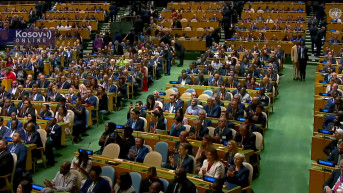
The General Debate of the 81st session of the UN General Assembly has concluded, but the session itself is only beginning its year-long work. Following the addresses by world leaders and meetings on the sidelines, one question remains—one that General Assembly President Khalilur Rahman raised as a key theme: how can trust be restored and change managed in a rapidly changing world?
In New York, however, the focus should not be on the algae on the seabed, but on the waves at the surface. Statements, accusations and diplomatic incidents are merely the visible traces of a deeper shift in the balance of political, economic and diplomatic power. The General Debate should therefore be read as a snapshot of a changing world.
UN Secretary-General Antonio Guterres placed this process in a broader context. He warned that multipolarity could lead to fragmentation and conflict, but also to a networked multipolarity in which multiple centers of power operate within common rules of international law. The question, therefore, is no longer merely whether the world will be multipolar, but what kind of multipolarity it will be.
Donald Trump spoke from the standpoint of American strength, sovereignty and national interest; Emmanuel Macron defended European multilateralism; while Sergey Lavrov, one of the world’s most experienced diplomats and Russia’s long-serving Foreign Minister, set out Moscow’s positions. Vladimir Putin entrusted him with presenting Russian policy in New York at a time when the question of the future international order has once again come to the fore.
Viewed through both a European and a Balkan lens, Lavrov’s message brings the debate back to the UN Charter, the sovereign equality of states and the need to resolve security disputes through political means rather than by imposing solutions through force. For the Balkans, a region where questions of sovereignty and territorial integrity have been intertwined with the interests of major powers for decades, such a message carries particular significance.
Xi Jinping did not address the General Assembly from its podium, but China’s voice in the chamber was heard through Vice President Han Zheng. Yet Beijing’s political message reached New York from Washington, through Xi’s meeting with Trump. Despite their strategic rivalry, the two major powers demonstrated that dialogue can serve as a means of preventing escalation and seeking solutions, even when negotiations take a long time.
This also reflects China’s broader political weight—not only as one of the principal centers of global power, but also as an important pillar of BRICS and the Global South. The greater the influence of major powers, the greater their responsibility to keep their differences within the framework of dialogue.
The differing views of Trump, Putin, Xi and Macron do not mean that they want the same things. That is precisely why one simple diplomatic fact matters: diplomacy does not exist because states agree, but because they disagree.
This is also evident beyond the UN podium. BRICS is expanding the space for political and economic cooperation, while Washington, Moscow and Beijing continue to maintain channels of communication despite their differences. Trump and Xi have opened new channels and supported the holding of APEC in Shenzhen in November and the G20 in Miami in December. These forums do not resolve strategic disputes, but they do provide frameworks within which competition can remain subject to dialogue.
And this is precisely where the most important question begins: when do the guns fall silent and dialogue begin? Not when differences disappear, but when a channel—bilateral, trilateral or multilateral—is opened through which those differences can be addressed.
November could therefore provide an important test: APEC in Shenzhen, with the possibility of talks in a Trump-Putin-Xi format, although such a meeting has yet to be confirmed. The G20 follows in December. From bilateral to trilateral and then multilateral formats—this is how a space is created in which weapons can give way to negotiations.
Europe occupies a specific position in this picture. It is not part of a potential Washington-Moscow-Beijing configuration, while at the same time insisting on international law, sovereignty and territorial integrity, particularly when speaking about Ukraine and Kyiv. While most EU Member States recognize Kosovo, five do not. These are not identical historical or legal cases, but they raise the question of consistency in the application of principles.
Macron and Antonio Costa spoke about the need to respect international law and multilateral rules. Europe, too, will therefore have to answer the question of how it applies those principles across different crises.
That question also leads to the selection of the next UN Secretary-General. Antonio Guterres’ term expires at the end of the year, and the process of choosing his successor is under way. The UN has never had a woman in that position, so the presence of female candidates raises the possibility of a historic first. More important than gender, however, will be the question of what kind of leadership the Organization needs—leadership capable of engaging with all centers of power, advancing reforms and restoring confidence in multilateralism, with the UN Charter and the sovereign equality of states as its foundation.
If Rahman’s question was how to restore trust in multilateralism, the answer to take away from New York is not that the major differences have disappeared. Quite the opposite. The answer is that those differences must once again be brought to the table—bilaterally, trilaterally and multilaterally.
A new world does not have to mean a new confrontation. Major powers do not need to share the same interests in order to talk. It is time for the guns to fall silent and dialogue to begin—not as a slogan, but as a political necessity.
The General Debate has ended, but the session has not. New York therefore does not leave us with the conclusion that differences have disappeared, but with the question of whether enough channels have been opened to manage them.
We should watch the waves. They are now moving from New York toward Shenzhen and Miami, from bilateral toward trilateral and multilateral formats. If those waves carry negotiations rather than weapons, then behind the harsh words of the General Debate something more important may begin to emerge—the beginning of a dialogue about a world whose new contours are only now taking shape.
0 comments