
UN General Assembly session: Kosovo (and Metohija) between law and political practice

Written by: Zeljko Sajn, Kosovo Online special correspondent in New York
As the 81st session of the United Nations General Assembly takes place at UN Headquarters, New York has once again become a place where international law and everyday diplomatic practice intersect. During the General Debate, representatives of 193 UN Member States gather here, while numerous bilateral meetings, receptions and political events take place alongside the official program. It is precisely within this space between the formal work of the Organization and diplomacy on the sidelines that the question also arises of how Kosovo and Metohija is treated in New York.
The General Assembly is composed of the Member States of the United Nations, whose representatives participate in its work in accordance with the applicable rules on accreditation and procedure. In addition, certain non-member states, international organizations and other actors may participate in particular activities on the basis of a specifically established status or invitation. Permanent observer status, for example, is not expressly provided for in the UN Charter, but has developed through the practice of the Organization.
Kosovo is not a Member State of the United Nations, nor does it have permanent observer status in the General Assembly. A representative of Pristina therefore does not have the status of a representative of a Member State in the General Assembly or the rights deriving from membership. This, however, does not in itself prevent political contacts with representatives of Member States. States independently decide with whom they will engage and what diplomatic relations they will maintain.
Accordingly, any meeting between Albin Kurti and representatives of Croatia, North Macedonia or any other Member State should be viewed within the framework of bilateral diplomacy. Such a meeting may carry political significance for the participants, but it does not constitute a United Nations decision on the status of Kosovo and Metohija. It does not give Pristina a seat in the General Assembly or voting rights, nor does it alter the number of Member States of the Organization.
It is precisely for this reason that a distinction must be made between the formal work of the UN and activities taking place “on the sidelines” of the session. That term encompasses a wide range of bilateral meetings, receptions and other events and does not in itself constitute a separate category of membership or international status. The fact that a meeting takes place during the General Assembly or at a venue associated with the UN does not mean that its participants thereby acquire the same institutional status as delegations of Member States.
These questions are not merely theoretical. As far back as 2015, a discussion took place within the UN system concerning the presence of Kosovo representatives at an event held at UN Headquarters. The official record stated that the event had taken place on the sidelines of the General Debate, while also pointing to the obligation of the organizers and the host country to respect the relevant UN rules and practice. That case demonstrates that holding an event on the sidelines of the General Debate does not in itself exempt it from United Nations rules and practice.
The legal framework governing membership is particularly clear. Article 4 of the UN Charter provides that the admission of new members is effected by a decision of the General Assembly upon the recommendation of the Security Council. Membership, therefore, is not acquired through bilateral recognition, a political meeting or attendance at a diplomatic event, but through the procedure prescribed by the Charter and decisions of the competent United Nations organs.
Accordingly, recognition of Kosovo by individual states and membership in the UN are two distinct categories. Recognition is a decision by an individual state and governs its relations with Pristina, whereas membership in the United Nations constitutes a multilateral institutional status. One does not automatically result in the other.
In the case of Kosovo and Metohija, UN Security Council Resolution 1244 of 1999 carries additional significance. Adopted under Chapter VII of the Charter, the resolution established international civil and security presences in Kosovo and Metohija and the mandate of UNMIK. In its preamble, the Security Council reaffirmed the commitment to the sovereignty and territorial integrity of the then Federal Republic of Yugoslavia, while providing for substantial autonomy and meaningful self-administration for Kosovo.
Resolution 1244 remains part of the UN legal framework relating to Kosovo and Metohija. The United Nations continues to maintain UNMIK, and its mandate is periodically discussed by the Security Council, confirming that the issue of Kosovo and Metohija remains within the framework of the United Nations system.
For that reason, the status of Kosovo and Metohija within the UN cannot be determined solely by the number of states that recognize it bilaterally. Political realities may change, as may the number of states holding a particular position toward Pristina, but institutional status within the United Nations derives from the rules of the Organization and decisions of its competent organs.
This is also reflected in the symbolic space of UN Headquarters itself. The flag of the Republic of Serbia is displayed among those of the Member States, while Kosovo is not among the 193 UN Member States. At the same time, representatives of Pristina may hold political contacts during the General Debate with representatives of states that recognize Kosovo. These two facts are not of the same legal nature and can therefore coexist.
While the rules governing the composition of delegations, accreditation and voting rights apply inside the General Assembly Hall, extensive diplomatic activity takes place on the sidelines, where states engage with various political actors regardless of their institutional status within the UN. Such contacts may be politically significant, but they do not in themselves alter the composition of the General Assembly.
If restoring trust in multilateralism is one of the objectives of the 81st session, it is important not to conflate these two levels. Political contact may be significant, but it does not in itself alter institutional status.
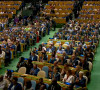
In that sense, the picture presented by New York during the 81st session is sufficiently clear: representatives of 193 Member States sit in the General Assembly, and the Serbian flag is among their national flags. At the same time, meetings with various political actors, including representatives of Pristina, take place on the sidelines. These two levels can coexist, but they do not constitute the same institutional status. It is precisely this boundary that is defined by the United Nations Charter and the decisions of its competent organs.
0 comments