
Progressivism, in theory and target practice
Written for Kosovo Online by Srdjan Garcevic, founder of The Nutshell Times
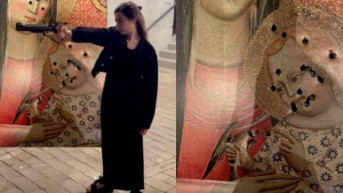
A truly incredible story rocked Switzerland earlier this month – ironically as Western Christians were celebrating the Nativity of the Virgin Mary – when Sanija Ameti, a progressive Zurich politician, decided to share photos of a shot-through poster of the Madonna and child, explaining that she used it in a target practice to calm down. Given that Ameti is a Green Liberal politician and co-leads Operation Libero, an organization that sees itself as a force for inclusion and equity, it is strange that she did not think that her de-stressing routine can be distressing to many.
What makes the situation even stranger is that Ameti, who moved to Switzerland as a child from war-torn Bosnia and Herzegovina and launched her campaign for the Swiss Federal Assembly as a representative of the Green Liberal Party (which is now considering her expulsion) at Priština airport and thus is not only familiar with the fact that many of her potential constituents (particularly those of Serb origin) have experienced their sacred sites desecrated in the very near past but also that such thoughtless provocations in a multicultural society lead to nothing good.
However, as noted by many before me, while current progressive politics should mean ensuring the inclusion of everybody, in practice, it dovetails nicely with identitarianism. Is it not strange for a progressive politician who fights for a truly multicultural society, to campaign on their ethnic origin, such as Ameti did in Priština?
However, as many progressives and Operation Libero claim, providing group-level benefits and thus encouraging group-level identification – such as affirmative action – is acceptable on a "temporary" basis if it means "achieving and normalizing real equality," which in practice, however, almost always encourages clannishness. Furthermore, the very reductive – however overwrought - progressive theory of the “oppressors” and the “oppressed” generally takes away all responsibility and agency from one side and puts it on their enemies. Thus, it is no wonder you do not really consider the side of those you claim are oppressing you, no matter how, in reality, privileged you are.
Ameti is a mid-level political operative in a country that probably achieved the highest level of quality in the whole of human history and who is now supported and defended by part of its cultural elite. People criticizing her tend to be, on average, much less socially connected and probably poorer. The progressive logic of "privilege-checking" would suggest it is okay to punch up as long as someone is above you socially, but in this case, it is not, especially with threats now made against Ameti, despite her resignation and apology.
The deeper problem, however, remains: progressivism does not deal with ethnic and other identarian clannishness too well, which ultimately encourages it and even intensifies it. By allowing polarisation across identarian lines and negating universalism and equality, it corrodes pluralistic, multicultural societies.
However, it does allow (ethno)narcissists to push their agenda. Nominally progressive Dua Lipa proudly shared an image of Greater Albania, but has attacked British ministers for hurtful comments against Albanian migrants and their insistence on their own state’s borders.
This self-centered attitude, where one is never challenged to think beyond one's own perspective, is not limited to celebrities. One can be a renowned philosopher and still approach the very complicated issue of migration by almost purely relying on one's own “lived experience”, in three whole articles - and not finding time to consider that somebody can have non-bigoted qualms about a foreign organized crime syndicate shipping migrants illegally into their countries.
While insistence on empathy is the name of the game in progressive politics and is core to its theory, many progressives in practice, much like the most rabid chauvinists, deny empathy to whoever they designate as an "outgroup" and thus "a threat ."Societies like Switzerland, who, due to their historic complexity, have to work hard to maintain a universal – but accommodating - national identity, understand the threat that such a divisive ideology can bring.


0 comments