
A shot at innocence and the sanctity of life
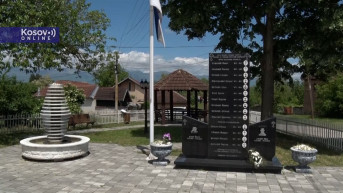
An unbearably hot day in Metohija. Darkness has gathered over the ghetto. People are arriving from different directions, brought together by the death of the boys at the river. The day of the tragedy on the Bistrica began as a childhood idyll. Going down to the river was like opening a window out of a ghetto surrounded by barbed wire, soldiers, and armored vehicles. Almost a hundred children went swimming, some on foot, others by bicycle. A small rise above the swimming hole. A fire over which corn was roasting.
"We swam there for a while. In the meantime, my brother crossed to the other side of the Bistrica and lit a small fire with Bogdan Bukumiric. It was somehow cold and the sky had become overcast; the clouds were black, as though they were foretelling some great tragedy. I was next to my brother, and he was on the other side of the fire. Suddenly, bursts of gunfire rang out and the branches shook. In that chaos, we headed for the other bank, toward the village. There was a raised embankment formed by the river, and we were slipping over the clay and the roots. Then we reached the wire and tore ourselves up on it; we were all covered in blood. Throughout all that chaos and confusion, I kept seeing my brother Panto in front of me, as though he were some kind of guide leading me to safety, when in fact he had fallen there beside the fire. He had a gunshot wound to the head," says Nemanja Dakic, the murdered boy's brother.
He was eight years old at the time.
For the Jovovic family, too, everything began as a happy day. Senka kept telling her son Ivan: "Don't go to the Bistrica." When bursts of gunfire were heard at around 1 p.m., Senka knew that her son had been hit. Asked how she knew, she would answer simply: "A mother's heart knew."
After the evil came, Gorazdevac was transformed into a nightmare. The children were taken to the hospital in Pec, while staff from the Serbian clinic in Gorazdevac walked around in bloodstained coats, carrying the shock that would mark their lives forever. At the hospital in Pec—music, humiliation, insults.
An attempt was made to drag the most seriously wounded boy, Bogdan Bukumiric, out of the car in the city. The car broke down. Yesterday, all of it came back to life in the stories about a day everyone describes with the same words: "May it never happen again."
Thanks to the kindness and phone call of Darija Safranic, who reported on the children's condition and on doctors putting casts over gunshot wounds, the transfer to Belgrade began. "Is my Bogdan alive? Tell me, you have to—I'm your professor," Prof. Dr. Mileta Bukumiric told the author of this article that night. Dragana Srbljak, Marko Bogicevic, and Djordje Ugrenovic were also seriously wounded alongside Bogdan.
Djordje is a man with an ever-present smile. He organizes a football tournament and commemorative events dedicated to his friends and their suffering.
At the Church of the Dormition of the Most Holy Theotokos, Bishop Ilarion of Novo Brdo officiated at the memorial service together with priests, monks from Decani, and nuns from the Patriarchate of Pec. The Jovovic and Dakic families stand to one side, candles in their hands. Milisav Dakic, the father of the murdered Panto, rests his hand on the head of his grandson Tihon and says: "God is great. I have four of them." One has the impression that his large hand is trying to shelter the child.
On the other side of the church stand the Jovovics. Senka, Ivan's mother, stands quietly, almost motionless. It seems as though her son's youth has frozen upon her face and that this youth refuses to grow old.
Following the memorial service, Bishop Ilarion spoke of an embrace in eternity and of the fact that we are drawing closer to all those we love, offering this as consolation to the Dakic and Jovovic families.
"I ask you to live the Resurrection," he said, stressing the need "to resurrect forgiveness among ourselves, even forgiveness toward the executioners."
He emphasized that there was a duty to preserve the land soaked with the blood of Panto and Ivan.
"We must emerge from the grave of our own being and our loneliness by forgiving one another. Even—and forgive me for saying this—even these executioners, whom God will certainly judge, even them we must forgive. We must pray to God both for those who wish us well and do good to us and for those who do evil, that the Lord may bring them to their senses so that they inflict as little evil as possible upon themselves and others," the Bishop said, conveying the blessings of Serbian Patriarch Porfirije and
Metropolitan Teodosije of Raska and Prizren.
Speaking on behalf of the Office for Kosovo and Metohija, Bora Tajic concluded that "those were shots fired at what is most sacred to us." Yet the Serbs survived, and "our survival is our greatest memorial."
After the memorial service, everyone heads to their respective cemeteries. At the first, beside the wooden church and beneath the largest oak trees in Metohija, Ivan Jovovic is buried. For 23 years, relatives and friends have stood beside his grave and received a kind of condolence. That is what happens in a place where justice has never arrived and where there is no indication that it ever will. Beside the sanctity of an innocent victim, amid injustice and the failure to find the perpetrators, condolences will remain—a search for crumbs of meaning, a quest for the freedom that was taken away. Although the head of UNMIK promised to leave no stone unturned in finding the perpetrators, nothing was done. UNMIK handed the case over to the EULEX Mission, which subsequently closed it for lack of sufficient evidence. And they are still there, all around, in the hatred that has never ceased, in the music that blared from the surrounding Albanian villages on that fateful night.
In the deepest shade of Metohija, just below Ivan Jovovic's grave, snails cluster almost like bunches of grapes atop the Gasic family monument, as though they too had set off somewhere upward and stopped there to wait for the rain.
At the other cemetery, the Dakic family offers sweets, boiled wheat, and wine. Tihon, the boy from the church, hands them out. His face resembles the boy's face on the stone slab.
"You look just like Panto," Bishop Ilarion tells him.
Everything seems the same except justice. Justice is different every year because it is absent, because it drowned in the Bistrica swimming hole 23 years ago.
Written by: Zivojin Rakocevic for Politika, journalist and writer

0 comments