
High-level week in New York: Kosovo and Metohija at the UN
Written for Kosovo Online by Zeljko Sajn, special correspondent in New York
As the start of High-level Week is being prepared at the United Nations headquarters, Serbia is arriving in New York with an issue that for it is not merely part of its foreign policy agenda, but one of the country's key national issues – Kosovo and Metohija. Serbian President Aleksandar Vucic will take part in the work of the 81st session of the UN General Assembly tomorrow, and will address the Assembly on September 23, as the fifth speaker.
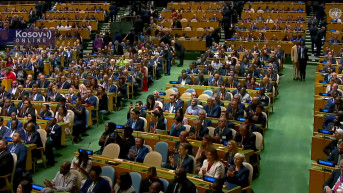
In the General Assembly hall, in front of the flags of 193 member states, including the flag of the Republic of Serbia, Vucic will speak about Serbia's position, international law and the UN Charter, but particularly about the security and position of the Serbian people in Kosovo and Metohija.
Kosovo and Metohija will thus once again come before the widest international public, precisely at the place where Serbia insists that the status of the province must be discussed within the framework of international law and UN Security Council Resolution 1244. For Belgrade, that resolution remains an important international legal framework, and the question is how much, amid changing relations in the world, the principles of the UN Charter will once again gain importance in resolving open issues.
Vucic is arriving in New York at a time when international relations are undergoing major restructuring. Khalilur Rahman, President of the 81st session of the General Assembly, has described his presidency as a period of restoring trust in multilateralism, with efforts to ensure that the United Nations responds to the challenges of a rapidly changing world.
In such an atmosphere, the diplomatic activity of the Serbian president has a particularly important place. On the margins of the session, he is expected to hold numerous bilateral meetings, including, as announced, a meeting with US President Donald Trump and talks with Russian Foreign Minister Sergey Lavrov.
These meetings give additional weight to the issue of Kosovo and Metohija. Serbia finds itself in direct contact with different centers of global politics at a time when questions about the future international order are once again being raised. Vucic's diplomatic activity will therefore also be aimed at preserving support for Serbia's state position on Kosovo and Metohija, as well as at seeking to keep the issue of the province within the framework of the United Nations and international law.
At the same time, a second major diplomatic development is emerging from Washington. After his activities in New York, Donald Trump is heading to Washington, where he will meet with Chinese President Xi Jinping. Xi will not address the General Assembly, but China will be represented by Vice President Han Zheng, while Russia will be represented by Foreign Minister Sergey Lavrov.
For Serbia, it is important that such a moment creates space for talks with different sides. Vucic is not coming to New York only to speak, but also to hold discussions. And for Belgrade, it is crucial that in those talks the issue of Kosovo and Metohija remain linked to international law, Resolution 1244 and the UN Charter.
This is also the broader picture of this year's High-level Week. The world is gathered beneath 193 flags, but behind them stand not only states, but also different visions of the future order. Some insist on the restoration of multilateralism, others on reforming international institutions, and still others on a greater role for new centers of power.
Within this picture, Serbia is seeking to preserve its state policy and maintain for Kosovo and Metohija the international legal framework it considers crucial to its position.
Vucic's presence in New York will therefore be important both because of what will be said from the podium and because of what will take place away from it. This is because in the corridors of the UN, talks often begin that later shape the course of global politics.
And among the issues Serbia brings into those discussions, Kosovo and Metohija remains one of the most important – an issue over which Belgrade insists that the future cannot be determined solely by the balance of current political power, but also by the rules of international law.
For Serbia, the 81st session of the General Assembly is therefore not merely another annual gathering of world leaders. It is a new opportunity to reaffirm its positions on Kosovo and Metohija before the international community and, at a time of major global restructuring, to seek space to preserve them.
0 comments