
War games in the Balkans: Is the KSF and AAF exercise in Albania a "diplomatic" response to Serbia?
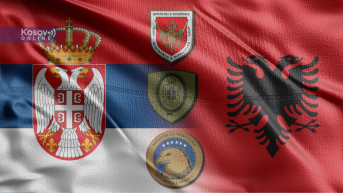
Within a span of just twenty days, artillery fired on two opposite sides of Kosovo. On April 19th, at the temporary military training ground "Pester," the Serbian Army thundered with heavy artillery and combat aircraft. Less than three weeks later, on May 10th, the Kosovo Security Force (KSF) and the Albanian Armed Forces (AAF) "responded" with a joint exercise at the Biza base in Albania, involving combined actions of direct and indirect fire from artillery weapons and Vuran combat vehicles. Analysts in Tirana and Belgrade told Kosovo Online that every army in the world must train. However, they have no doubt that each of these exercises also served as a diplomatic message to the other side.
The multi-day military exercise "Whirlwind 2024," which involved several thousand troops with around 500 complex combat systems and equipment held near Sjenica, was seen by official Pristina as a clear provocation.
"They are conducting exercises with kamikaze combat drones, and the location of these exercises is only 30 kilometers from the Kosovo border and just three kilometers from the Serbia-Montenegro border. This demonstrates that Serbia is an authority, an instance, a factor, the main actor of destabilizing efforts in the Western Balkans region, and that it poses a threat not only to our Republic, which it does not recognize, but also to the security of all citizens in our region," Kurti said.
Defense Minister Ejup Maqedonci also expressed concern about what he called the militarization of Serbia. He mentioned this on the sidelines of the Defense24 Forum.
Previously, he had described the military exercise on Pester as an escalation of tensions because Serbia was testing offensive, rather than defensive, weapons.
"At a time when this exercise is being conducted, the use of equipment and weapons systems in this exercise poses a threat to the stability and security in the Balkans. Serbia has camouflaged all its previous preparations and militarization actions for defense. Serbia will test offensive, not defensive equipment," Maqedonci said.
However, twenty days later, Maqedonci described the joint exercise of the KSF and AAF, which included heavy artillery, as an "increase in the KSF's combat capacities to maintain global peace and security."
"The purpose of this exercise is to increase the KSF's combat capacities, interoperability between our armies, and the exchange of experiences to maintain global peace and security," Maqedonci stated.
"Saber-rattling" as a Message
Marko Savkovic, senior advisor at the ISAC Fund, explains that military exercises are never just about training or demonstrating power but also about sending clear political messages.
"The emphasis here is primarily on demonstration. By conducting a military exercise, you send a message to partners and potential adversaries: 'We are here, we are ready for all eventualities.' And you might also be sending a message to your population to reassure them that you are capable of defending them in any scenario that might develop tomorrow," Savkovic assesses.
He explains that, in practical terms, the military exercises in Albania and Serbia cannot be compared because the one on the Pester Plateau was much more complex, involving multiple branches and systems of weaponry and military equipment, including aviation.
However, he adds, both have a hidden, common denominator.
"They do send a message, not just to the region, but a universal message to all allies, partners, and potential rivals: 'We are here, we are ready, and we can respond to various challenges,'" says Savkovic.
Savkovic recalls that armed forces must train to test their mastery of new capacities in the most realistic conditions.
In this context, the KSF exercise equipped with new weapons systems should be viewed.
Using the training ground in Albania is not surprising to him and is primarily seen as aligning with NATO standards, which has been Pristina's intention from the start.
"Of course, such exercises always have an internal function. By conducting them, you demonstrate that you are free in your actions and can train if you want to. Remember how much Belgrade opposed the formation of the Kosovo army. It was formed nonetheless, and now that army must strengthen its interoperability and readiness through exercises. This is all, I would say, a logical continuation of actions that have been going on for many years," Savkovic says.
He adds that military exercises do not always have to mean "saber-rattling," but due to distrust and poor bilateral relations in the region, they are generally interpreted that way.
"If there were more trust, we wouldn't be talking about saber-rattling. Military exercises are a normal occurrence, attended by many accredited military representatives. You invite other countries and seek their presence to legitimize the exercise and show that it is not an act against anyone. They do not necessarily have to be saber-rattling, but because trust is lacking, and because bilateral relations are what they are, we interpret them in that way," Savkovic explains.
He emphasizes that what should be most concerning is the trend of increasing such exercises and armament, not only in the region but also globally.
"It is certainly concerning to see a general trend of increasing military exercises, not only in our region but more broadly. The world we live in has evidently become less secure. We are seeing an exponential rise in military exercises worldwide, as well as increased investments in weapons and military equipment. Trust is diminishing, and everyone is preparing for different scenarios. As the conflict in Ukraine has shown, nothing can be ruled out anymore," Savkovic concludes.
Questions with Multiple Question Marks
For analyst and host of the show "Dekalog" on Albanian Radio Television, Roland Qafoku, these two military exercises have a fundamental difference.
He emphasizes that the Serbian Army exercise on Pester can be interpreted as a warning or provocation, while the joint exercises of the KSF and AAF were under NATO control and part of a normal joint training process because, as he points out, it is about two states but one people.
"It is completely normal for the Kosovo and Albanian armies to have joint training. Here in Albania, we think that when we talk about Albania and Kosovo, we are talking about two states and one people. I think we should be more concerned that the Serbian army is conducting maneuvers on the border with Kosovo, at the hottest spot in the Balkans and the second hottest spot on the continent, and perhaps one of the hottest in the world," Qafoku told Kosovo Online.
Commenting on the military exercises conducted by the Serbian Army, KSF, and AAF within a span of twenty days, Qafoku says that such a "coincidence" raises many questions.
"One question has many question marks. This can also be understood as the Serbian army's training on the border with Kosovo could have been a warning, or even a provocation. It seems that Serbia is not satisfied with the joint training in Albania, near Tirana," Qafoku said.
He adds that the exercise at the Biza base does not pose a potential threat to anyone and was not conducted in secrecy because Albania, as a NATO member, is under constant surveillance by the Alliance's command in Brussels, which has information about every armed training taking place on Albanian territory.
"Every action of the Albanian army is monitored by NATO. This is one of the obligations of NATO member countries, which means that every military action of each member is monitored by NATO command in Brussels. No one can think that this joint exercise of the Kosovo and Albanian armed forces took place secretly, in some 'corner' of Albania, without NATO knowing about it. No. The Alliance has information, and NATO supports and encourages every cooperation it considers normal. We are two states, but we are one people. We know that Albania's airspace is monitored by NATO, as well as its maritime border. This has even brought criticism in the country that NATO should not do everything. Undoubtedly, NATO has information about this joint armed training," Qafoku concluded.
Who Wants to "Rule" the Balkans?
Military analyst Aleksandar Radic, however, offers a different answer.
He claims that the recent joint exercise of the KSF and AAF at the Biza base should be viewed exclusively in the broader context of the aggressive Turkish neo-Ottoman project penetrating the Balkans.
"The real message of the joint exercises of Albania and the KSF is actually in the shadows. Turkey is the common denominator for both armies. They are now part of Turkey's project to penetrate the Balkans, which materializes through the delivery of weapons, military equipment, and intensive training of their partners in the Balkans," Radic emphasizes.
According to Radic, Turkey's approach to arms sales a few years ago was driven by commercial interests, but now it's exclusively political.
"Turkey's neo-Ottoman policy has become very aggressive. They want to display their flag from the Balkans to Central Asia, and south to Sudan. Turkey sends its military and arms wherever needed. Until a few years ago, Turkey's interest was to sell some vehicles to the Kosovo Security Force (KSF) to increase their fleet, which was a clear commercial motive. But now, it's part of a political agenda. The KSF, Albania, and the Armed Forces of Bosnia and Herzegovina are recipients of Turkey's donations, and then Turkey channels state funds to state and private companies that supply arms to these countries. This clearly reflects a policy aimed at showcasing Turkey's presence, establishing its power, and prominently displaying its flag and mortars," Radic emphasizes.
He points out that the arming of Kosovo and the region should also be viewed in a broader context where "old rules of the game" are returning to the scene.
"Everyone is now arming themselves. Since Russian forces crossed the border into Ukraine, the world has changed. Societies are moving towards militarization, and old rules of the game are coming back into play. In this context, everyone in the Balkans, except Bosnia and Herzegovina, is buying arms, and it's natural to work on increasing the combat readiness of the military, which naturally leads to exercises," Radic highlights.
He adds that it is a significant question how Serbia should build relations with Turkey in a situation where Turkey clearly shows it has main favorites in the Balkans.
"The weapons delivered to the KSF and Albania show who has the trust of official Ankara," he emphasizes.
Radic recalls that Kosovo intensified its procurement of arms and military equipment after changing the law in 2018, with Turkey playing a key role in serious acquisitions rather than Western countries.
"After changes to the legal package related to the Kosovo Security Force in 2018, limits on arms and military equipment were lifted. Meanwhile, KFOR adheres to the old law and maintains restrictions. Western countries arm the KSF but supply light armored vehicles like the American M-1017, which can mostly be used for military-police purposes, Humvees, automatic rifles, etc. But Turkey has shown a desire to significantly enhance the KSF's capabilities, providing them with firepower. Therefore, Turkey has delivered self-propelled 120mm mortars, battalion-level fire support weapons, 60mm and 81mm mortars, and various other weapons. Kosovo has 'Bayraktar' TB2 drones, very capable and powerful unmanned aerial vehicles that can be used for reconnaissance and fire missions. Turkey has delivered the same equipment to the Albanian army and manages training economically: some courses by Turkish manufacturers are organized in Turkey, some in Kosovo, some in Albania. The recent exercise in Albania was actually a readiness test for fire support units under the command of Tirana and Pristina," Radic explains.
When asked if the recent KSF and AAF exercise at the Biza base could be interpreted as a counterpart to the Serbian Army exercise on the Pester Plateau, Radic says it is a wrong comparison because the exercise in Albania was solely aimed at training Albanian and Kosovo security forces in the use of Turkish weapons.
"It has its own dynamics related to the delivery schedules of the weapons and the integration of that weaponry into the units that received it. Of course, primarily in a political sense, it confirms strong Turkish presence, and from a Serbian perspective, it confirms the growing but limited offensive capabilities of the KSF," Radic concludes.


0 comments