
Who is Who: Alice Weidel, the most popular candidate for Chancellor of Germany, opponent of Kosovo's independence
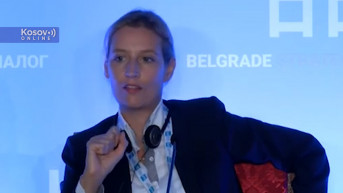
In surveys ahead of the parliamentary elections in Germany, when asked who Germans would most like to have as Chancellor, Alice Weidel, the candidate for Chancellor from the Alternative for Germany (AfD), a party that openly opposes Kosovo's independence, leads the rankings.
This is the first time since its founding that the AfD has nominated a candidate for Chancellor, but her chances of assuming this position are almost non-existent, as other parties refuse to cooperate with the Alternative.
However, according to public opinion polls, if a direct election for Chancellor were possible, 24% of Germans would vote for Weidel. She enjoys particular support, with as much as 36% of the vote, in the eastern part of Germany.
For comparison, the leader of the currently strongest political force, the Christian Democratic Union (CDU), Friedrich Merz, has less public trust – 20%, and only 16% in the east of the country.
Weidel wants Germany "to be at the top of the world again," to restore the faltering German economy to the "right track," as well as the energy transition, but also to reduce immigration.
Like her party, she is a fierce critic of the EU, to the point of even announcing that she would advocate for a referendum on EU membership similar to Brexit, and that her government would seek to reform the EU and remove its "democratic deficit," which includes limiting the powers of the European Commission.
Weidel is not unknown in Serbia, as she appeared at the Belgrade Strategic Dialogue seven years ago, where she advised Serbia not to join the EU.
"The EU in its current state is not just dysfunctional. Accession would bring Serbia a far-reaching loss of sovereignty in important political areas, such as refugee and migration policy," Weidel is convinced, adding that German citizens of Serbian descent "know the negative sides of EU membership very well."
When it comes to foreign policy, the AfD has been the only party represented in the Bundestag for years that opposes breaking ties with Russia. They are very clear in their stance against supporting Ukraine and for lifting sanctions on Russia, advocating the position that "Germany must not be allowed to serve American interests."
Regarding the Western Balkans, the party opposes Kosovo's independence.
On several occasions, Alice Weidel’s party colleague, AfD official Petr Bystron, pointed out that Serbs in Kosovo are the most endangered people in Europe and that Germany should "withdraw recognition of the fake state."
AfD members Armin-Paul Hampel and Markus Frohnmaier have previously stated that Kosovo should never have been recognized and that recognizing it was a huge mistake.
"This state entity is incapable of surviving on its own. For a long time, this country has only been receiving aid, with Germany bearing the largest cost. Huge amounts of money are being spent on projects that even intensify migration to Germany, and this is unacceptable," believe the AfD politicians.
Raised in the West, popular in the East of Germany, speaks Chinese, lives in a gay marriage...
Alice Weidel, nicknamed "Lille," was born in 1979 and grew up in Gittesloh in North Rhine-Westphalia in western Germany. Her father, Gerhard Weidel, is also a member of the AfD, and Alice joined the party in 2013.
Since 2017, she has been the head of the AfD parliamentary group in the Bundestag.
She holds a PhD in economics, and interestingly, she received funding for her doctoral thesis from the Konrad Adenauer Foundation, which is close to the CDU.
She is one of the few German MPs who speaks Chinese, as she spent some time in China. She worked for Goldman Sachs and Allianz Global Investors before entering politics.
She is a mother of two and lives in Uberlingen in a same-sex partnership with an immigrant from Sri Lanka.
0 comments