
Who Is Who – Bekim Sejdiu: Kosovo presidential candidate opposed the agreement on the principles of the CSM
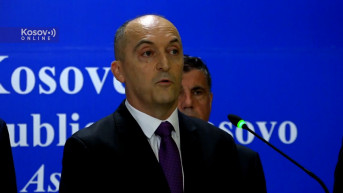
Bekim Sejdiu, the candidate for President of Kosovo agreed upon today by Self-Determination and the Democratic League of Kosovo, has years of experience in diplomacy, academia, and Kosovo institutions, having served as Kosovo’s Ambassador to Turkey and Consul General in New York. As a Constitutional Court judge, he ruled in 2015 on the constitutionality of the principles governing the Community of Serb Municipalities (CSM), describing the model envisaged by the Brussels Agreement in his dissenting opinion as problematic from the standpoint of the principle of multiethnicity.
Bekim Sejdiu, born in 1974, is a lawyer, diplomat, and university professor who has held a number of positions in Kosovo’s judiciary and diplomatic service throughout his career.
First generation of ambassadors
Sejdiu served as a judge of the Constitutional Court of Kosovo, a position to which he was appointed in 2015. Prior to that, he worked in the diplomatic service and was among the first generation of Kosovo ambassadors.
He began his diplomatic service as chargé d’affaires, and on August 20, 2009, President Fatmir Sejdiu formally appointed him Ambassador to Turkey. With this appointment, he became Kosovo’s first Ambassador in Ankara.
After completing his term in Ankara, his diplomatic career took him to the United States. From 2012 to 2014, he served as Kosovo’s Consul General in New York. Documents from that period show that he was also involved in activities of Kosovo’s highest-level state delegations during their visits to New York.
In September 2012, for example, Sejdiu was a member of the Kosovo delegation at a meeting that President Atifete Jahjaga and Prime Minister Hashim Thaci held with UN Secretary-General Ban Ki-moon.
Following his service in New York, he was also appointed Kosovo’s Ambassador to Canada for the 2014–2015 period. In 2015, Sejdiu’s career shifted from the diplomatic service to constitutional adjudication.
On the Community of Serb Municipalities
In 2015, as a Constitutional Court judge, Sejdiu was a member of the panel that considered the constitutionality of the principles governing the CSM. He also issued a separate dissenting opinion in the case, in which he adopted a more critical position toward the CSM than the majority of the Constitutional Court judges.
He assessed that the proposed CSM model introduced a territorially based distinction in rights within the Serbian community, as well as between Serbs and members of other communities living in the same municipalities. He described the CSM as “ethnocentric,” arguing that its establishment in the proposed form would be contrary to the principles of multiethnicity and non-discrimination.
“It is obvious that only Kosovo Serbs living in Serb-majority municipalities would be ‘entitled’ to enjoy a privileged political position...” he stated.
The Constitutional Court of Kosovo subsequently ruled that the agreed principles concerning the CSM were not fully aligned with the “spirit of the Constitution of Kosovo” and that the incorporation of those principles into a legal act and the Community’s Statute “should comply with the constitutional standards of the Republic of Kosovo.”
The Constitutional Court reviewed the principles concerning the CSM at the request of then Kosovo President Atifete Jahjaga.
Fall of Avdullah Hoti’s government
Sejdiu also served as judge rapporteur in several politically significant cases, including the 2020 decision that led to the fall of Avdullah Hoti’s government. According to media reports, Sejdiu considered the vote cast in favor of Hoti’s government by MP Etem Arifi, who had already been sentenced to imprisonment, to be unconstitutional.
In its judgment, the Constitutional Court found that the vote of an MP convicted by a final court judgment could not be counted as valid in the election of the Government, producing immediate political consequences.
Following the judgment, early parliamentary elections were held in Kosovo on February 14, 2021.
Engagement with the Presidency
Sejdiu left the Constitutional Court on May 25, 2021, when he resigned as a judge. In late 2021, it was reported that the Office of the President of Kosovo had engaged him as an external expert.
Sejdiu subsequently explained that the engagement formed part of a project supported by the Norwegian Embassy and that he was not a member of President Vjosa Osmani’s political cabinet.
“Our employer is the Group for Legal and Political Studies. Therefore, we are not part of the cabinet or the institution of the Presidency,” he stated.
Biography
Sejdiu graduated from the Faculty of Law at the University of Pristina. He completed a master’s degree in international relations at Bilkent University in Ankara, as well as a master’s degree in democracy and human rights at the University of Sarajevo and the University of Bologna. He holds a doctorate in international and diplomatic studies.
He has been affiliated with the Faculty of Law at the University of Pristina since 2002, where he has worked as a professor. His academic and professional interests include international law, international relations, diplomacy, and international security.
In addition to his academic and diplomatic career, Sejdiu has worked as a researcher and public policy analyst. According to biographical information available on KIPRED’s website, he is currently a senior researcher at the institute, while Legalis identifies him as one of its founding partners engaged in legal advisory work.
During his public career, Sejdiu has received numerous decorations and honors, including a citation from the New York State Assembly in the United States, the Key to the City of Worcester, Massachusetts, and a medal from the Minister of Foreign Affairs of the Republic of Turkey.


0 comments