
WHO IS WHO – Dejona Mihali: The “Pink Commissar” in the shadow of the Self-Determination movement’s power
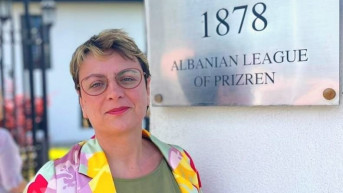
Once almost unknown to the public in Kosovo, and today one of the most influential figures outside formal decision-making institutions and the executive branch, Dejona Mihali has once again attracted significant public attention in recent days. An activist of the Self-Determination Movement (Vetëvendosje) from Albania, Mihali has never held a public office in the governments of Albin Kurti, nor has she appeared frequently in the media. However, according to her critics, her actions point to deep and informal power in the “disciplining” of party cadres, earning her the public nickname of the “pink commissar.”
Kosovo media reported on Wednesday messages allegedly linking Dejona Mihali and caretaker Minister of Economy Artane Rizvanolli to the appointment of Faruk Mujka as head of the public enterprise Ibar-Lepenac. Journalist Vullnet Krasniqi stated that the Special Prosecution should question Mihali, as the messages indicate that Mujka was unlawfully appointed as general director of the enterprise through political intervention by Self-Determination.
“She is a person with no official authority and, therefore, no formal responsibility, yet she clearly wields political influence. Dejona Mihali should have been the subject of an investigation,” Krasniqi said.
Always in the shadows, never before the cameras
But who exactly is Dejona Mihali?
She has never been seen at public events organized by the Self-Determination Movement, nor has she held any position during the Kurti I or Kurti II governments. She has consistently remained in the “shadow” of the party, avoiding public appearances and visible political engagement.
The official website of the Self-Determination Movement provides very little information about her role. The only publicly available detail is that since 2016 she has served as a “committee coordinator.”
Somewhat more information can be found on the official website of the Self-Determination branch in Albania, which states that she was born in 1980 in Tirana, completed undergraduate and postgraduate studies at the Faculty of Social Sciences in philosophy and sociology, worked as a university lecturer, and participated in research and translation projects.
An agent of control
Former Self-Determination MP Haki Abazi, when he resigned from two parliamentary committees in 2023, publicly accused the party leadership of suppressing internal democracy, describing Dejona Mihali as an “agent of control.”
“Mihali did not participate in voting or internal party competition, yet she is the main person who manages and makes decisions within the movement,” said Abazi, who later joined the Alliance for the Future of Kosovo.
He also publicly called on the Chief State Prosecutor to arrest Mihali, accusing her of endangering national security through contacts with opposition leaders.
Allegations and investigations
For months, according to activists and some MPs, Mihali was also accused of being behind the “purge” of Muslim members from the Self-Determination Movement. Media reports claimed that she played a central role in the removal of certain candidates from internal lists, citing their opposition to same-sex marriage and the proposed Civil Code.
Allegations of influence over appointments in public enterprises are not new either.
Former RTK Director General Shkumbin Ahmetxhekaj stated last year that Mihali, although formally holding a party role, “in practice governs Kosovo,” claiming that she personally demanded his dismissal from the head of the public broadcaster.
In September 2024, Mihali was also summoned for questioning by the Kosovo Special Prosecution due to suspicions of links to major tenders at the Kosovo Energy Corporation (KEK). As reported at the time, she was questioned in the capacity of a witness.
The most powerful in the “Group of Seven”
Earlier media reports stated that Mihali was the most influential figure in the so-called “Group of Seven,” which, in addition to her, reportedly included Boiken Abazi, Nazli Bala, Xhelal Sveçla, Ismail Kurteshi, Fatmir Kollçaku, and Elvis Hoxha.
According to those reports, she was the one who insisted on Albin Kurti’s re-election as party leader, describing as undemocratic the demands by part of the membership that Kurti withdraw from the race.
Clash with Edi Rama
In September 2023, Mihali also clashed with Albanian Prime Minister Edi Rama, reacting to his statement that KFOR should take control of northern Kosovo. She wrote on Facebook at the time that Kosovo had never requested such an intervention, but that it was a demand coming from Serbia.
“Rama would help Kosovo the most by remaining silent,” she told the prime minister.
Ban on entry to Kosovo
What is also known about Dejona Mihali is that on 18 July 2016 she was banned from entering Kosovo at the Morina border crossing. The Self-Determination Movement described the decision at the time as an “arbitrary decision of the governments of Hashim Thaçi, Isa Mustafa, and Kadri Veseli.”
“Such arbitrariness turns Kosovo into a country without democratic and civil rights and exposes it as a tyranny of petty despots whose sole function is servility toward the international community, Serbia, and the mafia,” the movement stated on its official website, demanding that the order be revoked.
This case further highlighted Mihali’s importance and role within the movement. Several days later, public attention was additionally drawn to the party following an incident in which the car of then Interior Minister Skender Hyseni was splashed with paint during a symbolic action by Self-Determination activists.
Contested documents
In September 2023, opposition parties LDK and PDK also announced that the autumn session of the Kosovo Assembly could begin with the formation of two investigative committees, one of which would deal specifically with the case of Dejona Mihali. PDK MP Ganimete Musliu stated at the time that it should be clarified how Mihali obtained documents permitting her stay in Kosovo, given that she had previously been banned from entering its territory.
Although there is little official information, the portal Paparaci published two documents in 2023 which it claimed indicated that Dejona Mihali is registered in Kosovo as a person without a listed place of birth and without a clearly defined identity, as well as an additional document in which her father declares himself to be of Greek nationality.
The first document, according to Paparaci, is a report by Kosovo institutions containing personal data. As reported, it does not list her place or city of birth, nor her nationality. Specifically, the fields state “unknown” for place of birth and “unknown” for city of birth, while the field related to citizenship is left blank.
The second document, obtained by Paparaci from civil registry records in Albania, concerns Mihali’s family data. According to that document, her father Aleksandar, who was born in Tirana, is registered as a member of the Greek community in Albania.
Based on the same document, the name of Dejona Mihali’s grandfather is listed as Leonid, while her grandmother’s name is given as Figalija. Dejona Mihali’s mother is named Lindita and, according to civil registry records, is registered as a citizen of Albania.

0 comments