
WHO IS WHO – Wesley Clark: A welcomed guest in Pristina, proud of NATO’s bombing of the FR Yugoslavia
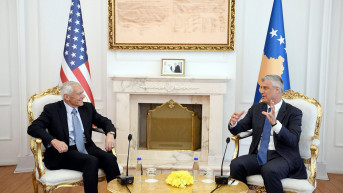
Retired U.S. General Wesley Clark, Supreme Allied Commander Europe during NATO’s 1999 bombing of the Federal Republic of Yugoslavia, who tomorrow will begin testifying before the Kosovo Specialist Chambers in The Hague as a defense witness, is well-known for lobbying for Kosovo and for his close ties with former KLA leaders.
Tomorrow he will once again appear before a court in The Hague—the city where he testified two decades ago, but that time against former FRY President Slobodan Milosevic.
Clark served as NATO’s Supreme Commander for Europe from 1997 to 2000, thereby commanding the Alliance’s military operations during the Kosovo war.
Since then, he has been a welcomed and celebrated guest in Pristina, where he has been received with military honors and even given a street bearing his name.
Kosovo has also awarded him distinctions for his “contribution to independence.”
The man he will testify on behalf of tomorrow—Hashim Thaçi—decorated Clark in 2018, as President of Kosovo, with the Presidential Medal on the occasion of the 10th anniversary of Kosovo’s declared independence.
Among other recognitions, the Democratic League of Kosovo bestowed on him the Ibrahim Rugova Award for his “historic role and contribution to Kosovo’s liberation.”
He has never concealed his open support for Kosovo.
“This country was created thanks to your rebellious spirit and the perseverance of its citizens to attain freedom,” Clark told Kosovo President Vjosa Osmani several years ago, expressing his readiness to “continue supporting Kosovo as before.”
“Thaçi the Hero”
Clark has referred to Hashim Thaçi as a “hero,” and first met him during the Rambouillet negotiations in 1999.
In one statement to RTK, Clark said he had “no idea” whether the indictments of the Specialist Chambers were accurate, but claimed it was evident that the process was “a continuation of the same activities still visible 20 years later.”
He maintained that attempts to obstruct Kosovo’s progress had never ceased and that the “proposed indictment of President Hashim Thaçi” was simply another manifestation of those efforts. In his view, pressures and attempts to diminish Kosovo have never stopped.
Proud of NATO’s Bombing
Clark is proud of the NATO bombing. In an interview with ABC News, he said the operation resulted in peace in Kosovo.
“I am very happy that we were able to bring peace and democracy to Kosovo. Alongside us was a large group of people who were part of this operation, a great operational team, because we witnessed a great crime and injustice being committed—an inhumane treatment. We wanted it to stop so that people in the region could have peace and security,” Clark stated.
Addressing the Kosovo Assembly via video link on the 23rd anniversary of NATO’s air campaign, Clark said that NATO’s first strikes in 1999 changed the history of Kosovo and Europe.
“To all friends in Kosovo, to the government and the people of Kosovo, I wish to congratulate you on this very important day, March 24. On this day in 1999, NATO’s first air missions entered Kosovo, and this changed the history of Kosovo and the history of Europe. It gave hope and light to the entire world,” Clark said.
He stressed that he was honored to have been NATO’s commander and to have had the opportunity, as he put it, “to help stop ethnic cleansing.”
Clark has repeatedly said that Serbia must recognize Kosovo.
At this year’s panel of the American Chamber of Commerce in Kosovo, he stated that Serbia would eventually have to recognize Kosovo’s independence and that economic cooperation would then become unavoidable.
Speaking on economic issues, Clark encouraged Kosovo to embrace regional cooperation with neighbors such as Albania, North Macedonia, and, as he phrased it, “even Serbia,” emphasizing that “ultimately Serbia will have to accept Kosovo’s independence and economic cooperation will be inevitable.”
“The global public is watching Kosovo, and the best way to strengthen its security is through economic development and investment, especially from the United States,” Clark said.
Recently, he told CNN that NATO must do more for Ukraine, citing Kosovo as an example of a successful intervention—“a free and democratic country 25 years later.”
He has not refrained from accusations toward Serbia and its leadership, claiming that Serbia is “Russia’s hand in the Balkans” and that President Aleksandar Vucic is an “eastern player” who wants Putin “to enable him to obtain at least northern Kosovo, but also the Republic of Srpska in Bosnia and Herzegovina.”
According to Clark, when conflict erupts in Ukraine, problems return to the Balkans.
Politician, General, and Businessman
Wesley Clark, born in Chicago in 1944, is an American Democratic politician, entrepreneur, and retired military general. He comes from a Jewish family that emigrated to the United States from Belarus.
Clark graduated as the top cadet of his class at West Point in 1966 and received the Rhodes Scholarship to Oxford University, where he earned a degree in Philosophy, Politics, and Economics. He later completed studies at the U.S. Army Command and General Staff College with a master’s degree in military science.
He commanded an infantry company in the Vietnam War, where he was wounded four times and decorated with the Silver Star for bravery in combat. He spent 34 years in the U.S. Army, receiving numerous military decorations, several honorary knighthoods, and the Presidential Medal of Freedom.
He sought the Democratic presidential nomination in 2004 but withdrew after winning only the Oklahoma primary. He subsequently endorsed John Kerry’s campaign.
Clark also attempted to use his contacts in Kosovo for business ventures.
Representing the company Envidity, he sought investment permits for energy-related mineral extraction.
“Envidity Energy Kosovo” was interested in underground coal gasification and the production of synthetic gas, diesel, and kerosene.
The company first applied for three licenses in 2013, covering over 3,400 square kilometers.
Three years later, Envidity again applied for a permit and was granted authorization to explore coal resources on one third of the territory it requested, according to the Balkan Investigative Reporting Network (BIRN).
From Bosnia to Kosovo
Clark was sent to Bosnia and Herzegovina by U.S. Secretary of Defense William Perry to serve as the military member of the diplomatic negotiating team led by Assistant Secretary of State Richard Holbrooke.
Holbrooke later described Clark’s position as “complicated,” as it offered future opportunities but could “bring him into conflict with senior officers whose careers might be threatened.”
Clark returned to Europe and the Balkans when he assumed command of U.S. Southern Command, after which President Clinton appointed him to U.S. European Command in 1997.
Just as with Southern Command, Clark had not been the initial choice, but Clinton and General Shalikashvili believed he was the right man for the job.
Clark thus took command of 109,000 U.S. troops, their 150,000 family members, 50,000 civilian support staff, and overall U.S. military operations in 89 countries across Europe, Africa, and the Middle East.
This position made him NATO’s Supreme Allied Commander Europe (SACEUR), giving him overall command of NATO forces in Europe.
Under President Clinton’s orders, Clark launched the bombing—codenamed Operation Allied Force—on 24 March 1999 in an effort to enforce UN Security Council Resolution 1199 after Yugoslavia rejected the Rambouillet Agreement.
Critics note that Resolution 1199 called for a cessation of hostilities but did not authorize any military action.
U.S. Defense Secretary William Cohen saw Clark as having powerful allies in the White House, such as President Clinton and Secretary of State Madeleine Albright, who enabled him to bypass the Pentagon in promoting his strategic ideas.
Clark, however, felt he was not sufficiently included in consultations with the National Command Authority, describing himself as “merely a NATO officer who also reported to the United States.”
This command dispute culminated symbolically when Clark was initially not invited to the NATO 50th anniversary summit in Washington, despite being the Alliance’s top military commander. He eventually secured an invitation, but Cohen instructed him not to speak about ground troops, to which Clark agreed.
The bombing ended on 10 June 1999 by order of NATO Secretary-General Javier Solana, after Milosevic accepted the conditions set by the international community and Yugoslav forces began withdrawing from Kosovo.
UN Security Council Resolution 1244 was adopted the same day, placing Kosovo under UN administration and authorizing the deployment of peacekeeping forces.
The Slatina Airport Dispute and Jackson’s Refusal — Prelude to Clark’s Retirement
Clark was prematurely removed as NATO’s Supreme Commander partly due to his order during the operation to seize Pristina airport, instructing British General Sir Mike Jackson to confront the Russian troops stationed there.
Jackson refused, delivering the now-famous line:
“I’m not going to start World War III for you.”
According to testimony by Russian General Leonid Ivashov before the ICTY during Milosevic’s trial, Clark rejected all Russian proposals aimed at de-escalation in Kosovo and had been preparing for an attack on Yugoslavia as early as 1997, partly in cooperation with the KLA.
Clark denied these claims.
He now comes before the Specialist Chambers as the “biggest star” witness, following James Rubin, Paul Williams, and Christopher Hill. He is the final defense witness for the former KLA leadership, after which a status conference will be held.

0 comments