
Who’s Who – Nexhmedin Spahiju: A mathematician warning of war if Belgrade and Pristina fail to implement agreements
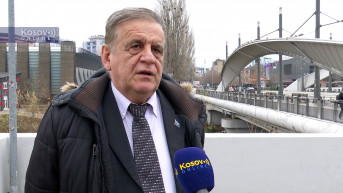
A recent meeting and photograph of Nexhmedin Spahiju with Serbian Foreign Minister Marko Djuric, taken in the minister’s office in Belgrade, triggered a wave of reactions on the university professor and political analyst’s Facebook page—ranging from sarcastic remarks about the absence of the Kosovo flag in the picture to arguments that “even the worst enemies must be spoken to if it protects Kosovo’s interests.”
Djuric stated that he and Spahiju had discussed ways to overcome tensions and improve interethnic relations, while Spahiju explained he was in Belgrade attending a conference and accepted Djuric’s invitation for a one-hour meeting.
The photo particularly angered former KLA member Ridvan Tahiri, who publicly called on the Kosovo Prosecutor’s Office to investigate Spahiju over what he termed a "controversial visit."
“Spahiju should consider himself lucky I’m not heading the security institutions—otherwise, he would have met the same fate at the Kosovo border as his friend once did,” wrote Tahiri.
Spahiju is a regular media commentator on political and social developments in Kosovo. Regarding peace in the Balkans, he insists there are only two options: either Belgrade and Pristina implement the agreements reached through dialogue, or war will break out.
When discussing the Ohrid Agreement, Spahiju often emphasizes that the formation of the Community of Serb Municipalities (CSM) is the top priority for Serbia. For Kosovo, he argues the most crucial step is opening permanent diplomatic missions—Kosovo in Belgrade and Serbia in Pristina—as a quiet, de facto recognition of Kosovo’s statehood.
He believes the creation of the CSM depends on whether Belgrade fulfills its obligation to open a Serbian diplomatic office in Pristina. According to him, such a move would pave the way for the five EU member states that have not yet recognized Kosovo to do so.
When the Kosovo Central Election Commission refused to register Serb List for the February 9, 2025 parliamentary elections (a decision later overturned after an appeal), Spahiju described it as a serious mistake.
“Serb List must be registered because it is the largest and most influential party within the Serbian community in Kosovo. I believe Self-Determination is playing political games before the election to appear more patriotic than others,” Spahiju said at the time.
He considers Kosovo’s Prime Minister Albin Kurti to be a patriot and uncorrupt, but also deems him unfit to govern.
Two years ago, he stated that Kurti would remain in power only as long as it suited the U.S.
“Kurti will certainly stay in power while he’s useful, but the moment he’s seen as a liability to U.S. strategic interests, he’ll be removed from the political stage,” he predicted.
He has also criticized Kosovo President Vjosa Osmani for allegedly using international contacts for personal promotion rather than for Kosovo’s benefit.
Commenting on the results of Serbia’s December 2023 parliamentary elections, in which the Serbian Progressive Party won, Spahiju noted that the outcome shows Serbs are not inclined to resolve the Kosovo issue through war—but also not ready to embrace rapid integration into the European community.
He harshly condemned Albanian Prime Minister Edi Rama’s cancellation of a planned joint session of the Kosovo and Albanian governments in 2023, calling it a humiliation of Kosovo by Tirana. Spahiju suggested Rama should be treated similarly and denied entry into Kosovo on the next occasion.
Spahiju advocates the view that while Albanians in Kosovo and Albania share the same ethnicity, they constitute two separate nations. He warns that if Kosovo were to unite with Albania, one of those nations would eventually cease to exist—depending on where the capital would be.
Given current tensions between the U.S. and EU, Spahiju believes that Turkey is beginning to play a key role both in the Balkans and the Middle East.
Political Experience and Academic Background
Spahiju has also tested the political waters. In 2009, he ran for mayor of Mitrovica as the candidate of Behgjet Pacolli’s Alliance for a New Kosovo. He finished second with 22.57% of the vote.
He was born in Mitrovica on September 20, 1964, where he still resides.
A PhD in mathematical sciences, Spahiju completed his master’s studies in Southeast European studies at universities in Zagreb and Budapest. He has taught at universities in Tirana, Tetovo, Hamburg, and Pristina.
In 1999, he founded RTV Mitrovica. He served as editor-in-chief of the newspapers Albania and Republika in Tirana in 1995, and from 1990 to 1995, he was editor of the journal Republika in Slovenia.
He has published academic papers in mathematics and political science and authored several books, including The Childhood of the Kosovo Nation and Kosovo and Albania in the Future: Closer or Further Apart?
He speaks both English and Serbian.
0 comments