
Radovanovic: Regional leaders in Skopje on the formation of a common market, Open Balkan still open
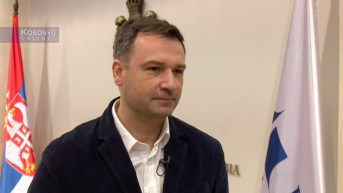
The head of the Center for Regional Cooperation at the Chamber of Commerce of Serbia, Aleksandar Radovanovic, says for Kosovo Online that during the summit of Western Balkan leaders regarding the EU's plan for the region's growth worth six billion euros, taking place on Monday in Skopje, representatives of states and economies in the region will discuss accession to the common EU market as well as the formation of a unified regional market, which is, as he says, precisely what the regional initiative Open Balkan strives for and contributes the most to.
Ahead of the gathering of regional leaders, protocols on free access to the labor markets of participating countries - Serbia, North Macedonia, and Albania, were supposed to be signed within the Open Balkan initiative. However, this event, as explained, has been postponed until all technical conditions for the implementation of agreed measures are met.
It is stated that all protocols related to the conditions for free access to markets, as well as electronic identification schemes, are fully harmonized, and technical teams in each country are taking the appropriate final steps and activities to ensure this measure benefits citizens as soon as possible.
Radovanovic explains that the protocols on free access to the labor market will enable the mobility of the workforce from the three Open Balkan member countries. The allocation of the so-called 'Open Balkan number,' based on which one applies for a residence permit and a work permit simultaneously, will simplify the application process for residence and work permits. The application will be made electronically through e-government, saving time and money for citizens and making it easier for them to apply for jobs in all three countries.
He points out that representatives of the Chamber of Commerce of Serbia and other chambers of the member countries of the regional initiative Chamber Investment Forum WB6 have been invited to Skopje regarding the Growth Plan for the Western Balkans, hosted by the Prime Minister of North Macedonia, Dimitar Kovacevski.
"A representative of the Chamber of Commerce of Serbia will be present at this forum, where discussions about accession to the common EU market are expected to be the main topic. This will be one of the topics, and the second will be the establishment of a common regional market, i.e., the challenges we face in terms of integration into one market," he said.
He assesses that the Open Balkan initiative has the fastest potential to lead to the realization of a common regional market, which is why he believes that it has a tendency to expand further in terms of new member accessions.
Montenegro and Bosnia and Herzegovina, as he says, have already shown interest in joining the initiative.
"From the very beginning, the Open Balkan initiative has been open to all members of our region, and the invitation to join is open to everyone. There was a certain interest when it comes to Montenegro. We believe that in some time, Montenegro, Bosnia and Herzegovina, and other members of the region will see that the Open Balkan initiative is in the interest of all and leads to the establishment of a common regional market more quickly," Radovanovic emphasized.
Speaking about the achievements of Open Balkan so far, Radovanovic highlighted that the greatest benefit was the facilitation of trade in agri-food products, mutual recognition of phytosanitary certificates, reports from accredited laboratories, as well as the introduction of tags on highways through Macedonia and Serbia, and faster border crossing for freight traffic, thanks to green corridors.
"We are now striving to establish a new terminal in Presevo by June, which will provide two separate lanes for freight traffic, thus increasing throughput for both freight and passenger traffic. I expect there will be significantly fewer jams in the summer period," he announced.
Regarding cooperation in the fields of energy and food security, Radovanovic says that Open Balkan has contributed to these processes functioning smoothly within the initiative, regardless of the geopolitical situation in the world.
"All three countries immediately reacted, and the bans that were introduced at the beginning of the war in Ukraine for the export of certain food and energy no longer exist between Open Balkan member states," he reminded.
When asked whether Open Balkan has "completed its mission," he said that despite politicians' statements, practice showed that it was not the case and that the initiative was still open.



0 comments