
Daniel Smith or Do Balkan Pundits Dream of Electric Sheep?

What a fake Balkans expert tells us about his real counterparts
One of the tell-tale signs of a bot account is a Twitter handle consisting of a generic name and several numbers. Thus when, a few months ago, I saw opinions of a certain Daniel Smith aka DanielS18352008 cross my feed, I immediately muted him. “He” had interests in “International Relations, Politics, Security Ukraine [and the] Western Balkans” and “kept an eye on Russian disinformation, propaganda, and hybrid warfare!”, which in practice meant that he was posting hysterical propaganda and pure chauvinism, thinly veiled in catch-phrases of the day.
In the world of Balkan punditry both, indeed, are features, not bugs.
Real “experts” and “commentators” publish pieces in “reputable” publications to excuse murders of political leaders as something that “Kosovo needed” (it was recently stealthily retitled) and regularly dehumanize whole nations as inherently evil (Muharem Bazdulj, one the best essayists in the region made a great round-up of those). These excesses come on top of general aversion to actually write about goings-on in the region, as opposed to comically and predictably one-sided think pieces, with a lot of dramatic, emotional language.
Factual errors and omissions are the norm, and generally swing one way, such as when Serbs were accused of attacking KFOR, when there is Holocaust distortion, when a mistranslated statement by the Serbian PM and launched a full blown social media campaign praised by “reputable” press and any number of regular jingoistic pieces which have, in the past, cost actual lives of people in Kosovo (Lily Lynch’s article in the New Left Review offers a good summary).
I was not shocked that unsubstantiated troll-like musings were published by publications such as as Al Jazeera Balkans, Danas and Geopost, a new Pristina-based outlet “fighting propaganda” funded by the US Embassy, but was a bit surprised that they were presenting Daniel Smith as a real person. For them, he was a Balkans expert from the UK however, it was strange that there were no specifics given as to what makes him an expert, something that anybody with a basic grasp of reporting would include.
Thankfully, a fellow Twitter user, Mirko Radoš, decided to dig deeper and provided strong arguments that Daniel Smith does not exist. It turned out that “Smith” is probably an Albanian nationalist posing as a British commentator who left many red flags. Other users analyzed Smith’s photo and proved it to be AI-generated, something that editors and journalists of all these outlets, some of which enjoyed being part of various Western government-funded anti-disinformation and media literacy programmes, failed to do. This effort generated a lot of buzz on Twitter and proved to be embarrassing for publications that published him. They retracted their reporting, and Daniel Smith deleted his account. Danas also published a strange (non-)apology, in which Smith’s interviewer blamed Russian and Serbian disinformation machines. The funniest part of this strange article was a frank admission that Smith was expressing views that are so common among Balkan experts, that they let their guard down and played themselves into the trap of their scheming foes.
This made me think about what we can expect from Balkan pundits and journalists in the future. I’ll leave it to the smarter, more analytical, and harder working people to try to understand how beneficiaries of extensive anti-disinformation training and funding ended up spreading low-quality propaganda by such an obviously fake person, and how information operations work in the Balkans.
For me, this strange case revealed the true nature of “pundits” and journalists at the cusp of major technological advances that will change media.
Ever since I started following much of the coverage of the region, I noticed that a lot of punditry and reporting had a predictable, algorithmic, quality to it. I even produced a flow chart on how to deal with crises and long suggested that, in light of falling media revenues, some of the tritest pieces can be written by smart text generators. The latter advice was recently heeded by Buzzfeed. With the ever more sophisticated AI-powered voice and video, whole media productions could be made without actual humans, relentlessly pushing whichever narrative.
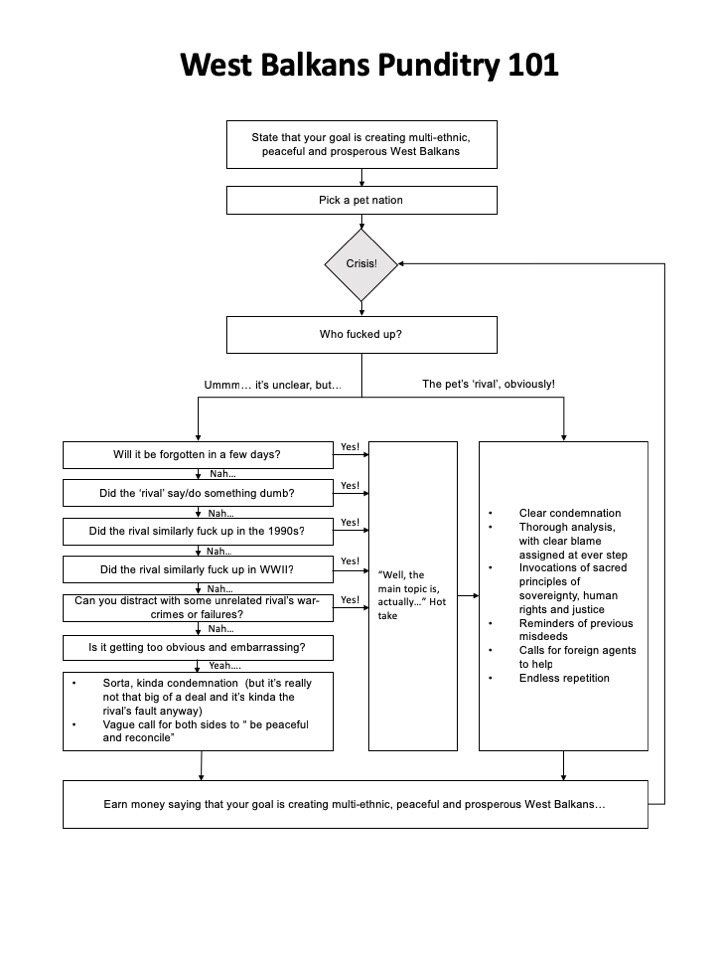
The only value humans have is providing a certain veneer of prestige and neutrality. In the case of Daniel Smith, that was simply his “Britishness”, another testament to the long and sad tendency of Balkan elites to fetishize “the West”. However, I wonder, if all the flesh and blood contributors to Danas, Al Jazeera Balkans, and the like, who invested time and effort into their “careers”, stop and think about what is the purpose of their existence if they can be replaced and even upstaged by a literal non-entity. We have finally come to the question long asked by androids in Philip K. Dick stories: What is exactly one’s purpose when you can be approximated by an algorithm and a bad AI-generated image, and only are relevant as long as you serve a goal?
Written by: Srdjan Garcevic, founder of TheNutshellTimes.com


0 comments