
Dialogue - an urgent need of the modern world

Writing for Kosovo Online: Zeljko Sain, Politika's special correspondent from Skopje
Unfortunately, the Balkans is once again a region where we cannot control tensions. After a century of experience, we can conclude that the Balkans air does not breathe reconciliation, at least for now, nor are there signs of normalization of relations between Belgrade and Pristina, Sofia and Skopje, and there is no sign of suppressing the "Ukrainian pandemic", which can be transmittable and highly contagious, especially for a region without immunity.
This kind of atmosphere in the Western Balkans, in which even fascism and Nazism flourish, is stimulated by the actions of politicians from Pristina, Sofia, and even Kyiv, who introduce themselves into history by using military weapons, while, on the other hand, we have those Slavic people who, with their statesmen at the head, oppose such ideology and claim their place in history by fighting for peace.
First, we cannot ignore the fact that the presidents of the most powerful countries in the world at the moment - Putin and Biden - keep dialogue on the military-political scene, as the most modern tool for conflict resolution. The world is still at a crossroads, where one road shows peace and the other war.
While the war in Ukraine is in full swing, arms caches are emptying faster and faster, which many countries use for their own enrichment, Serbia persisted under pressure not to sell arms for the needs of the Ukrainian market. Despite his neutral policy, John Bryan, an American media expert, during his visit to Podgorica, Skopje, and Tirana, accused Belgrade of spreading disinformation from Russia and China. The goal of this accusation was to discredit Serbia and its state leadership, to belittle it in the negotiations with Pristina, and maybe we missed something else.
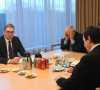
At a time when the outcome of the talks between Vucic and Kurti as part of the Brussels agreement on the normalization of relations between Belgrade and Pristina is uncertain, let us recall the words of the two most important statesmen and spiritual leaders of Catholicism, the leaders of the Vatican, who did not recognize the independence of Kosovo. In the interviews that Pope Francis and Vatican Secretary of State Pietro Parolin gave exclusively for Politika, they talked about the topic of peace, love, and dialogue, which is an urgent need in today's world.
Cardinal Pietro Parolin, the second man of the Vatican, on May 5, 2019, told our newspaper:
"I think that one of the needs that authentic reconciliation requires is the purification of memory. In order to do that, I think it is more than ever necessary to formulate a correct judgment of history over the events of the past, with sincere and courageous actions that are capable of opening a 'new tomorrow' for everyone, filled with truth and peace. I think that in that process the greatest attention should be paid to the elements that make the difference between the past and the present."
In this context, Parolin particularly emphasized the following.
"We need to get rid of apologetics, which wants to justify everything, and at the same time we need to avoid undeserved blame based on historically unsustainable responsibility."
From the beginning of his pontificate, Pope Francis established dialogue as an effective tool for solving social, political, economic, cultural, and religious conflicts - not only did he propose it, but he also adopted it as a way of life. Let's also remember his words that he addressed to the world through "Politika":
"In the encyclical 'Fratelli Tutti' I wanted to emphasize that 'great transformations are not created at desks or in offices.' There is an 'architecture' of peace, which is created by different institutions of society, each from its own competence, but there is also a 'craft' of peace, which includes all of us; it is a place of dialogue that entails putting aside the often empty and superfluous 'nice statements' in order to embrace a future where differences are recognized, valued and articulated in such a way that no one feels excluded. Today we do not need impressive monologues that prioritize the welfare of one community, sowing fear among those who are different. Dialogue does not mean canceling or ignoring differences and even wounds that may have been inflicted in the past. On the contrary, dialogue is a conscious and modest way of accepting history, injustices, and differences and positioning them in relation to the future in which the politics of integration and division, systems that imply an insatiable race for profit, and ideological tendencies that encourage hatred will not have the last word (see Document on Human Fraternity). Conflicts are not resolved by forgetting, ignorance, or 'erasing everything and starting over', but by dialogue, which involves recognizing the other and joyfully accepting that we are called to broaden our view to recognize the greater good, from which we will all benefit. No one matures or reaches their fullness by closing in on themselves and their beliefs, no matter how valid they are. It is important to remember that healthy openness never compromises identity. Enriching itself with elements from other places, living culture does not make a copy or mere repetition, but integrates novelty in its own way."
The modern age lacks one Andrei Gromyko, who was the Minister of Foreign Affairs of the USSR for 27 years and resolved the Cuban and Indian-Pakistani crises, guided Khrushchev and Kennedy with his diplomatic experience to prevent the third world war; or one Henry Kissinger, who resolved conflicts only with the facts at the table, not with the wishes of individuals; or one Mihajlo Pupin, a respected world scientist who, together with Tesla, set new civilizational trends in the world, and as the honorary consul of the Kingdom of Yugoslavia in the USA managed to preserve the territorial integrity and sovereignty of the Kingdom of Serbs, Croats and Slovenes with Wilson at the Peace Conference in Paris in 1918, after the Great War.
Everything always ends with dialogue, which has only one solution - compromise.

0 comments