
It's peaceful while the church is burning
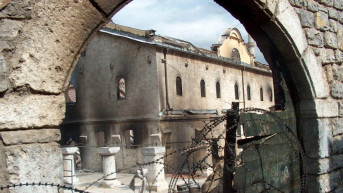
One fake news published on the public service RTK forever changed the life and legacy of Kosovo and Metohija. Nineteen were killed, 39 churches and monasteries destroyed, 4,000 expelled Serbs, Roma people, Ashkali...
"The Serbs forced a group of Albanian children into the swollen Ibar and three of them drowned”. This fake news is the basis of the campaign that started the Pogrom on March 17, 2004, in Kosovo and Metohija. The explosion of violence, in which a crowd of about 50,000 people, almost perfectly, precisely, and targeted, wiped out one particularity, could not stop life. In vain and subsequently, the UNMIK police conducts an investigation, and its spokesperson Neeraj Singh declares that the children who survived were "under strong pressure from Albanian journalists and politicians to accuse the Serbs from the neighboring village".
However, it is too late for 19 killed, 39 churches and monasteries, thousands of houses and buildings, and thousands of graves... Thirty thousand KFOR soldiers, police, and secret and public services failed to protect four thousand expelled Serbs, Roma people, and Ashkali; libraries were burned – monastery, private and school ones; icon collections were blown up and destroyed in Pristina, Urosevac, Djakovica, Podujevo; iconostases, frescoes, Uros Predic in Stimlje disappeared, urban areas, Potkaljaja in Prizren, villages and fragile returnee communities were lost. Basically – one piece of news published on the RTK public service changed the life and heritage of Kosovo and Metohija forever. What did the media in the Serbian and Albanian languages do that day, how did they survive and what is their view of the Pogrom, almost two decades later?
"There is chaos here," Valentina Cukic reported, editor of Kontakt Plus radio from Kosovska Mitrovica. This brave and unique woman was seriously wounded in Pristina in 1999. She survived by a miracle but remained in her profession - collected and smiling. Her voice about the Pogrom that day was like a cry and was a prelude to disaster. Her colleague Ivana Vanovac from Kosovska Mitrovica received her first work assignment that day. "I fell right into the fire, and it was immediately clear to me that there is no justice in this world. We realized that the whole world was silent. Since then, I don't expect that world to ever speak about Serbian suffering again. We heard and remembered that silence well. Once again, a part of the Serbian hope of Kosovo has gone," Ivana says for "Politika", adding that the TV cameramen did a perfect job in those days.
Half an hour after the dramatic news from Kosovska Mitrovica, the storm hit Caglavica. Telephone connections are almost down, and journalists are reporting about a crowd heading toward Gracanica. Cameraman Goran Avramovic, tall and with long flowing hair, jumps on one leg, hit by one of the first stone that showered us. Journalist Budimir Nicic tries to understand what is happening and watches as the flames approach his and his parents' house. Today, he realizes that the media have also suffered, "A dozen Serbian media outlets have since gone out of business and the rest have stagnated and no development has taken place for 20 years. RTK, the public broadcaster and initiator of chaos, received a million euros to increase its capacities."
Everyone tried to send a message or a testimony that day. Swedish and Norwegian soldiers with smashed heads and broken arms were almost uninteresting to film as the crowd surged and approached each one individually and, it seemed, with purpose.
"One Serb was wounded by a sniper shot in the leg, three bombs were thrown, and an entire street in Caglavica was on fire," the writer of these lines reported to an editor in an important national agency. "Who is the source of this news, do you have confirmation from the police?" asked the voice on the other end. The answer followed, "I see it with my own eyes!" Everything turned into a collection of pictures and only those who had connections with other Serbian ghettos in Kosovo and Metohija could understand what was happening. RTV Most journalist Zoran Babovic reported from Kosovo Polje that the fire was engulfing one Serbian house in this neighborhood and that the flames were approaching the building of Masinski Park, where the Serbs lived at the time. The bad news began to spread and the Serbs began to flee towards the centers of their towns, towards the monastery, unknown where.
"Do you have anything positive, Babovic? Can you find out where the fire stopped and where are the Serbs who were not burned in Kosovo Polje?" Not long after that, news arrived that some sort of defense line had been formed between the villages of Bresje and Uglare in the municipality of Kosovo Polje. That news from journalist Zoran Babovic was the first sign that not everything would burn, although we later counted and recorded that 142 houses, the post office, the "Saint Sava" school, the Health Center, and the Russian Hospital was turned into ashes...
Thanks to the network of terrestrial links and repeaters on the hills, which, according to the idea of the Association of Journalists of Serbia and with the implementation of the OSCE, connected the radio stations in Kosovo and Metohija, the Kosma network was created. It significantly contributed to understanding the extent of the chaos that engulfed the province.
"Radio Gorazdevac and I were part of the newly founded Kosma and later we realized the great role and influence on the inhabitants of the largest Serbian village in Metohija. Bad news came from all sides, so in fear of an invasion of Albanians from Pec, many residents packed their bags, ready to go to the KFOR base," Radio Gorazdevac editor Darko Dimitrijevic told "Politika". "My colleagues and I reported the situation from minute to minute at the checkpoints and the news that the Romanian KFOR soldiers stopped the crowd that was heading towards Gorazdevac," he adds.
The aggressive crowd turned its anger towards the returnee village of Belo Polje, while the Kosovo Police just watched what was being done and, according to the returnee's testimony, its members laughed. "During the evacuation of the Serbs from the church residence, an American woman, a member of the UNMIK police, shot a man from the crowd and prevented his knife swing from being fatal for the Serb returnee," Dimitrijevic testifies and adds that his fellow citizens were calmed by the news that the Spaniards were guarding the returnee village of Osojane. and that on that day it became clear to him that the Pogrom "made senseless the return process, which was stopped forever after that".
On this day, the crew of the Radio Klokot newsroom broke into the crowd in Gjilan. The atmosphere of the lynching, the column, and the armored vehicles were discussed in the exceptional feature-length documentary "Kosma" by Sonja Blagojevic. Radio director Nikola Stolic moved to America. Before this Pogrom, he did not check his messages.
On the other hand, the media in the Albanian language, in some places in coordination with the Kosovo Police Service, led and directed the conflict.
In the OSCE analysis of the Pogrom, it was noted that a reporter from the RTV Kosovo television reported from Djakovica that the citizens were protesting and that "the situation in the city is calm while the Serbian church is burning". An ordinary "natural" sentence of public service, which effectively ended the campaign of evil. After all, RTK received around 100,000 euros for training staff, and over time that sum reached a million euros. No one was replaced, no one answered and the general picture was transmitted to the media and the media community. Of the church and the complex, the collection of icons, and the library, nothing remained - only a slab in the ground on which the contours of the altar could be seen.
Cameraman Goran Avramovic later came to those remains with the refugees from Djakovica. A pile of stones covered them. Again, almost the first stone, hit Avramovic while he was crouching down and filming the burning candles. She plucked a strand from his tied hair and it remained on the altar. The Church of the Assumption of the Blessed Virgin Mary was rebuilt, and the words, hair, reports, and pictures of those who tried to bear witness to the ethnic storm and evil times remained in its foundations.
Writes: Zivojin Rakocevic, writer and journalist

0 comments