
Little Banjska
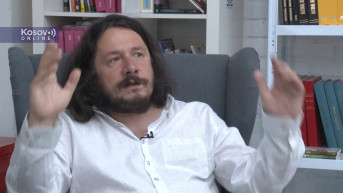
Writes for Kosovo Online: Muharem Bazdulj, writer and journalist
Just before the formal declaration of independence by the Albanian authorities from Pristina, Dejan Jovic offered an original solution to the entire Kosovo issue in one of his articles. His idea was to establish a border on the Ibar River between Serbia and Albania. Kostunica's Constitution, that is, the preamble would not be violated - Northern Kosovo would remain in Serbia, and in the future, it would be the only piece of territory officially called Kosovo. Because a part of the agreement would include the provision that Albanians are not allowed to officially use the term Kosovo/Kosova for the rest of the territory of the former Socialist Autonomous Province of Kosovo; it would simply be Northern Albania.
There were some symbolic coincidences: Kosovo is about 15% of Serbia's territory, while the part north of the Ibar is about 15% of Kosovo's territory, so both Belgrade and Pristina would abandon an equal percentage of territory. As an intellectual exercise, this entire proposal sounded very effective, but in practice, it was probably very difficult to implement. It included the idea of protecting the rights of the Serb minority in enclaves and the Albanian minority in Presevo, Bujanovac, and the surrounding areas in a similar way. It also aimed to create some mechanism for the protection of the Serbian Orthodox Church's holy sites south of the Ibar.
However, as much as the word "Kosovo" is significant to the Serbs, it is not an empty signifier, as they say. It's Pec, it's Prizren, it's Dečsni. Perhaps the only settlement with that political weight in Serbian history and culture located north of the Ibar is Banjska.
The importance of Banjska in contemporary Serbian culture was best recognized by Milena Markovic in the poem "Little Banjska." It's the poem that begins like this:
"I set off for Mitrovica on the Ibar highway,
where there are hoopoes, tractors, and trees heavy with fruit,
and girls with bare navels.
I reached Kosovo, where my mother was from,
and her mother,
and my sister was born there, and the doctor was drunk."
And it ends:
"and then I saw a sign on the right,
it said Banjska,
and there my grandma, mother, sister, the land got to me,
the graveyard, the Ibar River,
and it wouldn't release its grip on me,
it will never let me go because I remembered
in the middle of the night, I remembered,
and I will never forget Banjska,
because
someone was Strahinjic Ban,
he was Ban in little
Banjska."
When this poem was first published, I wrote this, "The poem would actually be less subversive (much, much less subversive) if it didn't have that devastating crescendo at the end. (...) It's like when a person first comes to Greece and realizes that the word 'metaphor' has a real meaning, beyond the metaphorical, when they realize that tradition is not fiction. The poet saw a sign on the right and realized that there was a place called Banjska. Then her grandma, mother, sister, the land, the graveyard, and the Ibar River got to her, both from the poem and in reality. Because there is both land and water, no matter how much some pretend it doesn't exist. There are grandmas, mothers, and sisters, and there is a graveyard, and there are people for whom all of this means something, and who will not let it go. But even this poem could have ended much better than it did, before the sign on the right, It would have been very good, but much, much less subversive. Because there is a language, there is culture, there is memory. There is also that which we would always remember, even at three in the morning, which would come to us in the dead of night. What Milena Markovic would remember in the middle of the night is connected to the little Banjska (...) One must be a poet to take the Ibar Highway and recall Strahinjic Ban at the Banjska signpost. Being a poet today means being able to reconcile the irreconcilable, it means embracing everything. To be a poet, in the true sense of the word, means being like Vlah Alija, a fusion of things everyone wishes didn't go together. There are few genuine poets today. Milena Markovic is a genuine poet. Being a true poet is not, at least from the perspective of everyday life, a particularly desirable position. But a genuine poet doesn't choose to be a poet; poetry chooses the true poet.
"What I'm going to say in the end has nothing to do with any analysis or information that "ordinary" people cannot obtain. It's just indicative that the largest, most serious, and most tragic incident in northern Kosovo in over a decade happened right in Banjska. And this is one of those situations where you should ask the question that high school students already know from their Latin textbooks: to whom does this suit, for whose benefit did this happen? From the Serbian perspective, it's important that people, who in their deepest intimacy, understand the verse, "Someone was Strahinjic Ban" contiune to live in Banjska. This is almost the last trace of our real presence in Kosovo.


comments