
Kosmet, an English word
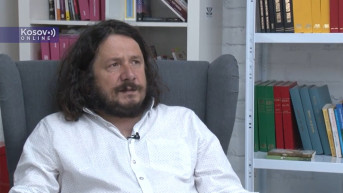
Writing for Kosovo online: Muharem Bazdulj, writer and journalist
Montenegro is called Crna Gora in Serbian, and Montenegro in English. Kosovo is called Kosova in Albanian, but in English it is called Kosovo, the same as in Serbian. Historically, it is easy to explain, the first mentions of Kosovo in English are related to Serbian history and culture. Nevertheless, in spite of this, some (pro)Albanian authors will use the term "Kosovo" in English-language texts as well.
Within the Serbian public, the attitude towards the constitutional-legal status of Kosovo can often be guessed from the terminology. Those for whom Kosovo is a southern Serbian province will often use the terms "Pristina", "Kosovo and Metohija", "KiM", and even "Kosovo", but never "Republic of Kosovo", which is again the favorite term of those for whom Kosovo is independent country.
In the English language, however, the term "Kosovo and Metohija" in all its incarnations (including "KiM" and "Kosmet") practically does not appear anywhere in the past quarter of a century. And it wasn't always like that.
These days I came back to a book that I read in detail about fifteen years ago: "Cities and Stones" by Brian Aldiss. SF fans will recognize the author's name. He is one of the most important authors of the science fiction genre, the author of several dozen novels and several hundred stories. Aldiss was born in 1945 and died in 2017.
The only prose book by Aldiss that belongs to the non-fiction genre is the mentioned book "Cities and Stones", which has not been translated in Serbia, but there is a Zagreb-Sarajevo edition from 2006 under the title "Oxford - Ohrid". It is a travel book through socialist Yugoslavia, a report on a six-month stay along and across Yugoslavia with his then fiancee.
Brian Aldiss and his fiancee Margaret Manson traveled through Yugoslavia in 1964. In the introduction to his book, he says: "Yugoslavia is an unusual and fascinating country. It is truly a unique country (...) Yugoslavia is a communist country. Leaving politics out of the overall picture would be like watching 'Hamlet' without the Danish prince (...)".
A little later, the author explains that Yugoslavia is a country of South Slavs, but that there are other ethnic groups in it, and adds: "Yugoslavia generally dealt with these differences in a reasonable and civilized way, especially with regard to the relationship with the Hungarians in the north in Vojvodina and with Albanians or Shiptars in Kosmet. Many minority groups in Europe - for example, Catalans or Walloons - would be happy to receive similar rights from their countries".
Let's once again pay attention to, as they say, "action time". The year is 1964, therefore, before the fall of Rankovic, that is the time when, according to an almost universal consensus within even South Slavic historiographies, the Albanian minority in Kosovo and Metohija was discriminated against. And Brian Aldiss, a man on the threshold of forty years of life, an Englishman who has traveled all over Western Europe, claims that the "minority policy" in Yugoslavia is superior to those in Spain and Belgium.
However, this topic is not present only in the introduction. The twenty-second chapter of the book is called "Discord in Kosmet". Aldiss's first interlocutor from Pristina tells him verbatim: "During the time of the Turks and the old Yugoslavia, Kosmet was the poorest region in all of Yugoslavia." A little later, Aldiss informs the readers that about 905,000 people live in Kosmet, and that 67 percent are Albanians, while the remaining 33 percent are Serbs, Montenegrins and Roma.
And although he points out that he also heard some "anti-regime comments" in Kosmet, this is his dominant impression: "It seems that this unstable mixture (often separated by religion, not just race) lives in harmony, which can be largely thanks to the recognition of minority rights . Radio Pristina blasts shrill Shiptar music, and one of our friends from Pristina, a Shiptar himself, works for the Shiptar newspaper Rilindiju, and as their correspondent he traveled from Algeria to Stratford on Avon". (Just to avoid confusion, the term "Shqiptar" is consistently used here by the author Aldiss himself, and translated as "Shiptar" by the Croatian translator Irena Raseta.)
As a man who is surely aware of the limitations that exist among journalists in countries of real socialism, Aldiss is completely fascinated by the possibility of a journalist from a minority newspaper traveling from Algeria to the birthplace of William Shakespeare. Today, Algeria does not recognize the independence of Kosovo, and even if Great Britain was one of the most passionate supporters of that independence, the authorities there do not even think of considering the possibility of canceling visas for Kosovo passport holders. Even English writers who write travelogues from the Balkans today are generally less talented but more prone to stereotypes.


0 comments