
Pupin’s borders
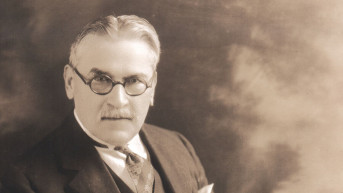
Publicist Zeljko Sajn published the book The Bell of Freedom - Pupin's Diplomacy (RTV-Press, Skopje). With the author’s consent, Kosovo Online publishes an excerpt from this book.
In the memorandum that he submitted to the President of the USA, Woodrow Wilson, on April 19, 1919, Pupin relied on the ethnic principle of demarcation and the right of peoples to self-determination and democracy, whose representative and ideologist at the Paris Conference was Wilson himself. A few days after the submission of that memorandum, on April 22, 1919, the Paris papers published President Wilson's statement that the United States did not recognize the London Pact.
Mihajlo Pupin was a supporter of the idea of liberation and unification of all occupied parts of the Serbian people in the Austro-Hungarian and Turkish empires.
Thesis on the creation of the so-called Greater Serbia was also present in the Balkan wars, until the middle of the First World War, when it was opposed to the thesis of the creation of Yugoslavia. At that time, many leaders of the struggle for the liberation and unification of the Serbian people clashed over such a concept.
Pupin came into conflict with other members of the Yugoslav National Council due to the interpretation of certain positions of the Corfu Declaration. Since he was better informed than others, he tried to present the real situation - for which the great powers, including America, were ready. He claimed that the Allies would solve the Yugoslav issue by expanding the Kingdom of Serbia into the Kingdom of Serbs, Croats and Slovenes, which would be a federative monarchy headed by the Karadjordjevic dynasty and in which all parts of the Yugoslav people would be equal.
Mihajlo, who was not at all soft and sensitive, especially when his ideas were in the middle, was very affected by the Serbian discord in America in 1917. Much more than the attacks of his opponents, because he understood the goal of the attacks - to diminish his importance among the Serbian community in America and weaken its influence. He considered the article The conflict of Serbs in America harmful and that it was published at the least convenient time. He was aware that the young Serbian democracy, in addition to undeniably gifted politicians, also created a strain that would come to the fore in Serbian politics, a strain of professional politicians who think only of themselves and their own interests. Although the Serbian government supported him to end that episode with Milicevic and Pribicevic, there remained bitterness and a thought, which was not characteristic of him, about the futility of so many efforts... "I will not give up... In my way..."
... The Kingdom of Serbia had the largest delegation of 110 members after the United States at the Peace Conference in Paris. Nikola Pasic knew how much respect and influence Mihajlo Pupin had in the American delegation. At the time of Pupin's arrival in Paris, the struggle to establish the borders of the Yugoslav state was extremely difficult. Based on the London Pact, which England, France and Russia signed during the war, Italy demanded that a significant part of the territory of Dalmatia, Istria and part of Slovenia belong to it. Romania claimed the Banat, the Bulgarians claimed eastern Macedonia up to Skopje, and Medjumurje and Baranja were also disputed.
Austria-Hungary wanted to keep all territories, including Bosnia, for which it had great support from the Vatican. The Holy See openly sided with Austria-Hungary in all disputes and war conflicts. The Corfu declaration on the unification of the Yugoslav peoples, which was signed in July 1917 by the Serbian government and the Yugoslav Committee, caused the Vatican to be indignant. In the peace note of Pope Benedict XV, published on August 1, 1917, it was demanded that Austria-Hungary be preserved and that the situation in the Balkans be restored as it was before the Balkan wars. Robert Lansing, US Secretary of State, managed to convince US President Wilson to reject the Vatican's peace note, claiming that the Pope's proposal was unfair and contained nothing new, that it neglected the Belgian question, the restoration of Poland, reparations for the destruction caused to France, Belgium, Serbia and Montenegro.
Wilson highly respected the opinions of experts in order to create such relations between peoples and countries that would ensure a just peace for generations to come. President Wilson had a large team of experts at his disposal. A group of informational researchers, the Inquirers, was formed at the request of President Wilson in 1917 with the aim of preparing information for the upcoming conference. The group consisted of about one hundred and fifty researchers of various specialties. Geographical research was managed by Isaiah Bowman, and cartographic work by Mark Jefferson. Basic tasks were carried out in the field of cartography, a wide program of compiling various thematic maps of Europe, including the Balkan Peninsula, was realized. The maps contained information on geological structure and relief, population density and its ethnic composition, agriculture, industry, traffic, settlements, as well as many other data that could be necessary for conference participants when considering disputed territories and borders. All negotiations at the Versailles Conference were accompanied by a demonstration of maps, so it was said that one map is worth ten thousand words.
Maps have become the international language of the conference. Copies of the maps of Europe entered the Black Book, and the American delegation had the maps in the Red Book. Other delegations also had their maps and geographic advisors at hand. The task of these experts was to study even the smallest detail that will be discussed at the conference. They studied not only the history, ethnology and geography of the individual countries between which the conference will draw borders, but also every writing, every book of a political character that related to these issues. Affairs were arranged in such a way that President Wilson did not need to look at a map when deciding on borders. He only had to ask his experts if it was a natural national border, to ask another expert how that border stood with regard to possible defense against the onslaught of conquest. Third experts had to say how such drawn boundaries would affect large facilities for flood control and the fight against other disasters.
Pupin turned to his old friend Colonel House to help him in this business, and the latter replied: "Whatever you persuade our experts to do, we will agree!"
That spirit of trust and intimacy of Mihajlo Pupin with American friends and new friend Jovan Cvijic marked the Paris Conference.
With the help of experts from the Yugoslav delegation, Pupin collected objective and convincing data at the Peace Conference in Paris. He mostly collaborated with Jovan Cvijic, Trumbic, Kosta Stojanovic, Trinajsticf, Jogler, Radovic, Bishop Zermenski, Proto Mihaldzic, Tresic-Pavicic, Ribarz and other experts in the delegation.
The Americans themselves believed that the Yugoslav border with Hungary should run along the Danube and the Drava.
Since the Americans and President Wilson highly valued him, Pupin was the person through whom the Yugoslav delegation tried to especially influence the representatives of the USA.
He was involved in all border issues, especially those towards Italy and Austria, and he also played a certain role in deciding on the border towards Hungary. That role was certainly far from the point where it could be said that the Serbian parts of Banat and Baranja, as well as Medjumurje, were saved only by cooperating with Pupin, but Pupin's influence on the Americans was probably such that it should be taken into account. In the memorandum that he submitted to US President Woodrow Wilson on April 19, 1919, he relied on the ethnic principle of demarcation and the right of peoples to self-determination and democracy, whose representative and ideologist at the Paris Conference was Wilson himself. A few days after the submission of that memorandum, on April 22, 1919, the Paris papers published President Wilson's statement that the United States did not recognize the London Pact. In protest, the president of the Italian delegation, Orlando, left the Conference on the same day and traveled to Rome. According to the treaty between the Allies and Romania, the western Banat was supposed to belong to Romania. Pupin wrote the following about it:
"The Romanians were looking for that province. But they could not deny the fact that the population of Banat is Serbian... President Wilson and Robert Lansing found out from the Yugoslav delegates that I was a native of Banat, and thus the Romanian reasons lost much of their persuasiveness..."
The events surrounding Bled inexorably pointed to a completely opposite solution...
"When American experts confided in me that England and France had agreed to cede the Bled Basin to Italy, that President Wilson himself had signed the records in question, I pointed out a strategic argument against it. In this way, the door will be open for Italy to penetrate into Yugoslavia whenever it wants".
After being informed of this, President Wilson immediately revoked his signature on the record. Thus the Kingdom of SHS got the Bled Basin and Bled. When the Slovenian expert Ribarz heard about it, he wanted to meet with Pupin immediately. Upset, crying...
"Why are you crying, Mr. Ribarz?"
"Mr. Pupin, I am crying with happiness" .
Pupin was observing that shaken, hard man...
"If there's one thing I can't expect, it's that I'm going to make him cry. In science, it was easy for me to deal with the human race and its achievements. Here, in politics, where I consciously went astray, I knew that commitment and persistence must bring success... which can also have an impact on the human soul."
When the issue of Koruska came up on the agenda, the Slovenian delegates presented to Pupin the request of the Slovenian nation for unification. Pupin spoke with President Wilson's delegation and explained the need and justification for all of Koruska to belong to the Yugoslav state. American experts proposed that Koruska be divided into two zones - the southern one to be immediately ceded to Yugoslavia, and the northern one to Austria. Pasic was willing to accept it. However, the Slovenian delegates demanded a plebiscite, and at that plebiscite the whole of Koruska unexpectedly belonged to Austria. Apparently, the Slovenians did not properly evaluate the political determination of their compatriots.
Pupin also played a significant role in the Transmurian sector of the Yugoslav-Hungarian border. Dr. Slavic, a Slovenian expert on territorial issues, wrote that the "Serbian compatriot" Pupin also fought for the Transmurian borders, and that he "came to Paris and spoke to the Americans about our borders."
In early May 1919, Pupin presented the ethnological map made by Dr. Slavic on the basis of the Hungarian census of 1890, in which Slovenians were mentioned for the last time, to Johnson, his colleague from the New York Academy and from Columbia University, who based it on the proposed border line which is recognized as a border.
The question of the disputed territories in Baranja and Medjumurje, which the allies had already assigned to Hungary, was being resolved. Pupin, with a rational approach to solving the problem of the overflowing of the Danube and Drava, as well as moving these riverbeds at the expense of our territories, managed to convince the American delegation of the justification of the request. That was enough for the American attitude to be decisive for their joining to the newly created state.
Pupin asked the American delegation to cede all of Dalmatia and all of Istria to the Kingdom of Serbs, Croats and Slovenians. The American proposal was to cede all of Dalmatia and most of the islands of the Adriatic Sea to the Kingdom, and to divide Istria with Italy. Nikola Pasic communicated the American position to Anto Trumbic, Minister of Foreign Affairs of the Kingdom of SCS. Dr. Trumbic flatly rejected the opinion of the Americans. After that, the whole of Istria became part of Italy. This attitude of Dr. Trumbic disappointed Pupin, which was talked about by Professor Mitreski, with whom we stayed at the Vevcan springs near the houses of his ancestors. Pupin supported Wilson's forty principles that small nations should get their freedom. People who fought against the Austro-Hungarian and Ottoman occupation for centuries were also thought of. He also advocated for the autonomy of Macedonia. The Serbian delegation did not share that opinion with Pupin.
Pupin showed a special interest in favoring Macedonia and the Macedonian people. His ancestors, father Constantine's ancestors, came from Macedonia.
Pupin considered Macedonia his country and always used the terms Old Serbia and Macedonia. There was a danger that Bulgaria, with the help of the British, would take over part of Macedonia. Pupin advised against asking for Wilson's and American mediation in the Yugoslav-Bulgarian demarcation because he knew that there were Bulgarianophiles in the American delegation and he feared their possible influence, as well as the fact that the USA had never declared war on Bulgaria. Pupin believed that the negotiations should be left to France and Serbia.
Pupin also knew about the changing attitude of the British towards the Balkan issue...
"In short, Serbia has to choose between a bright future and the risk of losing everything", this was the attitude of the British first minister during the war, Mr. Grey. Later, the creation of the Yugoslav state would become one of Great Britain's war goals, especially since America entered the Great War. And on this occasion, Wilson's opinion ruled that Bulgaria was conquering other people's territories and thereby contributing to the turbulent situation in the Balkans. Wilson's condition was the withdrawal of Bulgarian troops from Serbia, Macedonia, and Epirus. Thus, Macedonia within its borders was ready to join the common state that was being created.
Written by: Zeljko Sajn, a publicist

0 comments