
Basic Court in Pristina: No Serbian flags or symbols during Vidovdan celebration in Kosovo
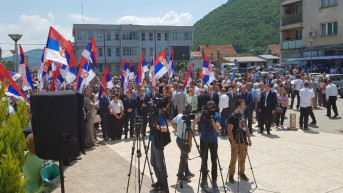
The Basic Court in Pristina has ruled that the decision made by the Municipality of Gracanica in June last year to mark and celebrate Vidovdan using Serbian symbols and flags constitutes an “overstepping of powers established by law.” According to the Court’s interpretation, such a decision “seriously undermines the unitary and constitutional character of Kosovo.” The Court also believes that the decision “seriously endangers public order and interethnic coexistence and may provoke interethnic tensions,” Gazeta Express reports.
As a reminder, on June 10 last year, the Municipality of Gracanica decided to commemorate and celebrate Vidovdan with the use of Serbian flags and symbols and submitted the decision to the Ministry of Local Government Administration for a legality review. Two days later, the Ministry forwarded the request to the Ministry of Internal Affairs for further legal assessment.
After its review, the Ministry of Internal Affairs responded to the Municipality of Gracanica and the Ministry of Local Government Administration, stating that “June 28 is not established as an official holiday or memorial day in Kosovo,” thereby questioning the legality of the decision.
As a result, on July 31, the Ministry of Local Government Administration filed a lawsuit against the Municipality of Gracanica, requesting the Basic Court in Pristina to annul the decision.
Almost a year later, in a ruling issued on June 9 of this year, Judge Kreshnik Kaciu fully upheld the Ministry’s lawsuit and annulled the decision of the Municipality of Gracanica, stating that “this ruling replaces the annulled act and has binding authority.”
The explanation adds that, according to the Law on Official Holidays in Kosovo, “only the Government, in cooperation with the President, may designate memorial days, two of which can be determined in consultation with the Serbian community.”
“Municipalities do not have the authority to declare special holidays with public impact, especially those involving the use of state or national symbols in public spaces,” the ruling states.
The Court assessed that the Municipality of Gracanica’s decision to allow the display of “another state’s flag” in honor of a holiday not officially recognized by Kosovo institutions constituted “an overreach of the powers defined by law.”
Such a decision, according to the Basic Court in Pristina, “seriously undermines the unitary and constitutional character of Kosovo.”
“According to Article 1 of the Constitution, Kosovo is a single and indivisible state, and municipal authorities cannot undertake actions that relativize this principle. Authorization to display another state’s flag (Serbia’s), outside legally defined cases, may be perceived as a symbolic act of dual sovereignty or political self-organization contrary to the constitutional order. Any such authorization without a legal basis can create a dangerous precedent for undermining the legal order and national unity,” the ruling further explains.
The Court determined that the decision by the Municipality of Gracanica “seriously endangers public order and interethnic coexistence.”
“This decision may incite interethnic tensions, especially if it is perceived that municipal authorities are favoring one community in violation of the legal order and the sentiments of other communities. This threat to public order is even greater when the symbols of another state are publicly displayed by a municipal authority, without the consent or authorization of central institutions,” the Court added.
The Court also rejected claims by the Municipality of Gracanica that “the decision has no extended or lasting legal effect and is clearly time-limited to June 28, 2024.” In this regard, the Court determined that the temporary nature of the act does not exempt it from illegality.
It is emphasized that this ruling should serve as a model for action not only for the defendant but also for all other municipalities in the future. It reaffirms that municipalities do not have the right to undertake actions that infringe upon the powers of the central government, that they cannot legalize the public display of foreign state symbols through independent decisions contrary to the Ministry of Internal Affairs and relevant laws, and that they must respect the hierarchy of acts and decisions of Kosovo’s central authorities.


0 comments