
Bauer: We must bring the Western Balkans countries out of the EU waiting room
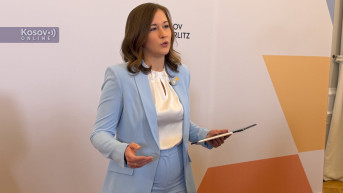
“We must bring the Western Balkans countries out of the European Union’s waiting room,” Austrian Minister for European Integration Claudia Bauer said today at an event held in Vienna as part of the Slavkov Format.
Bauer said that the Western Balkans conference, organized under Vienna’s presidency of the Slavkov Format, was being held to strengthen the focus on the EU enlargement process.
“We want to use our presidency of the Slavkov Format to refocus greater attention on EU enlargement, particularly on the Western Balkans. We must bring the Western Balkans countries out of the waiting room,” the Austrian minister stressed.
She recalled that more than 20 years ago the EU had promised that the future of the Western Balkans lay within the Union and that candidate countries had to meet clear conditions, such as strengthening the rule of law and implementing European standards.
“But those who implement these reforms must know that they can rely on the EU to keep its promise,” Bauer emphasized.
She pointed out that Montenegro was leading the accession process and had demonstrated what could be achieved with a strong commitment to implementing reforms, adding that it could become an EU Member State within a few years.
Bauer said it was necessary to discuss the next decisive steps because other powers, such as Russia and China, were seeking to expand their influence in the region.
“We cannot afford a geopolitical vacuum on our continent,” she stressed.
For that reason, she said, enlargement was not merely a political issue, but one of security and stability.
Bauer emphasized that discussions were needed on how to bring the region as close as possible to the European Union even before full membership.
She also said that the timing of the Vienna conference had not been chosen by chance, noting that Enlargement Commissioner Marta Kos had announced an “autumn of enlargement” and that progress reports were due to be presented in October.
In addition, a meeting of foreign ministers within the Berlin Process will be held in Montenegro in two days.
“With this conference, we want to strengthen the focus on the Western Balkans. Our intention is to place this issue high on the agenda in Brussels and ensure that the momentum generated in Vienna leads to progress in the process,” Bauer explained.
She stressed that both sides had to do their part and that there were clear criteria candidate countries had to meet.
She noted that some countries had made substantial progress on their European path, while others had “remained at the starting line.”
Bauer added that Vienna attached great importance to a gradual approach, stressing that this was not a substitute for full membership but could demonstrate to citizens the benefits that membership would bring.
“We want concrete results that we can take to Brussels. Austria, the Czech Republic and Slovakia are not only partners and neighbors, but are also united by the fact that they are friends of the Western Balkans. That is why we always insist that enlargement and the region must not disappear from the EU’s focus,” Bauer emphasized.
She also pointed out that EU countries had work of their own to do, noting that Austrians, for example, were among the most skeptical about enlargement.
Asked by Kosovo Online’s correspondent how Serbia and Kosovo could make progress on their European paths while the dialogue remained stalled, Bauer said it was important to contribute to stabilizing and normalizing relations between Belgrade and Pristina.
“The Belgrade-Pristina dialogue has been established. We are trying to achieve progress. But there must be a willingness on both sides to make that progress, and a framework for the normalization of relations exists,” Bauer stressed.
Asked whether there was such a willingness to advance the dialogue, she said she believed there was a desire for European integration and that “good-neighborly relations are a condition for membership.”
“Normalization of relations is a prerequisite for progress in the accession process,” Bauer emphasized.
Asked by Austrian journalists about Ratko Mladic’s funeral, she said that the announcement of a state funeral had been an irresponsible approach.
“However, I do not believe that progress in the accession process should be hindered merely because one minister had a bad idea. Serbia will have to be assessed on the basis of its reforms,” Bauer stressed.
Gorcevic: We are preparing to become an EU Member State
Montenegrin Minister of European Affairs Majda Gorcevic thanked the countries of the Slavkov Format—Austria, the Czech Republic and Slovakia—for their continued support for the European integration of the Western Balkans, adding that Montenegro was in the final stage of its path toward becoming the EU’s 28th Member State.
Gorcevic stressed that conferences such as today’s Slavkov Format meeting in Vienna were important for discussing the enlargement process, its challenges and everything involved in the path toward the EU.
“For us, this is particularly important because we are in the final stage. We are closing chapters and preparing for our main objective—to become the EU’s 28th Member State by 2028,” Gorcevic said.
Hoxha: Albania wants to join the EU
Albanian Foreign Minister Ferit Hoxha said today that the European Union was where Albanian citizens wanted to be and that Tirana would fulfill all requirements, within the established methodology and under the rules set by the EU, in order to become a member of the Union.
Speaking at the Slavkov Format conference in Vienna, Hoxha thanked the host, Austrian Minister Claudia Bauer, for Vienna’s support for EU enlargement, particularly with regard to the Western Balkans, and for its continued support for Albania on its European path.
“You can never have too many friends of enlargement and of the European perspective of the Western Balkans,” Hoxha said.
He stressed that, for Albania and the Albanian people, the path toward Europe was not merely a destination or a political objective—it was a return home, to the place where they belonged and where they felt part of a whole.
“That is where we want to be, and we will do our utmost. We will do everything within the methodology and rules established by the EU because that is what our citizens want. We will do everything we can to get there,” Hoxha said.
He added that much was happening in Brussels, but also in other European capitals, and that Vienna was one of the capitals from which Albania expected continued support.
0 comments