
Bosnjak: There is no discrimination against Albanians in Serbia; the problem lies in the ANC’s relationship with the state
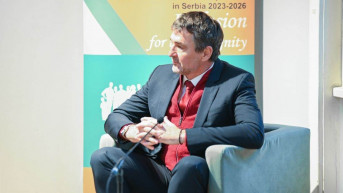
Ivan Bosnjak, State Secretary at the Ministry of Human and Minority Rights and Social Dialogue, commented on the draft law on the alleged discrimination of Albanians in Serbia, which was adopted by the Foreign Affairs Committee of the U.S. House of Representatives, stating that in recent years Serbia has made significant progress in its relations with the Albanian national minority.
Speaking to Euronews Serbia, Bosnjak emphasized that there are still several steps before such a law could be adopted in the United States.
“This is a draft law that has not yet been adopted, nor has it entered into force, as there are still several steps before it can be finalized. First, it must be voted on in Congress, and then confirmed so as to become binding for the President of the United States. However, this draft law shows that those who seek further disintegration of Serbia are not standing idle,” Bosnjak said.
He pointed to three important segments concerning the relationship between the state and the Albanian national minority in Serbia.
“The Coordination Body of the Government of Serbia continues to function. Then, another very important fact is that, for the first time—and unlike all other Balkan countries—Albanians in Serbia did not boycott the population census in 2022, but actively participated in it, regardless of the size of their diaspora. A large number of citizens of Albanian nationality have moved abroad in recent years, yet everyone was counted, and this is how all public policies are implemented. The third segment relates to the National Council of the Albanian National Minority, which, unlike many others, enjoys uninterrupted funding and, of course, operates successfully in the areas where it is granted authority by law and the Constitution—primarily education, the official use of language and script, the preservation of culture, and information,” the State Secretary added.
Bosnjak also explained that one of the candidates for the composition of the Regulatory Authority for Electronic Media (REM) came from the Albanian community. He further noted that his line minister, Demo Berisha, is himself a member of the Albanian community, and that, based on all of this, it cannot be said that there is any discrimination against Albanians in Serbia.
What does pose a problem, he stressed, is the relationship of the Albanian National Council (ANC) itself with state authorities.
“That is indeed the problem. They choose the issues they want to deal with. Seventy-six textbooks are currently awaiting approval by the National Council, while at the same time they are printing certain textbooks outside the systemic solutions of the Ministry—namely the Serbian Ministry of Education—despite the fact that, under the law, all low-circulation textbooks are free of charge both for publishers, that is, for national councils, and for the students themselves. Due to a lack of communication, primarily with the competent ministries, meetings have not taken place, and we are now in a situation where we are watching what might come from across the Atlantic, instead of sitting down and engaging in dialogue,” Bosnjak said.
He added that, on top of everything else, there is a serious political division among Albanians in Serbia.
“And a third aspect that may be important to highlight in this entire relationship is that there is still a serious political division among Albanians in Serbia. Namely, even at the level of local self-governments—both in Presevo and in Bujanovac—different coalitions are currently in power. Given that we are approaching an election year for the National Council, certain changes can be expected, which could unblock certain processes and make it possible for Albanians, and for the entire issue of dialogue and overall development of that part of Serbia, to truly be placed within the normative and legally prescribed framework, just like all other local self-governments where a minority constitutes the majority,” Bosnjak concluded.


comments