
Carpenter: Elections in Kosovo expected in the future, dialogue will be hard to get back on track
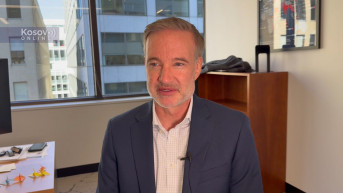
Senior Fellow at the International Institute for Strategic Studies Mike Carpenter said in an interview with Kosovo Online that elections in Kosovo are certainly expected in the near future as a way to resolve the current crisis, after Albin Kurti, the nominee for the formation of a new government, failed to secure majority support in parliament. Speaking about the Belgrade–Pristina dialogue, Carpenter noted that it will be difficult to bring it back on track.
In addition to discussing possible ways out of Kosovo’s current political crisis, Carpenter also spokefor Kosovo Online about US–Kosovo relations and American policy toward the Western Balkans, assessing that the status of President Donald Trump’s Special Envoy for Special Missions, Richard Grenell, is uncertain in the current administration. He also shared his views on the future of the Brussels dialogue.
Since Kosovo’s President Vjosa Osmani has two weeks to decide whether to nominate a new prime minister-designate or call snap parliamentary elections, Carpenter stressed that elections are inevitable.
“I think elections are certainly in the future, but this instability and inability to form a governing coalition are damaging the country because they allow for political paralysis and external interference in ways that are not helpful, including malign influence from some of its neighbors in the region and beyond. That’s why I’m concerned about Kosovo’s resilience as a democratic state. This blockade is politically very harmful. Kosovo will eventually get through it, but it will be a very difficult period,” said Carpenter, who has served as Senior Director for Russia, Ukraine, and Eurasia at the US National Security Council, Deputy Assistant Secretary of Defense for Russia, Ukraine, and Eurasia, and US Ambassador to the OSCE.
Asked how this situation could affect relations between Kosovo and the United States, Carpenter said the outlook is uncertain because current US policy toward the Western Balkans is very unclear.
“It remains to be seen. It’s hard to say who stands for what, and there are many conflicting interests within the United States, particularly in this administration. You know, Rick Grenell once played a significant role in the Western Balkans. His status in this administration is somewhat uncertain. He seems to have less influence than he did during Trump’s first term. And then you have family members like Jared Kushner and Don Jr., who also have interests in the Western Balkans. We’ll see how all this develops. It is unclear, but I can guarantee you one thing: it won’t be professional diplomats at the State Department setting the administration’s Western Balkans policy. It will be people close to the president who have his attention, not necessarily those with bureaucratic titles,” Carpenter explained.
When asked about the potential impact of Kosovo’s political crisis on the Belgrade–Pristina dialogue, Carpenter said frankly that he has been pessimistic about the dialogue’s prospects for progress.
“I think in the past we had a real opportunity to move the dialogue forward – not necessarily toward mutual recognition, but toward normalization of relations between the two sides. Unfortunately, I don’t think diplomacy has been particularly skillful. I’m thinking especially of the spring of 2023, when the US and the EU were only loosely coordinated, but now I think the US and EU are on different pages, which means it will be very difficult to get the dialogue back on track,” Carpenter emphasized.
Asked whether this might be a moment for stronger engagement by the Trump administration in resolving Kosovo’s political instability, Carpenter said that is a difficult question because, as he put it, the Trump administration is quite unpredictable.
“They tend to break with the previous elite consensus and take positions on issues that don’t necessarily align with past US policies. This could be an opportunity for President Trump to really push for recognition of Kosovo by the countries that haven’t recognized it yet. But that’s probably not at the top of his agenda. It would take a very influential voice close to him to convince him that it’s worth doing. However, I don’t see that voice at the moment,” Carpenter concluded.



0 comments