
Conference on the occasion of the Day of the Disappeared: Families and the state do not give up the truth about the victims
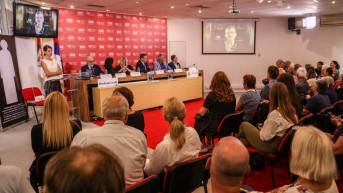
According to the data of the International Committee of the Red Cross, a total of 9,781 people had disappeared in the conflicts in the territory of the former Yugoslavia, of which 3,700 were of Serbian nationality, Dusko Celic said today at the conference on the occasion of the International Day of the Missing, who is the President of the Coordination of the Association of Families of the Missing, stressing that it was necessary that everyone in the region showed solidarity and willingness to cooperate in this matter.
At the conference of the Coordination of Serbian Associations of Families of the Missing, Murdered, and Deported from the Territory of the Former Yugoslavia, which was held today in Belgrade, the Minister of Labour, Employment, Veterans and Social Affairs of Serbia Nikola Selakovic, President of the Commission for Missing Persons of the Government of Serbia Veljko Odalovic, General Secretary of the Red Cross of Serbia Ljubomir Miladinovic, as well as family members whose loved ones, sons, brothers and relatives, disappeared in the war conflicts, participated.
After the media conference, the participants of the meeting laid a wreath and flowers at the Memorial to the missing and martyred persons in the wars of the '90s in the territory of the former Yugoslavia in the Tasmajdan Park.
The President of the Coordination of Serbian Associations of Families of the Missing Celic called on the entire region to approach solving the issue of the missing in a civilized and responsible manner, with empathy and solidarity, and above all, non-politically.
"This is the day when we remember the missing persons all over the world and call for the solidarity of society with their family members and when we call on the public in Serbia and the region to remember the tragic events, and not so far past in the territory of the former joint state. This is the day when we call on the public to support the basic human right of families to know the fate of their missing persons and the right to justice," he said, adding that "families will not allow their missing persons to disappear."
He indicated that understanding had to be found for human tragedies and victims and that they arose above political interests, pointing out that the Serbian authorities encountered resistance in Pristina, but also in Zagreb, from the local executive authorities for solving the issue of the missing.
He indicates that the Croatian authorities are trying to cover up the victims of the Petrovac road, while Kosovo Prime Minister Albin Kurti persistently insists on the context that "the Albanians are victims and the Serbs are criminals."
He expressed his satisfaction because, regardless of the circumstances, Serbia had not given up on the families of the missing, although, as he emphasized, legal regulations had to be determined for progress on this issue.
He adds that the families of the missing expect that the sufferings will be included in textbooks in Serbian schools, and not that they will be placed in a daily-political context and the context of inappropriate content that only causes pain to the families who lost their loved ones.
He points out that it is extremely important that the current Government in Serbia launched an initiative to nurture the culture of remembrance and announced that on September 4, representatives of the Association of Families of the Missing should meet with the President of Serbia, Aleksandar Vucic.
On this occasion, Minister Selakovic announced that the Government of Serbia would continue to work on the Law on Missing Persons, as well as on other issues of importance for the victims' families, such as fostering a culture of remembrance and coordination with associations.
"The result of the meeting held at the Ministry on August 16, a substantive conversation lasting several hours on all issues of interest to the families of the disappeared, is primarily three things. Continuation of work on passing the Law, coordination of work, and the third issue, the culture of memory," Selakovic said.
He emphasized that the most important topic was the continuation of work on the adoption of the Law and used the opportunity to emphasize that the process would not be started from the beginning, but a recapitulation of everything that had been done so far would be made, for which, as he stated, there was political will and the support of the President of Serbia and other institutions.
Selakovic promised that in terms of coordination and functioning, he would fight to secure funds from the budget.
The current ruling structure, he reminds, has started building a culture of remembrance and commemorating the suffering of the Serbs, and he will try, as he adds, to introduce the National Day of the Disappeared.
"We came to the conclusion that in the 73 municipalities in Serbia where we had martyred fighters, there is no memorial of any kind. We launched an initiative to provide a worthy memorial for the victims," Selakovic said.
He said that the disappeared have not been forgotten by the Government of Serbia.
"For every normal person, the issue of missing persons is a question of civilization. Our willingness to deal with this exists," Selakovic said.
The mother of Srecko, who was 14 years old at the time of his disappearance, and the sister of the missing Boban (25 years old), Zorica Blagojevic, said that she would never give up the search for her loved ones.
"I will search for them as long as I live. I have four children at home and I don't know what to tell them. It would be easiest for me if I could at least light a candle for them. I will wear black all my life because I have lost a lot," Blagojevic said.
The mother of the missing Ivan Majstorovic (17 years old), Dragana Majstorovic, appealed to the international community to open the archives and files of KFOR in Kosovo and thereby reveal at least a part of the truth about what "tortures and hurts them".
"I speak on behalf of all mothers, Albanians, Croatians, mothers of Republika Srpska, all Balkan and world mothers; mother's pain is the same and it must be banished with the truth of what happened to their children. On behalf of all mothers, I say that this is the last cry of mothers who want to find their children," she said.

0 comments